%20%20--%3E%0A%3Csvg%20version%3D%221.1%22%20id%3D%22Layer_1%22%20xmlns%3D%22http%3A%2F%2Fwww.w3.org%2F2000%2Fsvg%22%20xmlns%3Axlink%3D%22http%3A%2F%2Fwww.w3.org%2F1999%2Fxlink%22%20x%3D%220px%22%20y%3D%220px%22%0A%09%20width%3D%2239px%22%20height%3D%2240px%22%20viewBox%3D%220%200%2039%2040%22%20enable-background%3D%22new%200%200%2039%2040%22%20xml%3Aspace%3D%22preserve%22%3E%0A%3Cpath%20fill%3D%22%23FFFFFF%22%20d%3D%22M38.5%2C7H28.2v26h10.3V7z%22%2F%3E%0A%3Cpath%20fill-rule%3D%22evenodd%22%20clip-rule%3D%22evenodd%22%20fill%3D%22%23FFFFFF%22%20d%3D%22M26.1%2C25.5c0%2C5.8-4.1%2C7.5-12.9%2C7.5C3.9%2C33%2C0%2C31.2%2C0%2C25.2v-1.1h11.6%0A%09v2.4c0%2C0.7%2C0.1%2C1.4%2C1.2%2C1.4c1%2C0%2C1.2-0.4%2C1.2-1.3v-0.9c0-1.6-0.9-1.6-3.5-2.2C2.2%2C21.7%2C0%2C19.7%2C0%2C15.3v-0.9C0%2C9.3%2C5.5%2C7%2C12.9%2C7%0A%09c10.2%2C0%2C12.8%2C2.6%2C12.8%2C7.4v1.8h-11v-2.9c0-0.6-0.4-1.1-1.2-1.1c-0.6%2C0-1.2%2C0.4-1.2%2C1.1v0.9c0%2C1.5%2C0.9%2C2%2C3.3%2C2.5%0A%09c8%2C1.6%2C10.5%2C3.3%2C10.5%2C7.5V25.5z%22%2F%3E%0A%3C%2Fsvg%3E%0A)
How MLB's ABS Challenge System Works
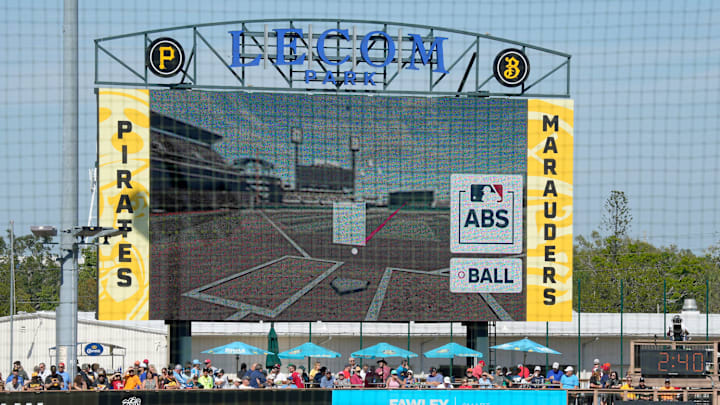
MLB games will look different in spring training and the regular season in 2026, as the league will be using the Automated Ball-Strike Challenge System in every ballpark for the first time in the big leagues.
The ABS Challenge System, which was tested in the minor leagues and during roughly 60% of spring training games this past season, was approved in September after a vote from the Joint Competition Committee. The system is the neutral ground between “robot umpires”, in which strike zone calls are fully automated, and the human element of the league’s longtime umpiring arrangement, in which none of the ball and strike calls are automated.
How does the ABS Challenge system work in baseball?
Each pitch is tracked by 12 Hawk-Eye cameras set up around the perimeter of every ballpark in MLB. If a batter, catcher or pitcher feels the home plate umpire missed a call, they request a challenge. The ABS Challenge system then compares the pitch location to the hitter’s individualized strike zone (more on that later).
The home-plate umpire will then announce the challenge to the ballpark and a graphic—produced via private 5G network from T-Mobile for Business’ Advanced Network Solutions—is displayed on the scoreboard and the television broadcast, showing the results of the challenge.
If any part of the ball touches any part of the strike zone, the pitch is considered a strike. In its entirety, the process takes roughly 15 seconds, resulting in a smooth transition back to play.
ABS Challenge System rules
Each team receives two challenges per game and can retain a challenge if it’s ultimately successful. Challenges can only be initiated by a pitcher, catcher or batter, and the request must come immediately after the pitch.
There are two ways players can signal for a challenge, either by tapping their helmet or cap, or by vocalizing their challenge request to the home plate umpire. Players may not receive help from the coaching staff, other players or anyone else while considering whether to challenge a ball or strike call.
If a team enters extra innings and has no challenges remaining, they’ll be provided an extra challenge in each extra inning. So if a team enters the 10th inning without a challenge, they’ll be provided one and if they utilize that challenge before the 11th inning, they’ll be provided with another, and so on and so forth. Teams that enter extra innings with a challenge will not be provided with one.
A pitch may not be challenged if a position player is pitching.
Both an ABS Challenge and video replay challenge can occur on the same play. The ball-strike call will be settled first, followed by the video replay on the bases.
The outcome of a stolen base is likely to stand regardless of a ball-strike challenge, with the two exceptions being a ball-four or strike-three call that was overturned by the ABS system. In that instance, umpires will have the discretion to determine if a ball-strike ruling impacted the behavior of baserunners and defenders in the play on the field.
For example, if a catcher stopped playing and didn’t throw to a base on a stolen base attempt because he heard ball four and the call was overturned, the umpire would have the freedom to send the runner back to his original base, nullifying the stolen base attempt.
How is the ABS Challenge System strike zone determined?
The strike zone is a two-dimensional rectangle set in the middle of home plate with the same width at the edges as home plate (17 inches). The top and the bottom of the strike zone will be personalized to each player based on each player’s individual height—53.5% of the batter’s height at the top and 27% at the bottom of the strike zone. The ABS Challenge System’s strike zone is slightly smaller than the strike zone of a human umpire.
Independent testers will measure the standing height of each player using a standardized process during spring training. Players are measured standing straight up without cleats. MLB will then certify each player’s official height.
How will the ABS Challenge System affect MLB TV broadcasts?
The strike zone box, shown on nearly every national and local broadcast, will remain on the screen but will no longer show whether a pitch was a ball or a strike, according to The Chicago-Sun Times. Instead, broadcasts will show a pitch landing in the zone in the form of a filled-in or hollow circle, but not both. It will essentially be up to the viewer to determine whether it was a ball or a strike, which should be fairly easy to do.
There will also be a five-second delay on pitch location data on MLB Gameday and roughly a nine-second delay on broadcast feeds with the strike zone box.
MLB is basically being overly cautious in an effort to eliminate the possibility of real-time data being acquired to exploit the ABS Challenge System.
More MLB on Sports Illustrated
 Add us as a preferred source on Google
Tim Capurso is a staff writer for Sports Illustrated, primarily covering MLB, college football and college basketball. Before joining SI in November 2023, Capurso worked at RotoBaller and ClutchPoints and is a graduate of Assumption University. When he's not working, he can be found at the gym, reading a book or enjoying a good hike. A resident of New York, Capurso openly wonders if the Giants will ever be a winning football team again.
Follow TimCapurso