
Mariners Knew About Colt Emerson’s Wrist Injury, Making Jerry Dipoto’s Comments Even Worse
In this story:
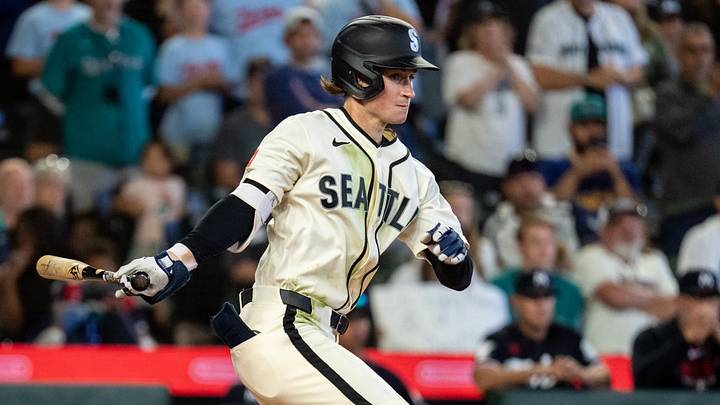
Jerry Dipoto had plenty of ways to explain Colt Emerson’s IL placement without assigning blame. The Mariners already knew the wrist was an issue, yet the severity of the rookie’s pain still caught the organization by surprise. That communication failure called for accountability from the top.
Instead, Dipoto made Emerson’s silence the headline.
“I wish he would have been a little more upfront if it was bothering him that much,” Dipoto told Adam Jude of The Seattle Times. “He should have said something.”
That was a lousy way for the Mariners’ top baseball executive to discuss a 21-year-old rookie whose desire to remain in the majors outweighed his willingness to acknowledge an injury.
Before we swing too far into full-on Emerson defense mode, he absolutely should have spoken up sooner. And, the Mariners should have kept asking.
Colt Emerson’s Demotion Exposed a Mariners Communication Breakdown
They knew the wrist was a problem. Emerson originally injured it during spring training in February. He saw a specialist, received a cortisone injection in April and missed five games with Triple-A Tacoma. The organization even acknowledged that the injury might have contributed to some of his early offensive struggles.
Then the Mariners promoted him in May and made him an everyday major leaguer. It was a weird move from the start. But understandable with Brendan Donovan’s injury issues. It wasn’t a mystery injury that suddenly appeared after Emerson struggled. The only mystery was its severity. The Mariners have had plenty of time and information to keep a close eye on it.
Dipoto’s own explanation makes Seattle’s failure to identify the problem sooner look worse. He said Emerson had never struggled with contact or velocity in the minor leagues, yet the Mariners suddenly watched him struggle with both in the majors. He admitted that the organization was seeing things that “didn’t make sense.”
Well, here’s a thought: When a player with a known wrist injury begins struggling in ways that don’t fit his profile, ask more questions.
Emerson slashed .190/.246/.335 and struck out in 34.4 percent of his plate appearances during his first 69 major-league games. Those numbers were alarming enough for the Mariners to send him back to Tacoma. Somehow, the wrist didn’t become the organization’s primary concern until Emerson brought it up after that decision had been made.
That sequence is the most troubling part of this entire thing. Emerson sat through the demotion meeting, accepted the decision and reportedly told the Mariners it was necessary. Only then did he ask for another examination of his wrist.
Why did it take losing his major-league job for Emerson to reveal the full extent of the problem? What convinced him that playing through the pain was preferable to telling the organization he could not perform normally? Did he believe admitting that the wrist remained an issue would cost him his opportunity?
Those are all questions that belong inside the Mariners’ offices. They are way more important than Dipoto publicly “scolding” Emerson for failing to provide the right answer sooner.
Baseball players are conditioned to compete through pain. The Mariners have watched veterans do exactly that. Cal Raleigh tried to play through an oblique injury this season. The organization publicly praised Luke Raley’s toughness while allowing him to push through forearm discomfort. Playing hurt is regularly presented as evidence of commitment right up until the performance or injury becomes a real problem. Emerson followed that culture to a predictable destination: the IL.
He’s just a rookie trying to prove that he belonged. He was also playing for an organization that signed him to an eight-year, $95 million contract before his major-league debut. To be fair, Dipoto did praise Emerson’s toughness and professionalism. He also suggested that the wrist injury could help explain why he looked so overmatched. That’s important context, but it doesn’t erase the whole “He should have said something” bit.
Public leadership requires better instincts than that. Dipoto said enough to shift blame toward Emerson without accepting the Mariners’ share of it. Fans already frustrated with this front office will see a familiar move. Dipoto turning a player into the face of a broader organizational failure. That’s an especially strange use of the spotlight from an executive often criticized for not stepping into it enough.
Most of these comments should have remained private. Hopefully, Dipoto told him that toughness doesn’t mean hiding pain. Or that the staff can’t help him unless he gives them complete information. Make it clear that reporting an injury will not be treated as surrendering an opportunity.
The public conversation demands organizational ownership. Dipoto should have said the Mariners knew about the wrist, missed the signs that it had become more serious and needed to improve their communication with Emerson. But apparently that’s asking too much.
Now Emerson is headed to Arizona for another examination, and surgery has not been ruled out. The Mariners are left wondering how much of his miserable debut was caused by an injury they already knew existed.
 Add us as a preferred source on Google
Tremayne Person is the Publisher for Mariners On SI and the Site Expert at Friars on Base, with additional bylines across FanSided’s MLB division. He founded the Keep It Electric podcast in 2023 and covers baseball with a blend of analysis, context, and a little well-timed side-eye just to keep things honest. Tremayne grew up a Mariners fan in Richmond, Va., and that passion ultimately led him to move to Seattle to cover the team closely and become a regular at home games. Through his writing, he connects with fans who want a deeper, more personal understanding of the game. When he’s not at T-Mobile Park, he’s with his dog, gaming, or finding the next storyline worth digging into.
Follow TremaynePerson