%20%20--%3E%0A%3Csvg%20version%3D%221.1%22%20id%3D%22Layer_1%22%20xmlns%3D%22http%3A%2F%2Fwww.w3.org%2F2000%2Fsvg%22%20xmlns%3Axlink%3D%22http%3A%2F%2Fwww.w3.org%2F1999%2Fxlink%22%20x%3D%220px%22%20y%3D%220px%22%0A%09%20width%3D%2239px%22%20height%3D%2240px%22%20viewBox%3D%220%200%2039%2040%22%20enable-background%3D%22new%200%200%2039%2040%22%20xml%3Aspace%3D%22preserve%22%3E%0A%3Cpath%20fill%3D%22%23FFFFFF%22%20d%3D%22M38.5%2C7H28.2v26h10.3V7z%22%2F%3E%0A%3Cpath%20fill-rule%3D%22evenodd%22%20clip-rule%3D%22evenodd%22%20fill%3D%22%23FFFFFF%22%20d%3D%22M26.1%2C25.5c0%2C5.8-4.1%2C7.5-12.9%2C7.5C3.9%2C33%2C0%2C31.2%2C0%2C25.2v-1.1h11.6%0A%09v2.4c0%2C0.7%2C0.1%2C1.4%2C1.2%2C1.4c1%2C0%2C1.2-0.4%2C1.2-1.3v-0.9c0-1.6-0.9-1.6-3.5-2.2C2.2%2C21.7%2C0%2C19.7%2C0%2C15.3v-0.9C0%2C9.3%2C5.5%2C7%2C12.9%2C7%0A%09c10.2%2C0%2C12.8%2C2.6%2C12.8%2C7.4v1.8h-11v-2.9c0-0.6-0.4-1.1-1.2-1.1c-0.6%2C0-1.2%2C0.4-1.2%2C1.1v0.9c0%2C1.5%2C0.9%2C2%2C3.3%2C2.5%0A%09c8%2C1.6%2C10.5%2C3.3%2C10.5%2C7.5V25.5z%22%2F%3E%0A%3C%2Fsvg%3E%0A)
Ozzie Albies Reminds Us of the Heart in the World Baseball Classic
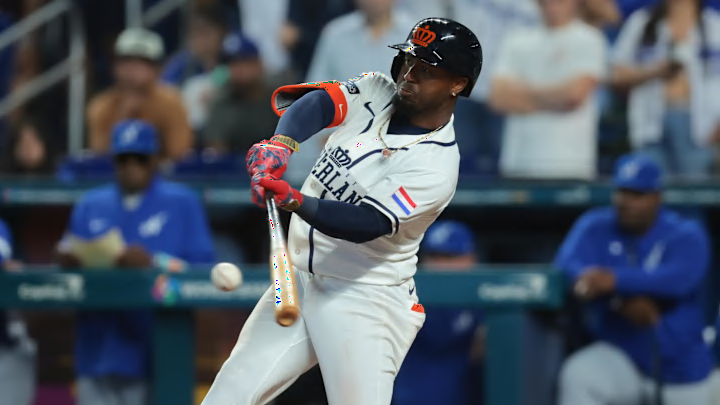
MIAMI — If you wished to measure what it means for millionaire veteran ballplayers to play baseball with the name of their home country on their chest, even when it takes 23 letters to spell it out, all you would need to do was listen to Ozzie Albies take stock of the greatest moment of his 10 years since reaching the majors.
“My whole career?” he asked me Saturday after I gave him the thought assignment.
“Yes.”
“Wow. This is as big as winning the World Series. It’s right up there. I cannot lie.”
Albies hit a game-winning three-run home run in pool play in a half-empty ballpark against a pitcher who last summer was pitching semi-pro ball in Nicaragua. The equivalency to winning the 2021 World Series might seem stunning, but for one immeasurable, immutable force that is the guaranteed magic of the World Baseball Classic: homeland.
Albies, the Atlanta Braves second baseman, is from Curaçao, one of the four constituent countries and three special municipalities of The Kingdom of the Netherlands, as spelled out on the team’s home white jerseys. His homeland was down to its last strike of what looked like a 3–1 loss to Nicaragua, whose manager, Dusty Baker, was on the losing side with Houston when Albies’ Braves won the 2021 World Series. Two outs, bases empty, down two and Ceddanne Rafaela, the Red Sox outfielder, staring at an 0-and-2 count. Holes don’t get much deeper than that.
And then ... baseball happened.
The zero-sum game of curse and blessing played out in astonishing favor for the Netherlands and painfully against spirited Nicaragua. Rafaela mishit a fastball from Nicaragua pitcher Angel Obando. It flared off the bat at 77 mph. It dumped safely into right field for a single.
Padres shortstop Xander Bogaerts batted next. Defeat seemed even more certain when Bogaerts hit a routine grounder to third base—at 72 mph, even weaker than Rafael’s flare. Bounce, bounce, bounce—one more bounce and the game was over—only for that last bounce to hit third base and carom mockingly away from an awaiting third baseman Cheslor Cuthbert. Double.
Albies was next. Pitching coach Lenin Picota walked to the mound to talk to Obando. Picota has been there and done that more than most. Over a 22-year career he pitched in the U.S., Mexico, Panama, Taiwan, Mexico, South Korea and the Dominican Republic. Not even those miles could have prepared him for what was about to happen.
With first base open, Baker had the option of walking Albies, the Netherlands’ best hitter, and going after former big leaguer Didi Gregorius, hitless for the WBC, and his slow bat. With one out to go, that was the smart play. But Baker spoke the old school code when he explained, “We don’t put the winning run on base.”
Even Albies did not think he could get a chance to swing the bat.
“I thought they were going to put me on first base,” Albies said. “It didn’t happen.”
A long time ago, back in 2018 and ‘19, Ogando pitched for a Yankees affiliate in the Dominican Summer League. It didn’t work out for him, so he returned to Nicaragua to pitch for the Gigantes de Rivas of the Nicaraguan winter league. He kept sharp in summer by pitching semipro ball, where he posted a 1.18 ERA. He throws in the mid-90s with a sharp slider that had vexed the Netherlands for almost four innings, a courageous effort.
“I was looking for the fastball,” Albies said, “and I told myself, ‘If he throws that pitch I cannot miss.’”
The first pitch was exactly what Albies was sitting on and exactly the one pitch you cannot throw a notorious first-ball, fastball hitter: fastball over the plate. Albies’s description of what happened next was one of the more beautiful descriptors I have heard when it comes to meeting a round ball squarely with a rounded club.
“You know how when you swing and miss you don’t feel anything?” he said. “That’s what it felt like. Like nothing. I hit it perfectly.”
Baker was much more prosaic.
“He threw the ball in an area where he didn’t want to throw it,” he said.
Game over. The Netherlands burnished WBC history with a memorable 4–3 victory, regardless of your birthplace.

Because homeland is the currency of the WBC, joy and pain are felt in added force. On Friday night, for instance, the powerful Dominican Republic hitters celebrated home runs in style and fervor that had to be seen to be believed: Junior Caminero running out from his helmet and shimmying his hips, Julio Rodríguez throwing his bat from halfway up the first base like to the catcher’s feet and Oneil Cruz waiting so long to begin his trot you wanted for someone to remind him of the necessity of running it out.
This time it was Albies’s turn to float around the bases while his teammates whooped like children. While that was happening, Obando fell to a crouch on the mound, his back to the joy as if he could wish it away, like a bad dream. He stayed down for several moments, until finally four or five teammates came to console him with words and hugs. He left the field in tears, then lingered on the dugout bench to try to make sense of what had just happened.
“It hurts,” said Baker, who endured more than anyone’s fair share of crushing losses until he won the World Series in 2022. “It hurts for our team, and it hurts for the entire country.”
Only once in postseason history has someone ended a game with a home run when down by two runs or more. Baker, baseball’s Gump, was on the winning side of that one: a three-run shot by Yordan Álvarez off Robbie Ray to allow the Astros to steal an 8–7 win from the Mariners in Game 1 of the 2022 ALDS.
In the annals of baseball history, the home run by Albies in early March in WBC pool play against a team that is 0–6 in the WBC never will come close to the resonance of the Álvarez home run. But don’t bother explaining such perfectly sane logic to Albies. When it comes to homeland, the heart always wins.
More MLB on Sports Illustrated
 Add us as a preferred source on Google
Tom Verducci is a senior writer for Sports Illustrated who has covered Major League Baseball since 1981. He also serves as an analyst for FOX Sports and the MLB Network; is a New York Times best-selling author; and cohosts The Book of Joe podcast with Joe Maddon. A five-time Emmy Award winner across three categories (studio analyst, reporter, short form writing) and nominated in a fourth (game analyst), he is a three-time National Sportswriter of the Year winner, two-time National Magazine Award finalist, and a Penn State Distinguished Alumnus Award recipient. Verducci is a member of the National Sports Media Hall of Fame, Baseball Writers Association of America (including past New York chapter chairman) and a Baseball Hall of Fame voter since 1993. He also is the only writer to be a game analyst for World Series telecasts. He lives in New Jersey with his wife, with whom he has two children.