%20%20--%3E%0A%3Csvg%20version%3D%221.1%22%20id%3D%22Layer_1%22%20xmlns%3D%22http%3A%2F%2Fwww.w3.org%2F2000%2Fsvg%22%20xmlns%3Axlink%3D%22http%3A%2F%2Fwww.w3.org%2F1999%2Fxlink%22%20x%3D%220px%22%20y%3D%220px%22%0A%09%20width%3D%2239px%22%20height%3D%2240px%22%20viewBox%3D%220%200%2039%2040%22%20enable-background%3D%22new%200%200%2039%2040%22%20xml%3Aspace%3D%22preserve%22%3E%0A%3Cpath%20fill%3D%22%23FFFFFF%22%20d%3D%22M38.5%2C7H28.2v26h10.3V7z%22%2F%3E%0A%3Cpath%20fill-rule%3D%22evenodd%22%20clip-rule%3D%22evenodd%22%20fill%3D%22%23FFFFFF%22%20d%3D%22M26.1%2C25.5c0%2C5.8-4.1%2C7.5-12.9%2C7.5C3.9%2C33%2C0%2C31.2%2C0%2C25.2v-1.1h11.6%0A%09v2.4c0%2C0.7%2C0.1%2C1.4%2C1.2%2C1.4c1%2C0%2C1.2-0.4%2C1.2-1.3v-0.9c0-1.6-0.9-1.6-3.5-2.2C2.2%2C21.7%2C0%2C19.7%2C0%2C15.3v-0.9C0%2C9.3%2C5.5%2C7%2C12.9%2C7%0A%09c10.2%2C0%2C12.8%2C2.6%2C12.8%2C7.4v1.8h-11v-2.9c0-0.6-0.4-1.1-1.2-1.1c-0.6%2C0-1.2%2C0.4-1.2%2C1.1v0.9c0%2C1.5%2C0.9%2C2%2C3.3%2C2.5%0A%09c8%2C1.6%2C10.5%2C3.3%2C10.5%2C7.5V25.5z%22%2F%3E%0A%3C%2Fsvg%3E%0A)
The Rockies Are Finally Embracing Analytics to Solve MLB’s ‘Most Interesting Puzzle’
In this story:
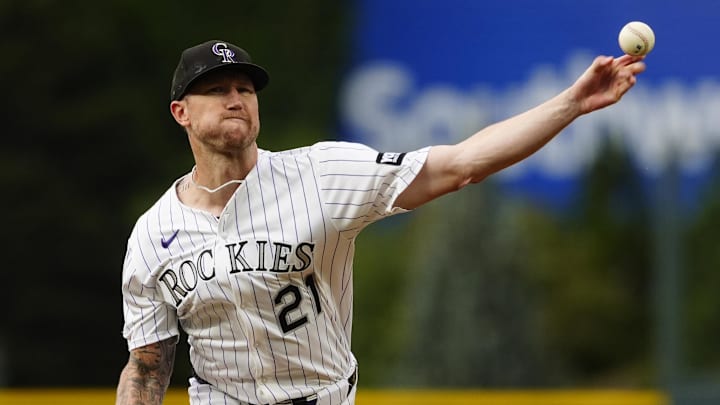
The Rockies took an unusual approach to recruiting pitchers this year: They didn’t.
They engaged in talks with most free-agent starters, as does just about every team, but new president of baseball operations Paul DePodesta and his lieutenants stopped short of trying to convince anyone who wasn’t immediately interested. Thirty-three years into baseball’s experiment at a mile above sea level, pitchers know what they are getting: Coors Field has a career ERA of 5.61. It has allowed the most runs in the sport since 1990, despite not opening until ’95. Kyle Tucker, who just got $60 million a year from the Dodgers, had an .841 OPS last year. The average hitter at Coors had an .828. It was hard to blame the pitchers who laughed and hung up. They wanted the ones who didn’t.
“It’s almost a self-selecting group,” says DePodesta. “You end up with the right people because those are the ones who are like, Let’s go do this!, as opposed to trying to convince someone, It’s not that bad! You should come here!”
The Rockies have spent three decades trying to figure out how to pitch at Coors Field. They have tried a four-man rotation with piggybacked starters to cap workload. They have tried throwing fastballs to compensate for the way the thin air flattens breaking balls. They have tried throwing down in the zone to limit home runs. They have tried for so long without success that at times it felt as if they were no longer trying at all.
In 2026, there will be a new group trying. Last season’s 43–119 record marked the worst in Colorado history, and the third-worst in a century and a quarter of modern baseball. In May, at 7–33, the Rockies fired manager Bud Black. In October, they fired general manager Bill Schmidt. DePodesta retained interim manager Warren Schaeffer and spent the offseason building a pitching apparatus of people who are fascinated by the question no one has yet answered.
“I think part of the calculus of coming to a place like this,” says assistant pitching coach Gabe Ribas, “Is solving the most interesting puzzle in baseball.”
That starts with being realistic. They understand that they are playing catch-up: Walker Monfort, son of owner Dick Monfort and team vice president, admitted this winter that the Rockies had “probably lost sight of innovation.” DePodesta, famous for his role helping build the Moneyball A’s of the early 2000s, left the sport in 2015 to run the Cleveland Browns. You might say he and the Rockies both missed the last decade of baseball.
Analytically minded players would ask for metrics only to be told the team didn’t have them; they’d sometimes ask contacts in other clubs for help. While the rest of the league leaned on devastating breaking stuff, the Rockies kept pounding the bottom of the zone with fastballs. As everyone else individualized scouting reports, Colorado operated in generalities. And while their opponents threw their best stuff down the middle and dared hitters to make contact, the Rockies kept nibbling at the corners and giving up walks. The result was a staff ERA last season of 5.99, 10th worst in modern history. People around the team joke about going from bad to good before they can go from good to great.
“When I was interviewing these guys in the off season, they were saying, Listen, these are not good numbers on the road,” Schaeffer recalls. “This is more of a pitching thing than it is a Coors Field thing, so let’s get our pitching right, and then we can worry about Coors Field.”
They found a receptive audience in Kyle Freeland and Antonio Senzatela, the only two holdovers from the teams that made consecutive playoff appearances in 2017 and ’18.
“For me, it’s very exciting,” says Freeland. “We have been very rinse-and-repeat the last handful of years. Nothing new, nothing different, no new ways of thinking, no new focuses. And that’s what they’re bringing in and then allowing us to open up to that and bring more ideas to the table. I think they’ve done an incredible job so far with that, allowing us to be the athletes that we want to be.”
In the past, Freeland felt he was supposed to work on his own to figure out what worked at Coors, both on the field and off. “Now we’re kind of creating a formula as a group,” he says.
At the moment, that formula is simple: Get ahead, stay ahead and go kill.
This, to be candid, is not revolutionary. This is basically just the goal of pitching. But it has been hard to implement at altitude, where any broken-bat flare could end up in the stands.
“One of the things that is absolutely essential to Coors Field,” says Schaeffer, “Is you can’t be scared.”

Which brings us back to the free-agent starting pitchers. In their first 32 years, the Rockies had signed nine. This winter, they picked up three: righties Michael Lorenzen and Tomoyuki Sugano, and lefty José Quintana.
All three have good feel for the zone, good athleticism and good ability to shape the ball—traits the Rockies believe are necessary to succeed at altitude. They are also smart; they recognize what they’re up against. They find it intriguing.
“It’s untapped,” says Lorenzen, who adds that he has actually lobbied the Rockies to let him come for the last several years. “And where else in baseball is there something like that?”
The Rockies believe they are on their way to solving Coors Field, and they plan to keep that solution to themselves. “Other teams don’t know how to recover in our place,” says Ribas. “We do. Other teams don’t know how to train and stay on their training schedule. Other teams are going to be affected in their sleep and recovery, whatever. Pitchers who don’t throw there regularly are going to be taken aback when their shapes take a hit. Our guys are gonna know exactly how we approach the place. Paul has said it many times: We’re getting into 15-round fights. The only thing that matters is who’s lying on the canvas at the end of the day. We might be bloodied. We might have a hard time, but if the other guy’s lying on the canvas, we did our job.”
Could it be that the whole time it was this simple? Look at Coors Field as an advantage, treat Coors Field as an advantage and watch as Coors Field becomes an advantage? The people who chose to be there are about to find out.
More MLB on Sports Illustrated
 Add us as a preferred source on Google
Stephanie Apstein was a senior writer covering baseball and Olympic sports for Sports Illustrated, where she started as an intern in 2011 and has since covered a dozen World Series and three Olympics. She has twice won top honors from the Associated Press Sports Editors, and her work has been included in the Best American Sports Writing book series. She graduated from Trinity College with a bachelor’s in French and Italian, and has a master’s in journalism from Columbia University.
Follow stephapstein