%20%20--%3E%0A%3Csvg%20version%3D%221.1%22%20id%3D%22Layer_1%22%20xmlns%3D%22http%3A%2F%2Fwww.w3.org%2F2000%2Fsvg%22%20xmlns%3Axlink%3D%22http%3A%2F%2Fwww.w3.org%2F1999%2Fxlink%22%20x%3D%220px%22%20y%3D%220px%22%0A%09%20width%3D%2239px%22%20height%3D%2240px%22%20viewBox%3D%220%200%2039%2040%22%20enable-background%3D%22new%200%200%2039%2040%22%20xml%3Aspace%3D%22preserve%22%3E%0A%3Cpath%20fill%3D%22%23FFFFFF%22%20d%3D%22M38.5%2C7H28.2v26h10.3V7z%22%2F%3E%0A%3Cpath%20fill-rule%3D%22evenodd%22%20clip-rule%3D%22evenodd%22%20fill%3D%22%23FFFFFF%22%20d%3D%22M26.1%2C25.5c0%2C5.8-4.1%2C7.5-12.9%2C7.5C3.9%2C33%2C0%2C31.2%2C0%2C25.2v-1.1h11.6%0A%09v2.4c0%2C0.7%2C0.1%2C1.4%2C1.2%2C1.4c1%2C0%2C1.2-0.4%2C1.2-1.3v-0.9c0-1.6-0.9-1.6-3.5-2.2C2.2%2C21.7%2C0%2C19.7%2C0%2C15.3v-0.9C0%2C9.3%2C5.5%2C7%2C12.9%2C7%0A%09c10.2%2C0%2C12.8%2C2.6%2C12.8%2C7.4v1.8h-11v-2.9c0-0.6-0.4-1.1-1.2-1.1c-0.6%2C0-1.2%2C0.4-1.2%2C1.1v0.9c0%2C1.5%2C0.9%2C2%2C3.3%2C2.5%0A%09c8%2C1.6%2C10.5%2C3.3%2C10.5%2C7.5V25.5z%22%2F%3E%0A%3C%2Fsvg%3E%0A)
Four Things We Learned From Spring Training ABS Challenge Data
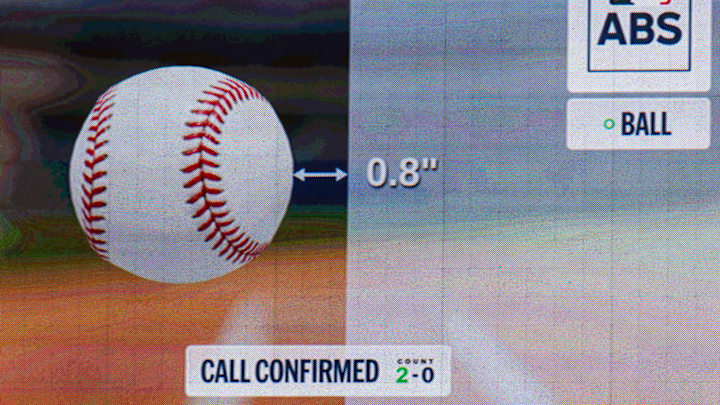
MLB is implementing the ABS challenge system for the first time in 2026. And while we’ve already seen it in action in the regular season’s first two days, its most extensive usage to date in the big leagues came during spring training. Keeping in mind that we’re working with small sample sizes, I looked at the spring training ABS Challenge data, which was compiled into a helpful dashboard on Statcast. Here’s what I learned—and what teams may be thinking about as the regular season kicks into gear.
1. Not as many pitches were challenged as you would think
I suspect social media played a role in this, as any time there was an ABS challenge—or two or three—during spring training, the videos seemingly went viral at every turn. Despite the fact that teams are only guaranteed two challenges on balls and strikes entering a given game, the large number of highlights likely made it seem like there were an inordinate amount of challenges.
In reality, there were not. 1.4% of all pitches were challenged during spring training, a number that lines up with data collected by MLB from the 2025 Triple A season.
MLB's Opening Night game between the Yankees and Giants seemed to confirm as much, as just one pitch was challenged—and upheld despite some unfortunate broadcasting luck for Netflix—during the entire game.
While this is somewhat of an unexciting thing to learn, it doesn't mean that the ABS challenge system isn't going to matter. The ABS challenge system will become an important part of a team's strategy entering games, particularly depending on the umpire, and games will greatly be impacted by it.
2. Catchers are going to be legitimate weapons with the ABS challenge system
Catchers were by far the most successful of the three positions allowed to challenge balls and strikes—catchers, pitchers and batters. Catchers had a highly impressive overturn rate of 60%. While we need to keep in mind that some of these backstops were minor leaguers and therefore are unlikely to see big-league action in 2026, some of the better defensive MLB catchers were at the top of the leaderboards.
Giants two-time Gold Glover Patrick Bailey, among the best pitch framers in the sport, challenged 14 pitches and was correct on 10 of them this spring, an impressive 71% overturn rate. Cardinals backstop Pedro Pagés, another solid pitch framer, was correct on all eight of his challenges.
Fellow big-league catchers Shea Langeliers, Ryan Jeffers, Henry Davis and Austin Hedges also enjoyed success on challenges, sporting overturn rates north of 70% on at least six challenges.
It stands to reason that catchers would be more skilled at challenges, given their optimal view of the plate. But the overwhelming success of so many major league backstops this spring means it's going to be fascinating to watch just how much of an impact many catchers are going to have on games, simply because of the ABS challenge system.
3. Specific players are going to be really good at this
As we've seen from the catcher data, some players are going to be naturals at challenging balls and strikes. But the data also tells us that being successful at overturning ball and strike calls might just be a skill that can be honed and developed over time (just like most other things in life).
Consider the tale of Reds catcher P.J. Higgins, who has spent the last two seasons with the team's Triple A affiliate Louisville Bats. Given that the ABS challenge system has been utilized at the Triple A level since 2019, Higgins has gotten in plenty of helmet taps. And along the way, he has gotten pretty darn good at it.
During the 2025 season, he was successful on 77% of his challenge attempts. In spring training, albeit with a smaller sample size, he outdid himself. He was successful on all seven of his challenges.
And to hear Higgins speak about it, it's clear that he's developed a strategy for using the ABS challenge system to his advantage.
“I use it based more off strategy as opposed to just using it to use it," Higgins told MLB.com in February. "I’ve been telling a lot of guys the game will dictate when I’ll use it, the situations especially later in the game in the most important innings. I use it more defensively than offensively.”
It seems likely that other big leaguers will have a knack for being successful at ABS challenges. For example, no hitter this spring was successful on more challenges (six) than the Red Sox's Willson Conteras (a former catcher, perhaps not coincidentally). It will be interesting to see if such success continues into the regular season—and if any other challenge savants will emerge.
4. Pitchers were better at challenges than teams thought
The prevailing thought among many big-league teams seems to be that pitchers aren't in the best position to challenge balls and strikes for multiple reasons. The first is spatial: pitchers simply don't have as good a view of home plate as a catcher or hitter would. The second is emotional: pitchers are invested in every single pitch. In other words, teams think pitchers believe nearly every pitch they throw is a strike, which isn't exactly conducive to winning a challenge.
However, maybe the pitchers should be given more of a chance. There were only 45 challenge attempts made by pitchers in spring training, so it's a small sample size. But pitchers were successful on 56% of those challenges, data that is difficult to ignore.
It doesn't mean that pitchers should be given the same freedom as catchers or hitters. But the fact that pitchers weren't a complete disaster at challenging ball-strike calls means teams should at least think again before barring them from making a challenge.
More MLB from Sports Illustrated
 Add us as a preferred source on Google
Tim Capurso is a staff writer for Sports Illustrated, primarily covering MLB, college football and college basketball. Before joining SI in November 2023, Capurso worked at RotoBaller and ClutchPoints and is a graduate of Assumption University. When he's not working, he can be found at the gym, reading a book or enjoying a good hike. A resident of New York, Capurso openly wonders if the Giants will ever be a winning football team again.
Follow TimCapurso