
Three World Series Winners Lead Detroit Tigers Catchers in bWAR
In this story:
Catcher is the most difficult position to find. It's the most important defensive position on the field, as the entire game runs through them. Finding a great defensive catcher is one thing, but its even more rare to find a catcher that can hit, too.
Because they have so much to worry about on the field and are squatting for the entire game, catchers are generally seen as the worst hitter on the team. Finding an elite offensive player at the position is hard, and they are only a few in the game today as it is.
The Detroit Tigers, in their illustrious history, have had a knack of finding some good catchers, especially offensively. For a few decades, across three World Series championships, the Tigers had a steady offensive presence behind the plate.
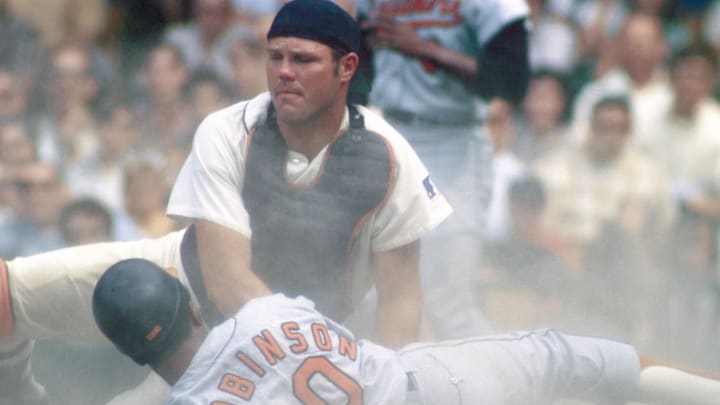
1. Bill Freehan, 44.7 bWAR

Not only is Freehan the top catcher for the Tigers, but he is one of the best players in franchise history. The 11-time All-Star has the 18th most bWAR overall and 12th most among hitters in team history.
He had a cup of coffee in 1961, and after not appearing in 1962, he made his first full-season debut in 1963. He had a nice season, playing in 100 games and posting a .718 OPS and 1.5 bWAR. He hadn't fully gotten the catchers' job just yet, but he would be behind the dish in Detroit for the next decade-plus.
Freehan made his first All-Star team in 1964, something he would do every year from then until 1973. It was his breakout season, in 144 games, he hit 18 home runs and drove in 80 RBIs, hitting .300 with an .812 OPS and 5.3 bWAR. He finished seventh in MVP voting, his first of three top 10 finishes.
An All-Star the next two years, Freehan had a couple of major down years. His OPS dropped to .645, and he had an OPS+ of 83 each season. Even though he struggled offensively, he began his five-year streak of Gold Glove wins in 1965.
After his two poor seasons at the dish, Freehan had the two best seasons of his career in 1967-68, becoming an above-average hitter by OPS+ for the rest of his career.
Freehan's bWAR shot up to 6.1 in 1967, when he hit 20 home runs, walked more than he struck out, and posted an .835 OPS. He finished third in MVP voting, but he wasn't done there. He had a career year in 1968, posting a career high 6.9 bWAR, 25 home runs, 84 RBIs, and a 145 OPS+. He was the MVP runner-up that year.
For the rest of his career from that point, he was about a 2 bWAR player every year aside from his final season in 1976. He was consistent, hitting 15 to 20 home runs a season and an OPS+ slightly above league average.
A model of consistency, only one catcher in baseball had more bWAR than Freehan did from 1964 to 1973. He also had the third most home runs among catchers in that time, behind Joe Torre and Johnny Bench.
2. Lance Parrish, 30.1 bWAR

Luckily, the Tigers didn't have to wait long to find a successor at catcher. Freehan retired in 1976, and Parrish, then 21 years old, made his debut the next year in 1977, though he didn't get a lot of playing time for his first two seasons.
He had some struggles in his first 97 games with a .682 OPS and 86 OPS+, but picked up where Freehan left off in 1979. In a season where he had 4.0 bWAR, Parrish hit 19 home runs and drove in 65 RBIs with an .800 OPS, but would get even better moving forward.
Parrish's power took a boost in 1980, when he hit 24 home runs, drove in 82 and had an .825 OPS, winning his first Silver Slugger and making his first All-Star team. After missing a chunk of 1981, the catcher took another step forward in 1982.
With a career high 5.0 bWAR, Parrish hit 32 home runs and 87 RBIs to go along with a Career high .867 OPS and 135 OPS+. He made his first of five consecutive All-Star games that season. From 1983 until he left after 1986, Parrish had at least 2.8 bWAR every season and had more than 3.1 in three of four years.
In that stretch, he hit at least 22 home runs every season and even hit a career high 33 in 1984, leading the eventual World Series champs in home runs. The year before 1983, he set a career high with 114 RBIs.
From 1979-1986, the prime of Parrish's career, he was third among all catchers in bWAR, home runs and RBIs.
3. Rudy York, 29.9 bWAR

York spent his first ten seasons in Detroit and was not only the best power hitter on this list, but was the premier power hitter in all of baseball throughout his career as a Tiger.
He made his debut in 1934, but after only seven plate appearances, he didn't get playing time until 1937. When he returned to the field, he became an elite power hitter right away. As a rookie, he played 104 games and blasted a career high 35 home runs and had a career best 1.026 OPS. He posted 3.4 bWAR, giving a preview of what was to come for the next eight seasons.
At 24 years old in 1938, York made his first of five All-Star games with the Tigers, hitting 33 home runs and driving in 126 runs.
During his peak, from 1937-43, York hit at least 20 home runs in every season and drove in over 100 runs five times, as well. He had 4.4 bWAR or more three times, including his career high mark of 6.1 in 1943 when he led the league in home runs (34), RBIs (118), and slugging percentage (.527). He finished third in MVP voting that season.
In 10 years with the team, York received MVP votes eight times. From 1937 to 1945, York led all of baseball with 239 home runs, four more than future Hall of Famer Mel Ott. On top of the power, he drove in 65 more runs than anyone else, collecting 933 RBIs in that span.
Even though he is not at the top of this catchers list, York was arguably the best hitter in baseball during his prime.
4. Johnny Bassler, 20.9 bWAR

Bassler is the oldest player on this list. He debuted in the majors as an 18-year-old in 1913 for the Cleveland Naps. After a short stint again in 1914, he left to play for the Los Angeles Angels of the Pacific Coast League and even missed 1918 for the war.
He reappeared in 1921 after being traded to the Detroit Tigers, and from there, he had a nice, albeit short career. In seven seasons with the Tigers, Bassler was a below-average hitter just two times and had 2.0 bWAR or more in every season but one.
The catcher had 3.0 bWAR or more each year from 1921-24, including a career high 4.9 in 1923. His best year at the dish came in 1924, when he had a career high .346 average, .864 OPS, 125 OPS+, 68 RBIs and a homer, the only of his career.
In a much different era of baseball, Bassler was a solid, everyday hitter for the better part of the 1920s. His best power season, 1924, saw him hit 20 home runs, three triples and a home run.
5. Mickey Tettleton, 14.8 bWAR

Although Brandon Inge is listed as higher than Tettleton in terms of bWAR, Inge only played catcher full-time for his first three seasons before transitioning to third base. Tettleton only played four seasons with Detroit, but was primarily a catcher during that span.
The Tigers acquired the catcher before the 1991 season and he had an immediate impact, having the best power numbers of his career. As a 30-year-old in 1001, Tettleton had a career high 5.6 bWAR, hit 31 home runs, and had an .878 OPS, winning his first of two Silver Sluggers.
Tettleton followed that up with another Silver Slugger, hitting a career high 32 home runs and walking a career best 122 times, a mark that led the AL. The next season, in 1993, he drove in a career best 110.
In three out of his four seasons with Detroit, the catcher hit 31 or more homers and walked 100 times in each of those three seasons, just missing the 100 walk mark in 1994 by three. Surely, though, with 17 homers and an .882 OPS, he would've replicated his previous numbers if not for the strike.
It was a short career for Tettleton in Detroit, but a memorable one. From 1991-93, only seven players hit more home runs than Tettleton, who hit 95. The next closest catcher hit 63.
More Tigers News
 Add us as a preferred source on Google
Sean O'Leary is an alumnus of the University of Nevada, Reno, where he majored in journalism. Before On SI, he covered baseball at websites such as Pitcher List and FanSided. Sean also covered the Triple-A affiliate of the Arizona Diamondbacks, the Reno Aces, for their official website. Watching minor league baseball over the years made him fascinated by covering prospects.