%20%20--%3E%0A%3Csvg%20version%3D%221.1%22%20id%3D%22Layer_1%22%20xmlns%3D%22http%3A%2F%2Fwww.w3.org%2F2000%2Fsvg%22%20xmlns%3Axlink%3D%22http%3A%2F%2Fwww.w3.org%2F1999%2Fxlink%22%20x%3D%220px%22%20y%3D%220px%22%0A%09%20width%3D%2239px%22%20height%3D%2240px%22%20viewBox%3D%220%200%2039%2040%22%20enable-background%3D%22new%200%200%2039%2040%22%20xml%3Aspace%3D%22preserve%22%3E%0A%3Cpath%20fill%3D%22%23FFFFFF%22%20d%3D%22M38.5%2C7H28.2v26h10.3V7z%22%2F%3E%0A%3Cpath%20fill-rule%3D%22evenodd%22%20clip-rule%3D%22evenodd%22%20fill%3D%22%23FFFFFF%22%20d%3D%22M26.1%2C25.5c0%2C5.8-4.1%2C7.5-12.9%2C7.5C3.9%2C33%2C0%2C31.2%2C0%2C25.2v-1.1h11.6%0A%09v2.4c0%2C0.7%2C0.1%2C1.4%2C1.2%2C1.4c1%2C0%2C1.2-0.4%2C1.2-1.3v-0.9c0-1.6-0.9-1.6-3.5-2.2C2.2%2C21.7%2C0%2C19.7%2C0%2C15.3v-0.9C0%2C9.3%2C5.5%2C7%2C12.9%2C7%0A%09c10.2%2C0%2C12.8%2C2.6%2C12.8%2C7.4v1.8h-11v-2.9c0-0.6-0.4-1.1-1.2-1.1c-0.6%2C0-1.2%2C0.4-1.2%2C1.1v0.9c0%2C1.5%2C0.9%2C2%2C3.3%2C2.5%0A%09c8%2C1.6%2C10.5%2C3.3%2C10.5%2C7.5V25.5z%22%2F%3E%0A%3C%2Fsvg%3E%0A)
The Best Version of Max Fried Is Still Being Unearthed
In this story:
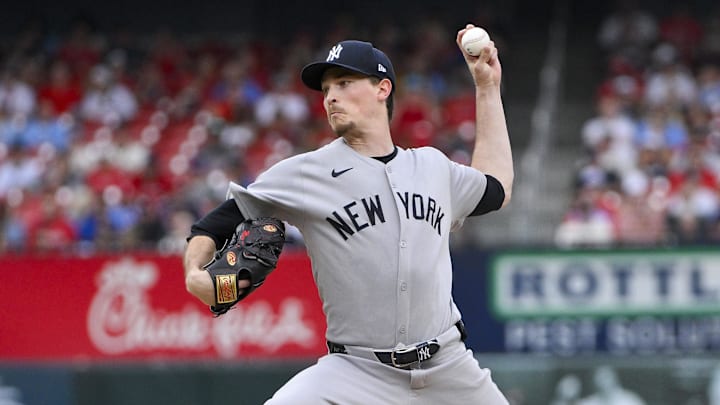
TAMPA — The most devastating element of Max Fried’s seven-pitch arsenal is that hitters have no idea what his fastball will do. For a long time, the most annoying element of his arsenal was that Fried didn’t, either.
“Sometimes it would cut, sometimes it wouldn’t, and I didn’t really know why,” he says. “I was just throwing it and hoping that it was going to go over. Now I have a little bit more of an understanding of, like, O.K., when I throw [this], it’s going to cut, and when I throw [that], it’s going to stay a little straighter.”
It was that search for understanding that led him to the Yankees when he became a free agent before the 2025 season, and it’s that search that has him feeling, as he heads into the second year of his eight-year, $218 million deal—the most lucrative ever for a left-handed pitcher—that he is in the right place.
“I think there’s just more answers to questions,” he says.
In some ways, he hasn’t needed many: He was the Yankees’ ace last year, stepping into a role vacated by Gerrit Cole when he underwent Tommy John surgery in March. At a time when New York badly needed stability, Fried made 32 starts; led the league in wins, with 19; and had the fourth-best ERA in the league, with 2.86. He threw 6 ⅓ scoreless innings against the Red Sox in Game 1 of the American League Wild Card Series. And he’s being trusted to start Opening Night on Wednesday against the Giants to kick off the 2026 season in San Francisco.
But he’s also endured fallow periods—a stretch in late summer when hitters seemed to jump on him, and an American League Division Series start against the Blue Jays in which he allowed seven runs and recorded nine outs. Winter arrived two days later for the Yankees. Fried opened the spring with a renewed focus on keeping hitters off-balance.
He has always been fascinated by information. He grew up in a board game family, and he recently added chess to his repertoire. If he wants to buy a pair of headphones, he’ll pull up six different reviews and cross-reference them. “Am I trying to look for comfort or for sound quality?” he says. “I enjoy that kind of stuff.”
He appreciated the people he worked with in Atlanta, where he spent the first eight years of his career and where he won the 2021 World Series and was a two-time All-Star and two-time Cy Young Award top-five finisher. They “taught me that at the end of the day, your stuff is your stuff,” he says. “It’s more about how you use it, and the art of pitching.”

Still, when he reached free agency, he decided he wanted to learn more about the science of pitching. He was delighted when the Yankees showed up with nine people to their introductory Zoom call, more than twice as many as any other team had brought. Instead of lavishing praise, they told him how they thought they could make him better.
“He always feels like he pitched with five gears,” Fried’s agent, Ryan Hamill of CAA, told SI at the time. “He wanted to find somewhere where he could find that sixth gear.” New York’s pitching lab was a perfect fit.
“It’s been a good back and forth because he’s come from the world of feel,” says pitching coach Matt Blake. “So we’ve been able to marry that with the data and kind of sharpen the edges.”
For example, Fried’s cutter is so dominant that every metric suggests he use it in almost every situation. But of course, if he uses his cutter in almost every situation, it loses the unexpectedness that helps make it so dominant. So after he carried a 1.92 ERA through the first three months but started to get hit around a bit in July and August, they decided to pull back.
“The league knows Max, and so they’re cheating to get to the cutter,” says Blake. “So even though the sinker may not be a good option in a vacuum to a righty, it is, because the hitter knows who Max is. But the data doesn’t know that the hitter knows who Max is.”
From June to late August, Fried threw 33.8% cutters with an ERA of 6.80. From late August on, those figures were 17.2% and 1.55.
“There’s a lot less late nights trying to figure out why stuff happens when it’s not going well,” Fried says. “The 2, 3, 4 in the morning sessions where I was staying up looking at video and all that kind of stuff, trying to find the answers—I don’t necessarily have those as much anymore.”
Blake could tell immediately that Fried would be a good fit for the Yankees’ abundant information. “I think he carries a little anxiety, which is what makes him good,” says Blake. “I think there’s a lot of resources around.” He adds, “Early on in the process, I think he felt comforted. Like, all right, there’s a plan here, and I’ve got a way to execute it.”
Fried often asks the Yankees pitching coaches to confirm with data what he is feeling. If a pitch appears to be moving well, what are the characteristics that make it so? If his mechanics seem off, what effect does that have on pitch shape? Then he takes the answers and integrates them into his process. The data might not always know who Fried is. But he’s starting to.
More MLB from Sports Illustrated
 Add us as a preferred source on Google
Stephanie Apstein was a senior writer covering baseball and Olympic sports for Sports Illustrated, where she started as an intern in 2011 and has since covered a dozen World Series and three Olympics. She has twice won top honors from the Associated Press Sports Editors, and her work has been included in the Best American Sports Writing book series. She graduated from Trinity College with a bachelor’s in French and Italian, and has a master’s in journalism from Columbia University.
Follow stephapstein