%20%20--%3E%0A%3Csvg%20version%3D%221.1%22%20id%3D%22Layer_1%22%20xmlns%3D%22http%3A%2F%2Fwww.w3.org%2F2000%2Fsvg%22%20xmlns%3Axlink%3D%22http%3A%2F%2Fwww.w3.org%2F1999%2Fxlink%22%20x%3D%220px%22%20y%3D%220px%22%0A%09%20width%3D%2239px%22%20height%3D%2240px%22%20viewBox%3D%220%200%2039%2040%22%20enable-background%3D%22new%200%200%2039%2040%22%20xml%3Aspace%3D%22preserve%22%3E%0A%3Cpath%20fill%3D%22%23FFFFFF%22%20d%3D%22M38.5%2C7H28.2v26h10.3V7z%22%2F%3E%0A%3Cpath%20fill-rule%3D%22evenodd%22%20clip-rule%3D%22evenodd%22%20fill%3D%22%23FFFFFF%22%20d%3D%22M26.1%2C25.5c0%2C5.8-4.1%2C7.5-12.9%2C7.5C3.9%2C33%2C0%2C31.2%2C0%2C25.2v-1.1h11.6%0A%09v2.4c0%2C0.7%2C0.1%2C1.4%2C1.2%2C1.4c1%2C0%2C1.2-0.4%2C1.2-1.3v-0.9c0-1.6-0.9-1.6-3.5-2.2C2.2%2C21.7%2C0%2C19.7%2C0%2C15.3v-0.9C0%2C9.3%2C5.5%2C7%2C12.9%2C7%0A%09c10.2%2C0%2C12.8%2C2.6%2C12.8%2C7.4v1.8h-11v-2.9c0-0.6-0.4-1.1-1.2-1.1c-0.6%2C0-1.2%2C0.4-1.2%2C1.1v0.9c0%2C1.5%2C0.9%2C2%2C3.3%2C2.5%0A%09c8%2C1.6%2C10.5%2C3.3%2C10.5%2C7.5V25.5z%22%2F%3E%0A%3C%2Fsvg%3E%0A)
As boxing fades, Ali still shines

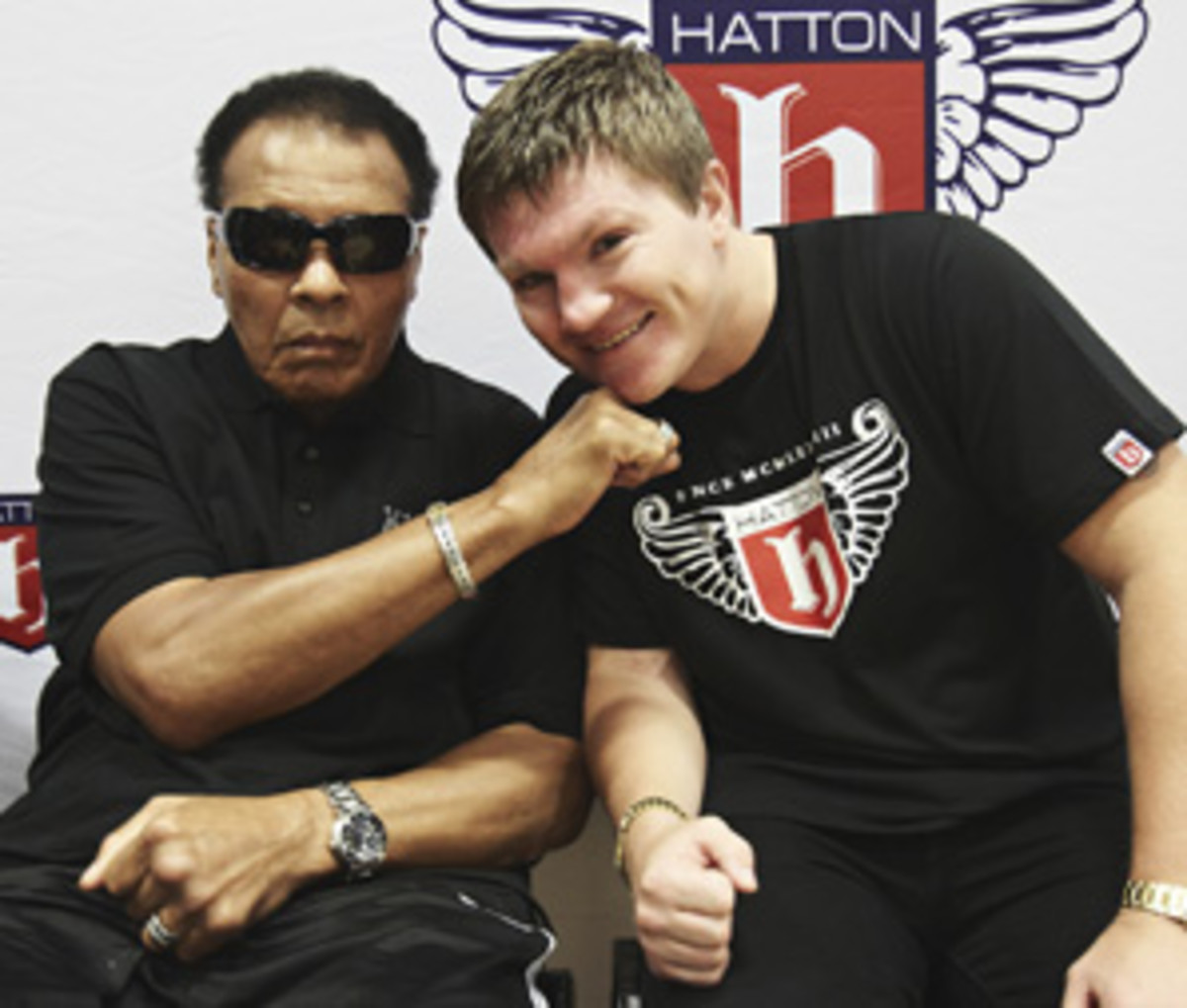
Muhammad Ali flew to England last week to make appearances in soccer stadiums. He said it would probably be his "last time" in the UK. He can barely move on his own now. One London newspaper called he, who was once a butterfly, "little more than a zombie," and a great many people find it as grotesque as it is sad that the old champ continues to make personal appearances.
Maybe it would've been best if our last image of him had been in 1996, when he appeared out of nowhere and -- already shaking terribly from Parkinson's disease -- still managed to light the Olympic flame. There was nobility to that scene, as if once more he'd gotten off the canvas, managed somehow to win another fight. But Ali wouldn't retire from the ring when he should have, and now he refuses to comfort us and slip away from public view. Perhaps there's a bolder statement in that, that the man who once so immodestly enjoyed standing before us, the laird of his realm, proclaiming his beauty to the heavens, is now unafraid to let us see him when his great body is slumped, in shambles.
But might we be too tender with our memories? The athlete dying young has always seemed so shocking, so unfair, but I suspect that it upsets us even more to actually see our heroes, those physical marvels, grown old and infirm, as vulnerable to age and disease as we ordinary folk are. We want to remember the paragon, not the mere human.
Ah, but in contradict ion, Ali's wife, Lonnie, speaks for her husband, saying that for as long as he can manage to travel and make silent appearances, it "is not just his living, it is his life." There must, for him, be as much in satisfaction as in remuneration that he can still command up to $100,000 just for showing up.
The busted old pug was long a stereotype in our athletic cavalcade. That Ali is broken, but not broke is a certain revenge. And he, who was once so reviled by many Americans, has become quite a beloved figure in his dotage. Complicated as he has been, he won the fight for our affection, too.
I can so vividly remember, a few years ago, when a photographer posed him before the Vietnam monument in Washington. I thought that was insane. Who, after all, was more identified with opposition to that war? But when the people there, searching for the names of their loved ones who had died for what Ali opposed -- when they spotted him, they rushed to him, even handed me their little cameras to take snapshots with him. They embraced him. It was dear.
Even as boxing fades to the fringes, Muhammad Ali still retains some kind of hold on us. If he yet wants to present his present, lesser self to us, it is not for us to feel pity for him.
VAULT: SI covers of Muhammad Ali
 Add us as a preferred source on Google
Frank Deford is among the most versatile of American writers. His work has appeared in virtually every medium, including print, where he has written eloquently for Sports Illustrated since 1962. Deford is currently the magazine's Senior Contributing Writer and contributes a weekly column to SI.com. Deford can be heard as a commentator each week on Morning Edition. On television he is a regular correspondent on the HBO show Real Sports With Bryant Gumbel. He is the author of 15 books, and his latest,The Enitled, a novel about celebrity, sex and baseball, was published in 2007 to exceptional reviews. He and Red Smith are the only writers with multiple features in The Best American Sports Writing of the Century. Editor David Halberstam selected Deford's 1981 Sports Illustrated profile on Bobby Knight (The Rabbit Hunter) and his 1985 SI profile of boxer Billy Conn (The Boxer and the Blonde) for that prestigious anthology. For Deford the comparison is meaningful. "Red Smith was the finest columnist, and I mean not just sports columnist," Deford told Powell's Books in 2007. "I've always said that Red is like Vermeer, with those tiny, priceless pieces. Five hundred words, perfectly chosen, crafted. Best literary columnist, in any newspaper, that I've ever seen." Deford was elected to the National Association of Sportscasters and Sportswriters Hall of Fame. Six times at Sports Illustrated Deford was voted by his peers as U.S. Sportswriter of The Year. The American Journalism Review has likewise cited him as the nation's finest sportswriter, and twice he was voted Magazine Writer of The Year by the Washington Journalism Review. Deford has also been presented with the National Magazine Award for profiles; a Christopher Award; and journalism honor awards from the University of Missouri and Northeastern University; and he has received many honorary degrees. The Sporting News has described Deford as "the most influential sports voice among members of the print media," and the magazine GQ has called him, simply, "The world's greatest sportswriter." In broadcast, Deford has won a Cable Ace award, an Emmy and a George Foster Peabody Award for his television work. In 2005 ESPN presented a television biography of Deford's life and work, You Write Better Than You Play. Deford has spoken at well over a hundred colleges, as well as at forums, conventions and on cruise ships around the world. He served as the editor-in-chief of The National Sports Daily in its brief but celebrated existence. Deford also wrote Sports Illustrated's first Point After column, in 1986. Two of Deford's books, the novel, Everybody's All-American, and Alex: The Life Of A Child, his memoir about his daughter who died of cystic fibrosis, have been made into movies. Two of his original screenplays have also been filmed. For 16 years Deford served as national chairman of the Cystic Fibrosis Foundation, and he remains chairman emeritus. He resides in Westport, CT, with his wife, Carol. They have two grown children – a son, Christian, and a daughter, Scarlet. A native of Baltimore, Deford is a graduate of Princeton University, where he has taught American Studies.