%20%20--%3E%0A%3Csvg%20version%3D%221.1%22%20id%3D%22Layer_1%22%20xmlns%3D%22http%3A%2F%2Fwww.w3.org%2F2000%2Fsvg%22%20xmlns%3Axlink%3D%22http%3A%2F%2Fwww.w3.org%2F1999%2Fxlink%22%20x%3D%220px%22%20y%3D%220px%22%0A%09%20width%3D%2239px%22%20height%3D%2240px%22%20viewBox%3D%220%200%2039%2040%22%20enable-background%3D%22new%200%200%2039%2040%22%20xml%3Aspace%3D%22preserve%22%3E%0A%3Cpath%20fill%3D%22%23FFFFFF%22%20d%3D%22M38.5%2C7H28.2v26h10.3V7z%22%2F%3E%0A%3Cpath%20fill-rule%3D%22evenodd%22%20clip-rule%3D%22evenodd%22%20fill%3D%22%23FFFFFF%22%20d%3D%22M26.1%2C25.5c0%2C5.8-4.1%2C7.5-12.9%2C7.5C3.9%2C33%2C0%2C31.2%2C0%2C25.2v-1.1h11.6%0A%09v2.4c0%2C0.7%2C0.1%2C1.4%2C1.2%2C1.4c1%2C0%2C1.2-0.4%2C1.2-1.3v-0.9c0-1.6-0.9-1.6-3.5-2.2C2.2%2C21.7%2C0%2C19.7%2C0%2C15.3v-0.9C0%2C9.3%2C5.5%2C7%2C12.9%2C7%0A%09c10.2%2C0%2C12.8%2C2.6%2C12.8%2C7.4v1.8h-11v-2.9c0-0.6-0.4-1.1-1.2-1.1c-0.6%2C0-1.2%2C0.4-1.2%2C1.1v0.9c0%2C1.5%2C0.9%2C2%2C3.3%2C2.5%0A%09c8%2C1.6%2C10.5%2C3.3%2C10.5%2C7.5V25.5z%22%2F%3E%0A%3C%2Fsvg%3E%0A)
Wild about the wild card
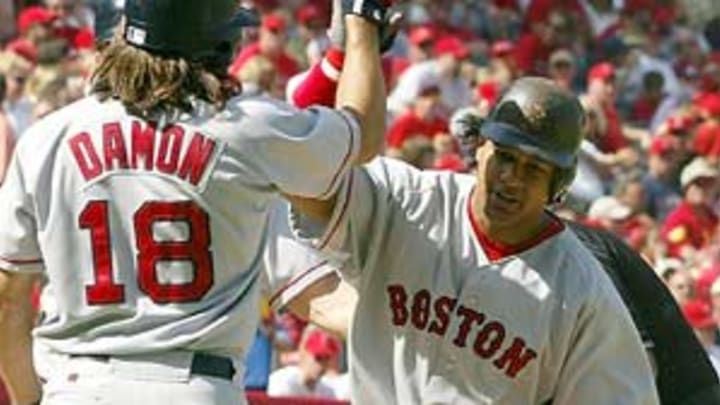
Of all the changes in sports, the one that fundamentalists have the hardest time accepting is the addition of the wild card in baseball. Not other sports -- just baseball. As the Yankees and Red Sox battled it out this season, you could hear the traditionalists whining that the competition sure didn't mean as much as it did in the days of yore because it was no longer do-or-die; no matter which team won the Eastern Division title, the runner-up was all but assured a spot in the playoffs as the league's wild card.
Never mind that fans were in a fever pitch whenever the Sawx and Yanks faced off. In fact, the anticipation that the two contenders might yet meet again in the postseason probably added to the excitement, but no, the purists remained in a pet that any runner-up could earn a second chance. It is heresy, sacrilege, a pockmark upon the face of our National Pastime! Instead, thank God that Major League Baseball finally caught up with the rest of the sports universe. As far as I'm concerned, if baseball had its wits fully about it, it would double the number of teams that make the playoffs. Only college football, which persists in selling itself down the river with a plethora of bowl games and resisting any playoffs whatsoever, is more benighted. Look at college basketball. The more teams added to March Madness, the more popular that championship became.
And three cheers for the National Hockey League! The Stanley Cup started out as an all-comers competition, so the NHL easily embraced the idea of playoffs for just about everybody. If you think playoffs are a sin against the natural order of humankind, please avert your eyes now when I tell you that the Chicago Blackhawks won the Stanley Cup in 1938 after finishing with the sixth-worst record in an eight-team league, winning only 14 of 48 regular-season games. I consider the the '38 'Hawks the patron saints of playoffs.
Pro basketball also quickly understood how to keep fans hoping and cheering. In the NBA's first season, 12 of the 17 franchises qualified for the playoffs. That's the spirit! The NFL took awhile to catch on, not even having a championship game in its first 13 seasons. But today, there's more interest in the waning weeks of the NFL regular season about what wild-card teams might qualify, than who will win the various divisions.
Major League Baseball's long-time failure to welcome wild cards to the party was all the more inexplicable because playoffs probably saved the minor leagues during the depression. An executive in the International League named Frank Shaughnessy dreamed up the concept of having the top four teams make the postseason. It kept fans interested. It kept most of baseball in business.
Oh, in an ideal universe, the team with the best regular-season record would be the champion, and then its players would be lifted up to heaven in chariots of fire. But if sport was just about absolutes, then mathematics would pack stadiums. The doctrinaire fuddy-duddies who dislike baseball playoffs argue that a regular season provides the truth of superiority. Yeah, but the playoffs have more to do with luck and unpredictability and second chances, which is to say: fun. Play on playoffs, and the more the merrier.
 Add us as a preferred source on Google
Frank Deford is among the most versatile of American writers. His work has appeared in virtually every medium, including print, where he has written eloquently for Sports Illustrated since 1962. Deford is currently the magazine's Senior Contributing Writer and contributes a weekly column to SI.com. Deford can be heard as a commentator each week on Morning Edition. On television he is a regular correspondent on the HBO show Real Sports With Bryant Gumbel. He is the author of 15 books, and his latest,The Enitled, a novel about celebrity, sex and baseball, was published in 2007 to exceptional reviews. He and Red Smith are the only writers with multiple features in The Best American Sports Writing of the Century. Editor David Halberstam selected Deford's 1981 Sports Illustrated profile on Bobby Knight (The Rabbit Hunter) and his 1985 SI profile of boxer Billy Conn (The Boxer and the Blonde) for that prestigious anthology. For Deford the comparison is meaningful. "Red Smith was the finest columnist, and I mean not just sports columnist," Deford told Powell's Books in 2007. "I've always said that Red is like Vermeer, with those tiny, priceless pieces. Five hundred words, perfectly chosen, crafted. Best literary columnist, in any newspaper, that I've ever seen." Deford was elected to the National Association of Sportscasters and Sportswriters Hall of Fame. Six times at Sports Illustrated Deford was voted by his peers as U.S. Sportswriter of The Year. The American Journalism Review has likewise cited him as the nation's finest sportswriter, and twice he was voted Magazine Writer of The Year by the Washington Journalism Review. Deford has also been presented with the National Magazine Award for profiles; a Christopher Award; and journalism honor awards from the University of Missouri and Northeastern University; and he has received many honorary degrees. The Sporting News has described Deford as "the most influential sports voice among members of the print media," and the magazine GQ has called him, simply, "The world's greatest sportswriter." In broadcast, Deford has won a Cable Ace award, an Emmy and a George Foster Peabody Award for his television work. In 2005 ESPN presented a television biography of Deford's life and work, You Write Better Than You Play. Deford has spoken at well over a hundred colleges, as well as at forums, conventions and on cruise ships around the world. He served as the editor-in-chief of The National Sports Daily in its brief but celebrated existence. Deford also wrote Sports Illustrated's first Point After column, in 1986. Two of Deford's books, the novel, Everybody's All-American, and Alex: The Life Of A Child, his memoir about his daughter who died of cystic fibrosis, have been made into movies. Two of his original screenplays have also been filmed. For 16 years Deford served as national chairman of the Cystic Fibrosis Foundation, and he remains chairman emeritus. He resides in Westport, CT, with his wife, Carol. They have two grown children – a son, Christian, and a daughter, Scarlet. A native of Baltimore, Deford is a graduate of Princeton University, where he has taught American Studies.