%20%20--%3E%0A%3Csvg%20version%3D%221.1%22%20id%3D%22Layer_1%22%20xmlns%3D%22http%3A%2F%2Fwww.w3.org%2F2000%2Fsvg%22%20xmlns%3Axlink%3D%22http%3A%2F%2Fwww.w3.org%2F1999%2Fxlink%22%20x%3D%220px%22%20y%3D%220px%22%0A%09%20width%3D%2239px%22%20height%3D%2240px%22%20viewBox%3D%220%200%2039%2040%22%20enable-background%3D%22new%200%200%2039%2040%22%20xml%3Aspace%3D%22preserve%22%3E%0A%3Cpath%20fill%3D%22%23FFFFFF%22%20d%3D%22M38.5%2C7H28.2v26h10.3V7z%22%2F%3E%0A%3Cpath%20fill-rule%3D%22evenodd%22%20clip-rule%3D%22evenodd%22%20fill%3D%22%23FFFFFF%22%20d%3D%22M26.1%2C25.5c0%2C5.8-4.1%2C7.5-12.9%2C7.5C3.9%2C33%2C0%2C31.2%2C0%2C25.2v-1.1h11.6%0A%09v2.4c0%2C0.7%2C0.1%2C1.4%2C1.2%2C1.4c1%2C0%2C1.2-0.4%2C1.2-1.3v-0.9c0-1.6-0.9-1.6-3.5-2.2C2.2%2C21.7%2C0%2C19.7%2C0%2C15.3v-0.9C0%2C9.3%2C5.5%2C7%2C12.9%2C7%0A%09c10.2%2C0%2C12.8%2C2.6%2C12.8%2C7.4v1.8h-11v-2.9c0-0.6-0.4-1.1-1.2-1.1c-0.6%2C0-1.2%2C0.4-1.2%2C1.1v0.9c0%2C1.5%2C0.9%2C2%2C3.3%2C2.5%0A%09c8%2C1.6%2C10.5%2C3.3%2C10.5%2C7.5V25.5z%22%2F%3E%0A%3C%2Fsvg%3E%0A)
Best of breed

Ours is a youth-centric culture, and nobody is supposed to care about history anymore. But curiously, it's really quite amazing the attention that sports fans pay to legacy, to how their favorite has-beens rank for posterity.
History is history, except for sports. And, with fans, the present is always playing the past. Mirror, mirror on the wall, who's the fairest of them all ... all-time?
All this is underscored at this moment because we find an absolute glut of brilliance. Is it possible that right now we have, plying their genius before our admiring eyes, yea, verily, at their peaks, the greatest professional football team ever, the greatest quarterback ever, the greatest tennis player ever and the greatest golfer ever? Really, have ever so many supernovas been aligned in the athletic heavens at once?
Of course, part of the mania to designate superiority in sports is because sports is, after all, competitive. But it is also true that it is an article of sporting faith that athletes are always getting better.
In no other area do we believe this. The greatest writers and composers and painters are all long dead -- they don't make 'em like they used to -- but inasmuch as the cliché tells us that records are made to be broken, then it follows for many that the record-breakers are bound to be better than all the erstwhile record holders of the past, ergo, the greatest in sports must always be right before our eyes.
Only right now the empirical evidence suggests that maybe that sophistry really is so, that the New England Patriots are the best team ever put on God's green grass, and Tom Brady is better than even Johnny Unitas and Joe Montana, and Roger Federer and Tiger Woods have surely come down from Mount Olympus to toy with the poor mortals who would dare take them on.
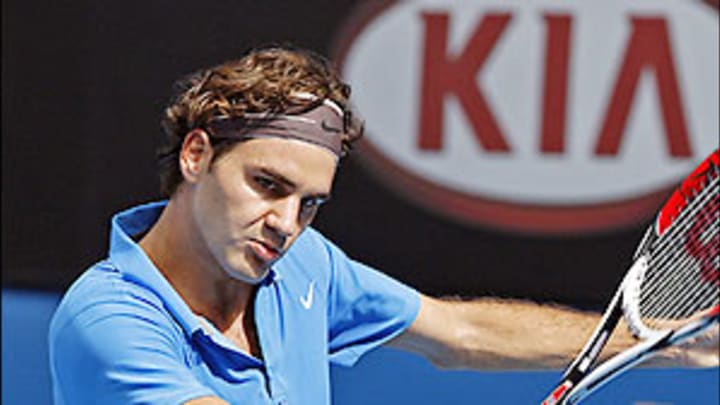
Because heroes in individual sports are not dragged down by imperfect teammates, it's easiest to rate the likes of Woods and Federer. Since the preponderance of opinion now is that they both are indeed better than anybody who's ever picked up a club or a racket, the new parlor game is to argue: Is Federer more dominant at tennis than Woods is at golf?
It's impossible to choose, though, because the challenges in the two sports are so different. Woods can have a bad day and survive, but he can't stop some other golfer, otherwise a nonentity, like Zach Johnson, at the Masters last year, from getting hot and beating him without ever really playing him directly head-to-head.
Federer only has to play one man at a time, so he controls his own fate better, but also, unlike golf, there are no off-days he can recover from; one bad match and he's eliminated. In the Australian Open the other day, in fact, Federer almost got taken down by tennis' own version of a Zach Johnson.
Down Under, Federer's seeking his 11th straight Grand Slam final. That's simply impossible. Even as I sit here and say these words, I think: He must get beat. Must. And Tiger can't possibly beat all the world's best golfers at all four majors. And surely it's only the law of averages for Brady to have an absolutely rotten day in the Super Bowl. And the Patriots are ripe to be upset.
But: No, no, no and no. Sometimes, I guess, they don't make 'em like they used to because, in fact, they make 'em even better.

Frank Deford is among the most versatile of American writers. His work has appeared in virtually every medium, including print, where he has written eloquently for Sports Illustrated since 1962. Deford is currently the magazine's Senior Contributing Writer and contributes a weekly column to SI.com. Deford can be heard as a commentator each week on Morning Edition. On television he is a regular correspondent on the HBO show Real Sports With Bryant Gumbel. He is the author of 15 books, and his latest,The Enitled, a novel about celebrity, sex and baseball, was published in 2007 to exceptional reviews. He and Red Smith are the only writers with multiple features in The Best American Sports Writing of the Century. Editor David Halberstam selected Deford's 1981 Sports Illustrated profile on Bobby Knight (The Rabbit Hunter) and his 1985 SI profile of boxer Billy Conn (The Boxer and the Blonde) for that prestigious anthology. For Deford the comparison is meaningful. "Red Smith was the finest columnist, and I mean not just sports columnist," Deford told Powell's Books in 2007. "I've always said that Red is like Vermeer, with those tiny, priceless pieces. Five hundred words, perfectly chosen, crafted. Best literary columnist, in any newspaper, that I've ever seen." Deford was elected to the National Association of Sportscasters and Sportswriters Hall of Fame. Six times at Sports Illustrated Deford was voted by his peers as U.S. Sportswriter of The Year. The American Journalism Review has likewise cited him as the nation's finest sportswriter, and twice he was voted Magazine Writer of The Year by the Washington Journalism Review. Deford has also been presented with the National Magazine Award for profiles; a Christopher Award; and journalism honor awards from the University of Missouri and Northeastern University; and he has received many honorary degrees. The Sporting News has described Deford as "the most influential sports voice among members of the print media," and the magazine GQ has called him, simply, "The world's greatest sportswriter." In broadcast, Deford has won a Cable Ace award, an Emmy and a George Foster Peabody Award for his television work. In 2005 ESPN presented a television biography of Deford's life and work, You Write Better Than You Play. Deford has spoken at well over a hundred colleges, as well as at forums, conventions and on cruise ships around the world. He served as the editor-in-chief of The National Sports Daily in its brief but celebrated existence. Deford also wrote Sports Illustrated's first Point After column, in 1986. Two of Deford's books, the novel, Everybody's All-American, and Alex: The Life Of A Child, his memoir about his daughter who died of cystic fibrosis, have been made into movies. Two of his original screenplays have also been filmed. For 16 years Deford served as national chairman of the Cystic Fibrosis Foundation, and he remains chairman emeritus. He resides in Westport, CT, with his wife, Carol. They have two grown children – a son, Christian, and a daughter, Scarlet. A native of Baltimore, Deford is a graduate of Princeton University, where he has taught American Studies.