%20%20--%3E%0A%3Csvg%20version%3D%221.1%22%20id%3D%22Layer_1%22%20xmlns%3D%22http%3A%2F%2Fwww.w3.org%2F2000%2Fsvg%22%20xmlns%3Axlink%3D%22http%3A%2F%2Fwww.w3.org%2F1999%2Fxlink%22%20x%3D%220px%22%20y%3D%220px%22%0A%09%20width%3D%2239px%22%20height%3D%2240px%22%20viewBox%3D%220%200%2039%2040%22%20enable-background%3D%22new%200%200%2039%2040%22%20xml%3Aspace%3D%22preserve%22%3E%0A%3Cpath%20fill%3D%22%23FFFFFF%22%20d%3D%22M38.5%2C7H28.2v26h10.3V7z%22%2F%3E%0A%3Cpath%20fill-rule%3D%22evenodd%22%20clip-rule%3D%22evenodd%22%20fill%3D%22%23FFFFFF%22%20d%3D%22M26.1%2C25.5c0%2C5.8-4.1%2C7.5-12.9%2C7.5C3.9%2C33%2C0%2C31.2%2C0%2C25.2v-1.1h11.6%0A%09v2.4c0%2C0.7%2C0.1%2C1.4%2C1.2%2C1.4c1%2C0%2C1.2-0.4%2C1.2-1.3v-0.9c0-1.6-0.9-1.6-3.5-2.2C2.2%2C21.7%2C0%2C19.7%2C0%2C15.3v-0.9C0%2C9.3%2C5.5%2C7%2C12.9%2C7%0A%09c10.2%2C0%2C12.8%2C2.6%2C12.8%2C7.4v1.8h-11v-2.9c0-0.6-0.4-1.1-1.2-1.1c-0.6%2C0-1.2%2C0.4-1.2%2C1.1v0.9c0%2C1.5%2C0.9%2C2%2C3.3%2C2.5%0A%09c8%2C1.6%2C10.5%2C3.3%2C10.5%2C7.5V25.5z%22%2F%3E%0A%3C%2Fsvg%3E%0A)
U.S., Canada must maintain focus

And where is that?
Boyle hesitated. "I know it's somewhere in Europe," he said, an answer as vague as Russia's passes against the Canadians the day before. "I don't know if I could pick out where the Czech Republic is."
This is not a critique of the grasp of world geography by a defenseman who has regained a significant role on Canada's blueline. After all, the game Canada will play against the Slovakians is the men's Olympic hockey semifinal, not "Where in the World is Carmen San Diego?"
But for all the ritualistic scraping and bowing about the Slovaks -- by the time the Canadian players were done Thursday, Slovakia was sounding an awful lot like the Edmonton Oilers of the 1980s -- there is something taxing about facing one of the generics, the only team of any repute that has not made an Olympic final since NHL players began participating in 1998.
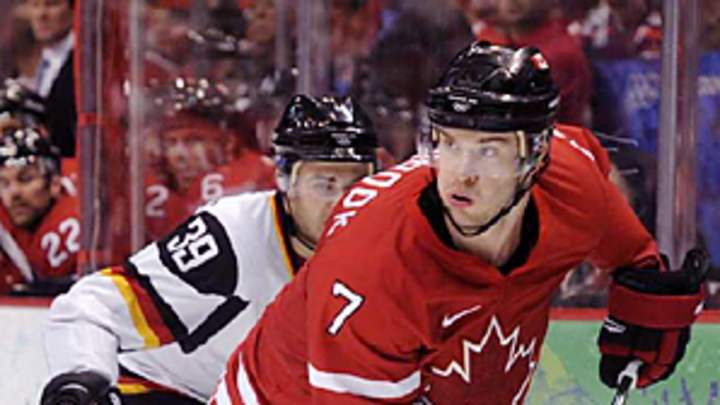
Just as Team USA must put on blinkers against Finland and not ruminate about the dizzying possibility of a rematch against Canada in the gold-medal game -- more on the Finns and Americans in a minute -- Canada has to come down from its soaring triumph over Russia and maintain its equilibrium against a country that produces nifty forwards but is a cruiserweight among hockey's super heavies. Despite praise that was laid on with a trowel, Slovakia's shootout win over Russia in the round robin and a quarterfinal victory over listless Sweden didn't exactly send anyone in a maple leaf jersey sprinting to an atlas.
"They're maybe not a name brand," Canadian defenseman BrentSeabrook said, "but they are definitely are coming on strong the last couple of years. I know we played them in the world championship of the U-18s in the final -- they'd beaten Russia -- and their program has gotten a lot better."
In fact, their program has gotten the same. Slovakia has reached into Professor Peter Bondra's Way Back Machine -- the NHL 503-goal scorer is the general manager -- for 37-year-old ZiggyPalffy, who last haunted the NHL in 2005-06 before disappearing into the Slovak league. Another familiar graybeard is JozefStumpel, also 37, who stole money from Florida in 2007-08 before leaving the NHL.
Curiously the most dynamic Slovak forward has been PavolDemitra, who has shocked Vancouver with a passion he rarely has displayed in his day job with the Canucks. Demitra has missed much of the season with a shoulder injury, scoring once in 11 games. (You really can't spell Demitra without IR.) With the added fillip of a flag on his chest, he now has two goals in five, one behind Marian Gaborik's team lead.
"I would not call it that," Bondra said when asked if reaching the semifinals represented a golden moment for players who are bordering on their expiration date. We have a mix of (young and old) players. We'll just be ready for the Canadians and do what we can ... Their roster has many more star players than my roster, no doubt."
Indeed. Other than Norris Trophy winner ZdenoChara, Gaborik and MarianHossa, the Slovaks are a quart low on truly elite talent. But Jaroslav Halak, the Montreal Canadiens' No. 1 goalie (pro tem) this season, is an X-factor. He might not steal a game for the Boys from Bratislava -- note to Boyle, that's the capital -- but he is capable of borrowing it for long stretches like he did against the Russians.
For Team USA, redoubtable Finland, the 2006 silver medalists and the best team pound-for-pound in Turin, presents other sets of problems. While the Americans have forged a hockey identity based on speed, Finland has become known as the JamesBrown of the game -- the hardest working team on the planet. They are the master of the hockey obvious, the short shift, the good 10-foot pass and puck support unlike the Russians, who have a lot of curlicues in their game. Not to paint them with too broad a brush, but Finns are Canadians with a surfeit of vowels.
Although the Finns shockingly capitulated in what ultimately was a meaningless match against Sweden to conclude the round robin -- "After they got a couple of goals down they didn't seem interested," PeterForsberg said -- they flummoxed the Czech Republic in the quarters behind goalie MiikkaKiprusoff. For all the warranted fuss over American goalie RyanMiller, Kiprusoff leads the Olympic tournament in save percentage - .946 to Miller's .944.
"They're a very fast, very well organized," Miller said. "From what I've seen in early games, they have some big shots on the power play to mix with a lot of skill around the net. This will be a good test for our locker room, to see if we can keep our heads in the right spot."
"It's only natural if you're thinking about (a gold medal game)," defenseman BrooksOrpik said. "I think you're lying (if you say you're not). I think it's good to look ahead. You have to set your goals high. You always picture yourself as having success. At the same time, you don't want to overlook (Finland)."
Finland is tough to overlook. It's that pretty long thing near Sweden and Russia on the map.

Along with the pages of Sports Illustrated, you'll find senior writer Michael Farber in the Hockey Hall of Fame. Farber joined the staff of Sports Illustrated in January 1994 and now stands as one of the magazine's top journalists, covering primarily ice hockey and Olympic sports. He is also a regular contributor to SI.com. In 2003 Farber was honored with the Elmer Ferguson Award from the Hockey Hall of Fame for distinguished hockey writing. "Michael Farber represents the best in our business," said the New York Post's Larry Brooks, past president of the Professional Hockey Writers' Association. "He is a witty and stylish writer, who has the ability to tell a story with charm and intelligence." Farber says his Feb. 2, 1998 piece on the use and abuse of Sudafed among NHL players was his most memorable story for SI. He also cites a feature on the personal problems of Kevin Stevens, Life of the Party. His most memorable sports moment as a journalist came in 1988 when Canadian Ben Johnson set his controversial world record by running the 100 meters in 9.79 seconds at the Summer Olympic Games, in Seoul. Before coming to Sports Illustrated, Farber spent 15 years as an award-winning sports columnist and writer for the Montreal Gazette, three years at the Bergen Record, and one year at the Sun Bulletin in Binghamton, NY. He has won many honors for his writing, including the "outstanding sports writing award" in 2007 from Sports Media Canada, and the Prix Jacques-Beauchamp (Quebec sportswriter of the year) in 1993. While at the Gazette, he won a National Newspaper award in 1982 and 1990. Sometimes Life Gets in the Way, a compendium of his best Gazette columns, was published during his time in newspapers. Farber says hockey is his favorite sport to cover. "The most down-to-earth athletes play the most demanding game," he says. Away from Sports Illustrated, Farber is a commentator for CJAD-AM in Montreal and a panelist on TSN's The Reporters (the Canadian equivalent of ESPN's The Sports Reporters in the United States, except more dignified). Farber is also one of the 18 members on the Hockey Hall of Fame selection committee. Born and raised in New Jersey, Farber is a 1973 graduate of Rutgers University where he was Phi Beta Kappa. He now resides in Montreal with his wife, Danielle Tétrault, son Jérémy and daughter Gabrielle.