%20%20--%3E%0A%3Csvg%20version%3D%221.1%22%20id%3D%22Layer_1%22%20xmlns%3D%22http%3A%2F%2Fwww.w3.org%2F2000%2Fsvg%22%20xmlns%3Axlink%3D%22http%3A%2F%2Fwww.w3.org%2F1999%2Fxlink%22%20x%3D%220px%22%20y%3D%220px%22%0A%09%20width%3D%2239px%22%20height%3D%2240px%22%20viewBox%3D%220%200%2039%2040%22%20enable-background%3D%22new%200%200%2039%2040%22%20xml%3Aspace%3D%22preserve%22%3E%0A%3Cpath%20fill%3D%22%23FFFFFF%22%20d%3D%22M38.5%2C7H28.2v26h10.3V7z%22%2F%3E%0A%3Cpath%20fill-rule%3D%22evenodd%22%20clip-rule%3D%22evenodd%22%20fill%3D%22%23FFFFFF%22%20d%3D%22M26.1%2C25.5c0%2C5.8-4.1%2C7.5-12.9%2C7.5C3.9%2C33%2C0%2C31.2%2C0%2C25.2v-1.1h11.6%0A%09v2.4c0%2C0.7%2C0.1%2C1.4%2C1.2%2C1.4c1%2C0%2C1.2-0.4%2C1.2-1.3v-0.9c0-1.6-0.9-1.6-3.5-2.2C2.2%2C21.7%2C0%2C19.7%2C0%2C15.3v-0.9C0%2C9.3%2C5.5%2C7%2C12.9%2C7%0A%09c10.2%2C0%2C12.8%2C2.6%2C12.8%2C7.4v1.8h-11v-2.9c0-0.6-0.4-1.1-1.2-1.1c-0.6%2C0-1.2%2C0.4-1.2%2C1.1v0.9c0%2C1.5%2C0.9%2C2%2C3.3%2C2.5%0A%09c8%2C1.6%2C10.5%2C3.3%2C10.5%2C7.5V25.5z%22%2F%3E%0A%3C%2Fsvg%3E%0A)
Penguins find that experience pays

Rummage through the footlocker of memory to last spring when the Pittsburgh Penguins, the eventual Stanley Cup champions, found themselves in Philadelphia, trailing 3-0, in Game 6. That was the moment Penguins forward MaxTalbot decided to become a sacrificial lamb, a punching bag for the Flyers' DanielCarcillo, who celebrated the lopsided bout as if he had just whupped MuhammadAli. The fight was mother's milk to the fans in Philadelphia. To the Penguins, Talbot's willingness to engage was even more critical. Whether you personally believe in the restorative power of pugilism in hockey ... well, that hardly matters. The Penguins do, and they all thought that Talbot taking one, or several, for the team spurred them to a 5-3 series-clinching road win.
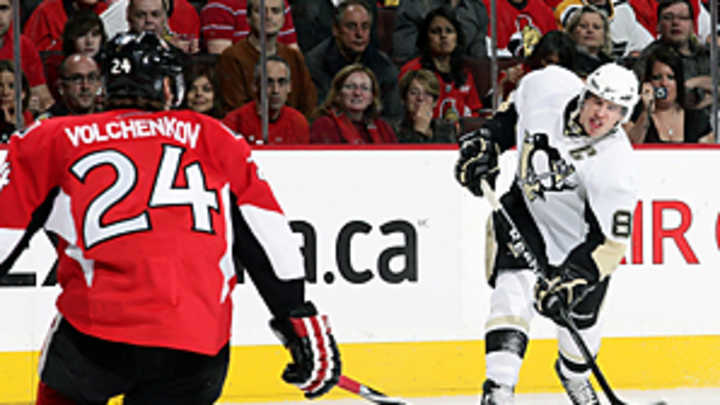
Now fast-forward to Saturday night in Ottawa. The Penguins, who like last year had failed to close out a series in five games, again fell into a 3-0 hole on the scoreboard. This one wasn't especially pretty. SidneyCrosby, who entered the game with a plus nine to go with his NHL-leading 14 playoff points, was on the ice for all three Ottawa goals. The defensive tandem of KrisLetang and MarkEaton, also a combined minus six, was being shredded.
With the unappetizing prospect of Game 7 looming, the Penguins, who at times this season have appeared to be lollygagging their way through a Stanley Cup defense, thumbed through the playbook. They were brushing up on the old formulas that can lead to another championship.
"I told Max," Penguins coach DanBylsma, "this time you didn't need to get beat up for us to come back from 3-0."
"We had a similar situation in Philly, this time minus the fight," MattCooke said. "We battled back there, too. You draw on your experiences. This is a different year, of course, but I think those experiences help you have success."
Informed by a glorious past -- this includes winning all four series on the road en route to the Cup in 2009 - the Penguins took a bold step into the future. Well, at least into the second playoff round. Instead of a fight, a gritty Cooke rebound goal midway through the second period cut the deficit to a manageable two goals and changed the tenor of the game. The Penguins came in waves, outshooting Ottawa 18-4 in the third period, while the Senators collapsed around goalie PascalLeclaire. Another 40 minutes or so later, PascalDupuis fired a rolling puck over Leclaire's shoulder at 9:56 of overtime, and the Penguins had a 4-3 victory that constituted an impressive show of depth and nerve.
"One of the things we talked about going into the playoffs was maintaining the focus," Bylsma said. "Staying unflappable in whatever comes our way, whether that's losing a game or situations in a game when we get a goal called back. It's about keeping to the game plan. Tonight was probably our best game in that (regard.) Our bench was rock solid. Focused."
Crosby was held without a point after five straight multiple-point games. EvgeniMalkin had a single assist. But Cooke, who was on the ice in triple overtime when defenseman Matt Carkner's goal gave Ottawa a 4-3 win in Game 5, responded with two goals, and BillGuerin added another on the power play. Eaton and AlexGoligoski also had assists. JordanStaal had two helpers. See, Pittsburgh can go deep, both in the tournament and on the scoresheet. Crosby might be the face and even the soul of the franchise, but he played less than a third of the match. That's hockey math.
"It says a lot," Crosby said of the Penguins goal scorers. "(Malkin and I) are going to do a lot to create things, but some nights it might not go in. We've still had to do things out there ... be responsible (defensively), find ways to help, but we have guys who can step up and score those goals."
In a perfect world, the Penguins would have rolled through Ottawa in four or at least jumped on the opportunity to finish the series at home in five. That would have helped their bodies after a long season. But a series-clinching Game 6 victory in Ottawa can be therapy for the mind. Said defenseman BrooksOrpik, "It gets you battle level up, obviously. (Losing a) triple overtime game, you kinda deal with adversity and see how your team is going to react. For a team like us, gaining more experience is only a good thing." The six games didn't just make the Penguins sore. It perhaps made them better.

Along with the pages of Sports Illustrated, you'll find senior writer Michael Farber in the Hockey Hall of Fame. Farber joined the staff of Sports Illustrated in January 1994 and now stands as one of the magazine's top journalists, covering primarily ice hockey and Olympic sports. He is also a regular contributor to SI.com. In 2003 Farber was honored with the Elmer Ferguson Award from the Hockey Hall of Fame for distinguished hockey writing. "Michael Farber represents the best in our business," said the New York Post's Larry Brooks, past president of the Professional Hockey Writers' Association. "He is a witty and stylish writer, who has the ability to tell a story with charm and intelligence." Farber says his Feb. 2, 1998 piece on the use and abuse of Sudafed among NHL players was his most memorable story for SI. He also cites a feature on the personal problems of Kevin Stevens, Life of the Party. His most memorable sports moment as a journalist came in 1988 when Canadian Ben Johnson set his controversial world record by running the 100 meters in 9.79 seconds at the Summer Olympic Games, in Seoul. Before coming to Sports Illustrated, Farber spent 15 years as an award-winning sports columnist and writer for the Montreal Gazette, three years at the Bergen Record, and one year at the Sun Bulletin in Binghamton, NY. He has won many honors for his writing, including the "outstanding sports writing award" in 2007 from Sports Media Canada, and the Prix Jacques-Beauchamp (Quebec sportswriter of the year) in 1993. While at the Gazette, he won a National Newspaper award in 1982 and 1990. Sometimes Life Gets in the Way, a compendium of his best Gazette columns, was published during his time in newspapers. Farber says hockey is his favorite sport to cover. "The most down-to-earth athletes play the most demanding game," he says. Away from Sports Illustrated, Farber is a commentator for CJAD-AM in Montreal and a panelist on TSN's The Reporters (the Canadian equivalent of ESPN's The Sports Reporters in the United States, except more dignified). Farber is also one of the 18 members on the Hockey Hall of Fame selection committee. Born and raised in New Jersey, Farber is a 1973 graduate of Rutgers University where he was Phi Beta Kappa. He now resides in Montreal with his wife, Danielle Tétrault, son Jérémy and daughter Gabrielle.