%20%20--%3E%0A%3Csvg%20version%3D%221.1%22%20id%3D%22Layer_1%22%20xmlns%3D%22http%3A%2F%2Fwww.w3.org%2F2000%2Fsvg%22%20xmlns%3Axlink%3D%22http%3A%2F%2Fwww.w3.org%2F1999%2Fxlink%22%20x%3D%220px%22%20y%3D%220px%22%0A%09%20width%3D%2239px%22%20height%3D%2240px%22%20viewBox%3D%220%200%2039%2040%22%20enable-background%3D%22new%200%200%2039%2040%22%20xml%3Aspace%3D%22preserve%22%3E%0A%3Cpath%20fill%3D%22%23FFFFFF%22%20d%3D%22M38.5%2C7H28.2v26h10.3V7z%22%2F%3E%0A%3Cpath%20fill-rule%3D%22evenodd%22%20clip-rule%3D%22evenodd%22%20fill%3D%22%23FFFFFF%22%20d%3D%22M26.1%2C25.5c0%2C5.8-4.1%2C7.5-12.9%2C7.5C3.9%2C33%2C0%2C31.2%2C0%2C25.2v-1.1h11.6%0A%09v2.4c0%2C0.7%2C0.1%2C1.4%2C1.2%2C1.4c1%2C0%2C1.2-0.4%2C1.2-1.3v-0.9c0-1.6-0.9-1.6-3.5-2.2C2.2%2C21.7%2C0%2C19.7%2C0%2C15.3v-0.9C0%2C9.3%2C5.5%2C7%2C12.9%2C7%0A%09c10.2%2C0%2C12.8%2C2.6%2C12.8%2C7.4v1.8h-11v-2.9c0-0.6-0.4-1.1-1.2-1.1c-0.6%2C0-1.2%2C0.4-1.2%2C1.1v0.9c0%2C1.5%2C0.9%2C2%2C3.3%2C2.5%0A%09c8%2C1.6%2C10.5%2C3.3%2C10.5%2C7.5V25.5z%22%2F%3E%0A%3C%2Fsvg%3E%0A)
Venue will go down as biggest star of NHL's All-Star weekend
RALEIGH, N.C. -- The sheared axons in Sidney Crosby's brain threatened to hijack the 2011 NHL All-Star game, but a city and a region grabbed it back with their two hands.
While this will be recorded for posterity as an 11-10 victory for Team Lidstrom -- three weeks from now you likely will have not the faintest idea who played for the eponymous teams -- the clear winner was Raleigh, which reinforced its position as a most prominent, if not model, Sun Belt franchise.
The "non-traditional" All-Star venues have been problematic. And by problematic, I mean awful. Los Angeles swallowed the All-Star game without even bothering to chew while the mid-season hockey festivals came and went in Tampa Bay and Florida without leaving a footprint in the sand. The Atlanta event didn't register within 100 yards from the arena. In all these cases, the tedium was the message.
But the Triangle region of North Carolina faced the challenges of holding an All-Star game -- the diffuse nature of the area, the distance of the arena from the modest Raleigh downtown -- and stared them down with a smile. This wasn't Montreal 2009 -- it was some 60 or so degrees warmer, for one thing -- but it was the next best thing, a reminder that hockey can have universal appeal.
Carolina Hurricanes owner Peter Karmanos expressed it well: after reaching a Stanley Cup final in 2002, winning the Cup in 2006 and serving impressively as All-Star host, Raleigh has crossed the divide from non-traditional hockey market to traditional hockey market.
Now Karmanos is overselling it. Hockey is not part of the local sporting DNA in the way that college basketball; the Blue Line is not Tobacco Road. And a once-a-generation hockey confection bestowed on a franchise like the All-Star game did not resonate with the same passion as it did in Montreal and presumably will next winter in Ottawa. But considering where this franchise has come from -- Hartford, yes, but metaphorically -- it is among the marvels of a 30-team league. The success of the weekend and the host team are reminders to all sunny American markets that there is a blueprint for success. For one thing, win. For another, do it in a market where you have it pretty much to yourself.
Unlike Nashville, which did absolutely everything right at the beginning of the franchise before starting a slow slide, the Hurricanes did absolutely nothing right at the beginning, including bivouacking in temporary digs 90 minutes away in Greensboro. But because general manager Jim Rutherford built a boom-and-bust team capable of winning with spasmodic regularity -- in addition to 2002 and 2006, there was that unexpected run to the conference final in 2009 -- this became a franchise with some heft but, more importantly, a palpable sense of fun.
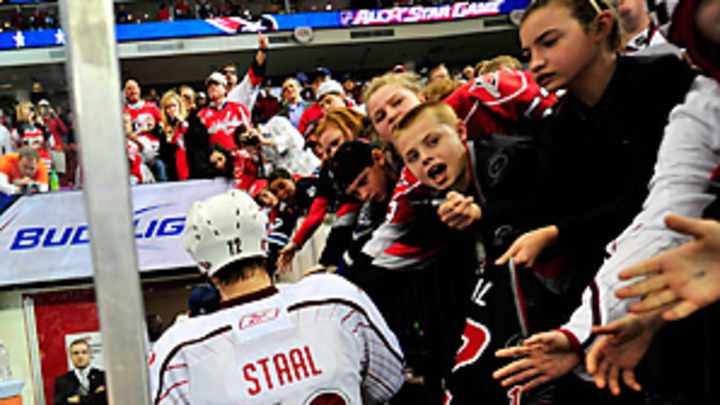
There is no better place in hockey in the United States than Carolina deep in the playoffs. The coterie of fans swells in the spring -- currently the Hurricanes, outside a playoff spot, are drawing at a little less than 90 percent of capacity -- and it treats each game like an event, tailgating as if it were North Carolina playing N.C. State in Carter-Finley Stadium across the parking lot from RBC Arena. In Game 7 of the 2006 final against Edmonton, there was no one in the seats at the rink. The reason: fans stood the entire game. Cameron Crazies met Caniacs. In the past decade, the NHL has not had a more delightfully organic moment. (The same fans stood six deep as they lined the "red carpet" while players made their way into the arena for the skills competition Saturday. One senior NHL official likened it to the Oscars, but there seemed to be more of a beery Golden Globe vibe.)
Not that the weekend was all hockey nirvana in Raleigh. While the so-called fantasy draft had cute moments, it was a good half hour too long for players, who have remarkably short attention spans. NHL vice president Brendan Shanahan, the brains behind the draft, was hoping to replicate the atmosphere of NHL players sitting around watching a Super Bowl, with all the attendant chirping and posturing. It seemed forced. (When NFL players sit around watching the Stanley Cup final, then we'll really have something.) The purported reason for the Friday night draft was the game needed a change of format, but this is disingenuous. The problem never has been the format; it's the game itself. Some are unwatchable. Some are merely mildly diverting shinny exercises, which is how the exercise in Raleigh, even with the energetic finish, is best categorized. In a contact sport, there is nothing the NHL can do except paste a yellow smiley face on the 60 All-Star minutes and move on. Apparently the CBC's Jeff Marek offered a fabulous, laugh-out-loud fix -- players on the winning team don't have to pay escrow -- but the guess is that won't fly.
Crosby, the face of the game who in the past month has become the head of the game, didn't fly either. If he had been able to come to Raleigh, he could have used the weekend as a bully pulpit to nudge the league further along the path towards banning head hits like the IIHF, college hockey and some Canadian junior leagues. Of course, that might have removed some of the spotlight from the star of the weekend, southern-fried hockey. Patrick Sharp of Team Staal was the Most Valuable Player, but Raleigh remains a Most Viable Place.
 Add us as a preferred source on Google
Along with the pages of Sports Illustrated, you'll find senior writer Michael Farber in the Hockey Hall of Fame. Farber joined the staff of Sports Illustrated in January 1994 and now stands as one of the magazine's top journalists, covering primarily ice hockey and Olympic sports. He is also a regular contributor to SI.com. In 2003 Farber was honored with the Elmer Ferguson Award from the Hockey Hall of Fame for distinguished hockey writing. "Michael Farber represents the best in our business," said the New York Post's Larry Brooks, past president of the Professional Hockey Writers' Association. "He is a witty and stylish writer, who has the ability to tell a story with charm and intelligence." Farber says his Feb. 2, 1998 piece on the use and abuse of Sudafed among NHL players was his most memorable story for SI. He also cites a feature on the personal problems of Kevin Stevens, Life of the Party. His most memorable sports moment as a journalist came in 1988 when Canadian Ben Johnson set his controversial world record by running the 100 meters in 9.79 seconds at the Summer Olympic Games, in Seoul. Before coming to Sports Illustrated, Farber spent 15 years as an award-winning sports columnist and writer for the Montreal Gazette, three years at the Bergen Record, and one year at the Sun Bulletin in Binghamton, NY. He has won many honors for his writing, including the "outstanding sports writing award" in 2007 from Sports Media Canada, and the Prix Jacques-Beauchamp (Quebec sportswriter of the year) in 1993. While at the Gazette, he won a National Newspaper award in 1982 and 1990. Sometimes Life Gets in the Way, a compendium of his best Gazette columns, was published during his time in newspapers. Farber says hockey is his favorite sport to cover. "The most down-to-earth athletes play the most demanding game," he says. Away from Sports Illustrated, Farber is a commentator for CJAD-AM in Montreal and a panelist on TSN's The Reporters (the Canadian equivalent of ESPN's The Sports Reporters in the United States, except more dignified). Farber is also one of the 18 members on the Hockey Hall of Fame selection committee. Born and raised in New Jersey, Farber is a 1973 graduate of Rutgers University where he was Phi Beta Kappa. He now resides in Montreal with his wife, Danielle Tétrault, son Jérémy and daughter Gabrielle.