%20%20--%3E%0A%3Csvg%20version%3D%221.1%22%20id%3D%22Layer_1%22%20xmlns%3D%22http%3A%2F%2Fwww.w3.org%2F2000%2Fsvg%22%20xmlns%3Axlink%3D%22http%3A%2F%2Fwww.w3.org%2F1999%2Fxlink%22%20x%3D%220px%22%20y%3D%220px%22%0A%09%20width%3D%2239px%22%20height%3D%2240px%22%20viewBox%3D%220%200%2039%2040%22%20enable-background%3D%22new%200%200%2039%2040%22%20xml%3Aspace%3D%22preserve%22%3E%0A%3Cpath%20fill%3D%22%23FFFFFF%22%20d%3D%22M38.5%2C7H28.2v26h10.3V7z%22%2F%3E%0A%3Cpath%20fill-rule%3D%22evenodd%22%20clip-rule%3D%22evenodd%22%20fill%3D%22%23FFFFFF%22%20d%3D%22M26.1%2C25.5c0%2C5.8-4.1%2C7.5-12.9%2C7.5C3.9%2C33%2C0%2C31.2%2C0%2C25.2v-1.1h11.6%0A%09v2.4c0%2C0.7%2C0.1%2C1.4%2C1.2%2C1.4c1%2C0%2C1.2-0.4%2C1.2-1.3v-0.9c0-1.6-0.9-1.6-3.5-2.2C2.2%2C21.7%2C0%2C19.7%2C0%2C15.3v-0.9C0%2C9.3%2C5.5%2C7%2C12.9%2C7%0A%09c10.2%2C0%2C12.8%2C2.6%2C12.8%2C7.4v1.8h-11v-2.9c0-0.6-0.4-1.1-1.2-1.1c-0.6%2C0-1.2%2C0.4-1.2%2C1.1v0.9c0%2C1.5%2C0.9%2C2%2C3.3%2C2.5%0A%09c8%2C1.6%2C10.5%2C3.3%2C10.5%2C7.5V25.5z%22%2F%3E%0A%3C%2Fsvg%3E%0A)
A special language just for sports
Many months ago I asked you to coin new words for familiar concepts in sports and you replied in great numbers, from places farflung and nearflung -- a word that doesn't exist but ought to, which is the whole point of this exercise.
 Add us as a preferred source on Google
For instance, there is no word to describe the yellow first-down stripe on televised football games. Or there wasn't until Twitter user @TheMNSportsGuy suggested "Invisiline" -- because couchbound fans still yell at players for failing to extend the ball over a stripe that those players can't actually see.
Alternatively, wrote Pat Fogg of Calgary: "It's a major boon to NFL fans and bright yellow, so why not call it the Dandy-Line?"
The Twitter user @WeNeedAWordFor wanted to know what we should call "the precise tone of shame" in an announcer's voice when he or she is forced to read, with feigned enthusiasm, the promo for the reality show coming up after the game.
I would suggest "Survivor Guilt," but whatever we choose to call it, you could hear it in Al Michaels' voice Sunday night during the Patriots-Jets game, when the man who once said "Do you believe in miracles?" had to utter the following: "On The Tonight Show this week, Jay welcomes Snooki ..."
From Adelaide, Australia, @benosborne17 suggested "Indifference-maker" to describe "a bland, non-quotable, Belichickian media performer." It's worth noting, too, that "Belichickian" wins as best adjective among current NFL coaches, narrowly excelling runners-up "Munchakian," "Kubiakian" and "Shanahanian."
Speaking of the Patriots, James T. O'Connell wrote from Camp Bondsteel in the Balkans: " 'Bradyseismic activity' is the rising and falling of the Earth's surface due to volcanic and seismic causes." But, he noted, the phrase might better describe "the movement of Gillette Stadium following a completed touchdown pass" by the Patriots.
The Pats also inspired the first known case of "Law-jaw," which is what an announcer calling a New England-New Orleans game gets whenever BenJarvus Green-Ellis is tackled by Isa Abdul-Quddus, assisted by Jo-Lonn Dunbar.
We could fill another volume of Gray's Anatomy with the new diseases you've diagnosed. Frank in Wellington, New Zealand said "Ryanitis" is "the condition coaches and players are afflicted with when they are too embarrassed to discuss a 'personal matter.' You could even say it's the opposite of putting one's foot in one's mouth." (C.f., Indifference-maker.)
Football-minded physicians might call this the "hoarse collar," in which the tighter one's collar gets, the less capable of talking one becomes.
"Messi Bottom" is another malady, more commonly found in Europe, according to Andrew Clearfield, who explained: "It's what a defender gets after being deked onto his rump."
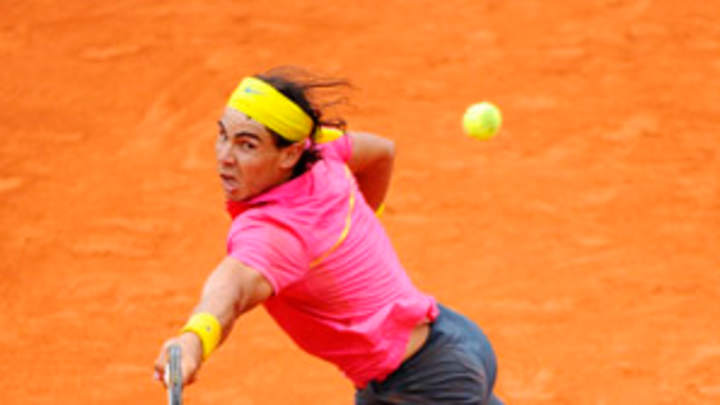
Another of Spain's sporting icons was cited by Twitter user @briburkhardt, who wrote, "Orange Shoe-lius describes [Rafael] Nadal's footwear after a match at the French Open." We might also call these Roland Garros-fouled sneakers "feet of clay," a phrase that first appeared in the King James Bible.
The latter-day King James was responsible for new coinages as well. Ed DiMenna -- evidently not enamored of LeBron James' televised special, "The Decision" -- suggested that any "act of publicly disrespecting one's current team and its fans before jumping to another team" be forever after known as a "Diss-ision."
Jeremiah M. Martin uses "Dustmites" as a taxonomical description of "The kids who mimic LeBron James' customary flinging of the chalk before games."
Here's another phenomenon we've all seen but were powerless to describe succinctly: A point guard crosses midcourt, dribbles idly, then passes the ball to an empty spot on the floor -- either because his man never cut, or he mistook an opponent for a teammate, or most likely because a power line went down somewhere between his brain and his hands. Whatever the cause, Twitter user @Salivar08 called this errant pass to an empty spot on the floor a "Where-ball." And now, so should the rest of us.
Likewise, we've grown accustomed to athletes committing a flagrant foul (or a helmet-to-helmet hit, or a red-card offense) and then flamboyantly pleading for mercy with the referee before said ref has even ruled on the matter. These pre-emptive gesticulations designed to avoid ejection are -- in the estimation of Bill Ward -- "premature eject-ulations."
"Sniglets," those coinages of comedian Rich Hall, were recalled by reader Brian Finnegan, who cited his favorite: "Musquirt, for that watery mess that ruins your hot dog if you fail to shake the mustard bottle sufficiently before use."
But even this new coinage is now rather old, and requires updating, in an age when most ballparks have those gallon-sized mustard dispensers with a single yellow plunger, of the sort contestants use to buzz in their answer on "Family Feud." Imagine the first person to use such an unshakable mustard cannon at the beginning of a baseball home stand. As Finnegan noted: "I can only assume that the bigger the bottle, the bigger the musquirt."
And so we could use a name for that Biblical, Category Five musquirt that happens when the industrial barrel of French's drenches your Dodger Dog. While you're at it, we'll also need a name for the kind of sports columnist who gets his readers to write his column for him. Let me suggest "Tom Sawyer."

Special Contributor, Sports Illustrated Steve Rushin was born in Elmhurst, Ill. on September 22, 1966 and raised in Bloomington, Minn. After graduating from Bloomington Kennedy High School in 1984 and Marquette University in 1988, Rushin joined the staff of Sports Illustrated. He is a Special Contributor to the magazine, for which he writes columns and features. In 25 years at SI, he has filed stories from Greenland, India, Indonesia, Antarctica, the Arctic Circle and other farflung locales, as well as the usual locales to which sportswriters are routinely posted. His first novel, The Pint Man, was published by Doubleday in 2010. The Los Angeles Times called the book "Engaging, clever and often wipe-your-eyes funny." His next book, a work of nonfiction, The 34-Ton Bat, will be published by Little, Brown in 2013. Rushin gave the commencement address at Marquette in 2007 and was awarded an honorary Doctor of Letters for "his unique gift of documenting the human condition through his writing." In 2006 he was named the National Sportswriter of the Year by the National Sportswriters and Sportscasters Association. A collection of his sports and travel writing—The Caddie Was a Reindeer—was published by Grove Atlantic in 2005 and was a semifinalist for the Thurber Prize for American Humor. The Denver Post suggested, "If you don't end up dropping The Caddie Was a Reindeerduring fits of uncontrollable merriment, it is likely you need immediate medical attention." A four-time finalist for the National Magazine Award, Rushin has had his work anthologized in The Best American Sports Writing, The Best American Travel Writing and The Best American Magazine Writing collections. His essays have appeared in Time magazine andThe New York Times. He also writes a weekly column for SI.com. His first book, Road Swing, published in 1998, was named one of the "Best Books of the Year" by Publishers Weekly and one of the "Top 100 Sports Books of All Time" by SI. He and his wife, Rebecca Lobo, have four children and live in Connecticut.