%20%20--%3E%0A%3Csvg%20version%3D%221.1%22%20id%3D%22Layer_1%22%20xmlns%3D%22http%3A%2F%2Fwww.w3.org%2F2000%2Fsvg%22%20xmlns%3Axlink%3D%22http%3A%2F%2Fwww.w3.org%2F1999%2Fxlink%22%20x%3D%220px%22%20y%3D%220px%22%0A%09%20width%3D%2239px%22%20height%3D%2240px%22%20viewBox%3D%220%200%2039%2040%22%20enable-background%3D%22new%200%200%2039%2040%22%20xml%3Aspace%3D%22preserve%22%3E%0A%3Cpath%20fill%3D%22%23FFFFFF%22%20d%3D%22M38.5%2C7H28.2v26h10.3V7z%22%2F%3E%0A%3Cpath%20fill-rule%3D%22evenodd%22%20clip-rule%3D%22evenodd%22%20fill%3D%22%23FFFFFF%22%20d%3D%22M26.1%2C25.5c0%2C5.8-4.1%2C7.5-12.9%2C7.5C3.9%2C33%2C0%2C31.2%2C0%2C25.2v-1.1h11.6%0A%09v2.4c0%2C0.7%2C0.1%2C1.4%2C1.2%2C1.4c1%2C0%2C1.2-0.4%2C1.2-1.3v-0.9c0-1.6-0.9-1.6-3.5-2.2C2.2%2C21.7%2C0%2C19.7%2C0%2C15.3v-0.9C0%2C9.3%2C5.5%2C7%2C12.9%2C7%0A%09c10.2%2C0%2C12.8%2C2.6%2C12.8%2C7.4v1.8h-11v-2.9c0-0.6-0.4-1.1-1.2-1.1c-0.6%2C0-1.2%2C0.4-1.2%2C1.1v0.9c0%2C1.5%2C0.9%2C2%2C3.3%2C2.5%0A%09c8%2C1.6%2C10.5%2C3.3%2C10.5%2C7.5V25.5z%22%2F%3E%0A%3C%2Fsvg%3E%0A)
Change keeps coming to Southeast Division benches

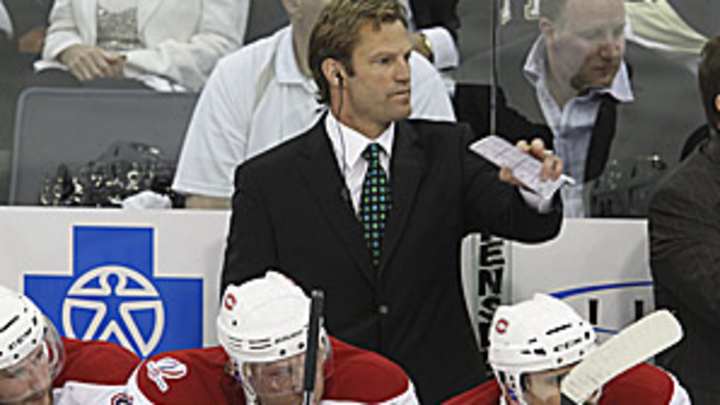
The grand old man of the NHL's Southeast Division is now Guy Boucher, who is all of 40. The comparatively grizzled X-and-O maven of the Tampa Bay Lightning has been behind the bench for all of one season and a quarter, which makes him the longest-tenured coach in this wacky division. Gee, 100-plus games. Or as they say in the frenetic Southeast, from here to eternity.
With Paul Maurice being fired a second time in Carolina and Bruce Boudreau losing the inevitable war in Washington all in a matter of a few hours Monday morning -- Kirk Muller and Dale Hunter will get their first NHL head coaching jobs in their stead respectively -- let's update what else is going on the Southeast:
Florida. Newcomer Kevin Dineen is doing a notable job with the Panthers, taking all the stuff that GM Dale Tallon threw at the wall during the summer and seemingly making it stick.
Winnipeg. Claude Noel, rookie coach of the erstwhile Atlanta Thrashers, has not overwhelmed in his short time, a performance that is not much different than his previous stint as interim head coach in Columbus, when his team won 10 of 24 games. This is, however, Winnipeg. The fans are so delirious about getting an NHL team back that Rin Tin Tin could be coaching it and they wouldn't care. Until All-Star break, anyway.
While Lindy Ruff in Buffalo and Barry Trotz in Nashville soldier on into their third decades with their teams -- both started in the late 1990s -- the Southeast keeps turning things over like Curtis Painter's Indianapolis Colts.
Muller had just started his first pro head-coaching job, stacked up behind Trotz with Nashville's minor league affiliate in Milwaukee. (Muller also coached Queen's University in his hometown of Kingston, Ont. While some NHL coaches have had Canadian university experience -- Mike Keenan, Mike Babcock and Dave King among them -- bucolic Queen's is hardly a cradle of coaches.)
Nashville never has been an organization impressed by so-called brand names. Indeed two weeks ago, a high-level Predators official noted that Muller was the first "star" the franchise had ever hired although the definition of "star" can be elastic. Muller was the second pick in the 1984 NHL entry draft behind Mario Lemieux, and while he had a noteworthy career that included a Stanley Cup in Montreal, he didn't score 400 goals and never managed 95 points in a season. While in Montreal, he was dubbed "Kirk is Work" -- indefatigability seemed to be his defining trait rather than innate talent.
While obviously perceptive about the game and life, Muller at the time did not exactly strike anyone as stellar NHL head coaching material.
Even after the Canadiens hired him as an assistant following his season at Queen's, the assumption was that he had been added as a sop to keep his old friend, neophyte coach Guy Carbonneau, company. Muller lasted five years. More impressively, he stayed after Bob Gainey, then GM, fired Carbonneau and hired Jacques Martin, who had no previous ties with Muller. Muller worked with special teams and wound up receiving effusive, maybe excessive, praise when the Canadiens shockingly reached the 2010 conference final after seven-game upsets of Washington and Pittsburgh.
There was rampant speculation that the media fawning over Muller created a rift between him and Martin although the Canadiens, now run by the hush-hush Pierre Gauthier, never air their laundry. This much was obvious: Muller would never be the head coach in Montreal.
Some jobs have glass or pink ceilings. In Montreal, there is a Berlitz Wall.
Unless a coach speaks French -- and Muller doesn't -- he has no shot under the current paradigm. If the Canadiens thought Muller's ties to the city and the team were enough to overcome that linguistic hurdle, they could have sent him to AHL Hamilton to replace Boucher and learn about running a team. They didn't. Meanwhile, Muller understood the cul de sac in Montreal.
New Jersey offered Muller a job as associate head coach under John MacLean, another old friend, but he stood firm even as he realized he needed a career alternative. Although he had a few interviews last summer, nothing panned out. He took the Milwaukee job as a steppingstone, one that proved a springboard when Eric Staal's game fell off the face of the earth and brought almost everything and everyone in Carolina, including Maurice, crashing down with it.
Meanwhile, Dale Hunter had been running a bench for 10 years. And he had one advantage most coaches on any level didn't have: he owned the damn team. Hunter is co-owner of the junior London Knights, a perennial Ontario Hockey League power, which has guaranteed a certain level of, uh, attentiveness from his players. Now by sheer force of his considerable personality -- and you can insert your own Dale Hunter/Chuck Norris joke here -- he will try to do the same with the Capitals.
It's safe to assume Alex Ovechkin, Washington's captain, will never refer to Hunter as a "fat f..."
Creditably, general manager George McPhee was loyal to Boudreau, whom he stuck by even during the 24/7 losing streak that made his coach look, at times, all too human. He always has considered Boudreau a good coach. The GM remembered the liberating effect of the breathing room Boudreau gave his players when McPhee plucked him out of the AHL in late November 2007.
HACKEL:Boudreau pays for Caps' failure to adjust
But eventually fresh air can grow as stale as, yawn, Ovechkin's signature cut-to-the-middle move. As soon as Ovechkin signed his 13-year contract extension in January 2008, the left-winger had the hammer. Boudreau had to find a way to make it work when Ovechkin's enthusiasm began to fade and his attention to detail vanished. Boudreau tried, including the last minute benching that prompted Ovechkin's Jenny Craig observation.
But even with the "C" on his sweater, Ovechkin seemed to have his own agenda, which didn't include backchecking. (See that 5-1 loss in Buffalo last Saturday.) So now McPhee starts over with a no-nonsense coach, which should at least provide a dead-cat bounce to a team that showed its talent when it stormed through October. Like Boudreau in his salad days in Washington -- and we use the term in its figurative sense -- a different voice behind the bench might have a salubrious longer-term effect.
And Guy Boucher, you are now on the clock.

Along with the pages of Sports Illustrated, you'll find senior writer Michael Farber in the Hockey Hall of Fame. Farber joined the staff of Sports Illustrated in January 1994 and now stands as one of the magazine's top journalists, covering primarily ice hockey and Olympic sports. He is also a regular contributor to SI.com. In 2003 Farber was honored with the Elmer Ferguson Award from the Hockey Hall of Fame for distinguished hockey writing. "Michael Farber represents the best in our business," said the New York Post's Larry Brooks, past president of the Professional Hockey Writers' Association. "He is a witty and stylish writer, who has the ability to tell a story with charm and intelligence." Farber says his Feb. 2, 1998 piece on the use and abuse of Sudafed among NHL players was his most memorable story for SI. He also cites a feature on the personal problems of Kevin Stevens, Life of the Party. His most memorable sports moment as a journalist came in 1988 when Canadian Ben Johnson set his controversial world record by running the 100 meters in 9.79 seconds at the Summer Olympic Games, in Seoul. Before coming to Sports Illustrated, Farber spent 15 years as an award-winning sports columnist and writer for the Montreal Gazette, three years at the Bergen Record, and one year at the Sun Bulletin in Binghamton, NY. He has won many honors for his writing, including the "outstanding sports writing award" in 2007 from Sports Media Canada, and the Prix Jacques-Beauchamp (Quebec sportswriter of the year) in 1993. While at the Gazette, he won a National Newspaper award in 1982 and 1990. Sometimes Life Gets in the Way, a compendium of his best Gazette columns, was published during his time in newspapers. Farber says hockey is his favorite sport to cover. "The most down-to-earth athletes play the most demanding game," he says. Away from Sports Illustrated, Farber is a commentator for CJAD-AM in Montreal and a panelist on TSN's The Reporters (the Canadian equivalent of ESPN's The Sports Reporters in the United States, except more dignified). Farber is also one of the 18 members on the Hockey Hall of Fame selection committee. Born and raised in New Jersey, Farber is a 1973 graduate of Rutgers University where he was Phi Beta Kappa. He now resides in Montreal with his wife, Danielle Tétrault, son Jérémy and daughter Gabrielle.