%20%20--%3E%0A%3Csvg%20version%3D%221.1%22%20id%3D%22Layer_1%22%20xmlns%3D%22http%3A%2F%2Fwww.w3.org%2F2000%2Fsvg%22%20xmlns%3Axlink%3D%22http%3A%2F%2Fwww.w3.org%2F1999%2Fxlink%22%20x%3D%220px%22%20y%3D%220px%22%0A%09%20width%3D%2239px%22%20height%3D%2240px%22%20viewBox%3D%220%200%2039%2040%22%20enable-background%3D%22new%200%200%2039%2040%22%20xml%3Aspace%3D%22preserve%22%3E%0A%3Cpath%20fill%3D%22%23FFFFFF%22%20d%3D%22M38.5%2C7H28.2v26h10.3V7z%22%2F%3E%0A%3Cpath%20fill-rule%3D%22evenodd%22%20clip-rule%3D%22evenodd%22%20fill%3D%22%23FFFFFF%22%20d%3D%22M26.1%2C25.5c0%2C5.8-4.1%2C7.5-12.9%2C7.5C3.9%2C33%2C0%2C31.2%2C0%2C25.2v-1.1h11.6%0A%09v2.4c0%2C0.7%2C0.1%2C1.4%2C1.2%2C1.4c1%2C0%2C1.2-0.4%2C1.2-1.3v-0.9c0-1.6-0.9-1.6-3.5-2.2C2.2%2C21.7%2C0%2C19.7%2C0%2C15.3v-0.9C0%2C9.3%2C5.5%2C7%2C12.9%2C7%0A%09c10.2%2C0%2C12.8%2C2.6%2C12.8%2C7.4v1.8h-11v-2.9c0-0.6-0.4-1.1-1.2-1.1c-0.6%2C0-1.2%2C0.4-1.2%2C1.1v0.9c0%2C1.5%2C0.9%2C2%2C3.3%2C2.5%0A%09c8%2C1.6%2C10.5%2C3.3%2C10.5%2C7.5V25.5z%22%2F%3E%0A%3C%2Fsvg%3E%0A)
Posthumous honors like Santo's are the ultimate mixed blessing
When George Harrison was posthumously inducted into the Hollywood Bowl Hall of Fame in 2002, his friend Eric Idle said: "I bet he won't show up."
Idle was right, so he spoke on Harrison's behalf at the ceremony, where the former Python said of the former Beatle: "I can hear his voice saying, 'Oh very nice, very useful, a posthumous award. Where am I supposed to put it?' "
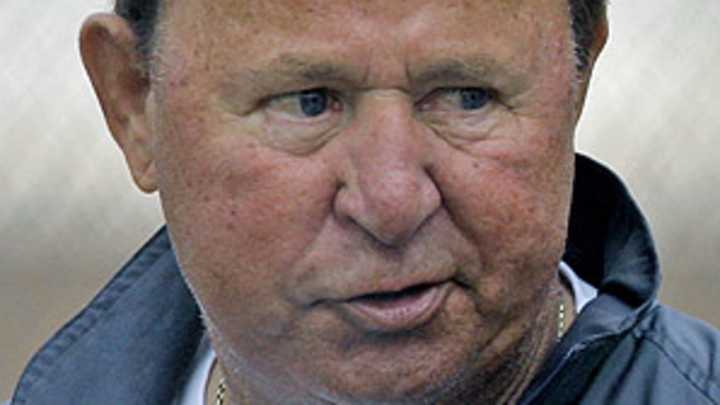
That's no doubt what the late Ron Santo said on Monday, having been voted into the Baseball Hall of Fame one year and two days after he died, in what is the epitome of a mixed blessing. The Cubs' third baseman-turned-broadcaster had repeatedly said that if he didn't go in alive, he didn't care to go in at all.
Some people feel that way about heaven, never mind the Hall of Fame. It's an almost universal human response. No one should have to die to join the immortals. "I want my flowers while I'm alive," is how Chubby Checker -- serially snubbed by the Rock and Roll Hall of Fame -- put it. "I can't smell them when I'm dead."
They're nice for one's family, and for the historical record, and they do alleviate the pressure of speechwriting. But posthumous honors have few other benefits for the honoree, which is why almost nobody wants them. Santo wasn't even the first Cubs' broadcaster to say that he wouldn't attend if invited postmortem. "If they wait until I'm dead, I hope they don't name me," Harry Caray said of the Hall. He told his son Skip: "If I get elected after I'm dead, don't accept it." Harry, mercifully, lived to see the honor -- he was 75 at the time -- but others who didn't also forbade their families to attend.
Leo Durocher spent 40 years in the big leagues, retiring as the sixth winningest manager of all time, then waited for a call that never came. "I've told my family I don't want to be voted in after I'm dead," he said. "If they don't want me now, I don't care." Durocher died in 1991, aged 86, having yet to make the Hall. He may well have assumed it would never happen, given his unpopularity among some members of the veterans' committee.
For many years, Durocher was closer to induction into the Black Athletes' Hall of Fame -- he was nominated in 1974, for his contributions to the careers of Willie Mays and Roy Campanella, among others -- than to the Baseball Hall of Fame. He wasn't voted into Cooperstown until he was dead for three years -- which seems an excess of caution by the veterans' committee, don't you think? His son Chris did accept on his behalf, but said, tearfully, of his father that day: "His last years were spent hoping he would get a call from the Hall of Fame." That he didn't get it still seems like an unnecessary cruelty.
Tony Oliva, another baseball near-legend, has spent the last 35 years since retiring from the Twins living out the Jimmy Buffett song, If the Phone Doesn't Ring, It's Me. In 2005, he told the St. Paul Pioneer Press: "You don't want to go to the Hall of Fame when you're dead. I told my wife, 'If I get into the Hall of Fame when I'm dead, don't go.' "
"This is the big drag about posthumous awards," Eric Idle said. "There's no one to give 'em to."
Because Halls of Fame are themselves a kind of death -- for athletes, induction means their career is over -- a few stars actually prefer to go in as a ghost. "I was hoping this day would be 20 more years, or [that I'd] actually go in when I'm dead and gone," Michael Jordan said of his 2009 induction into the Basketball Hall of Fame, where he was very much alive. (It was his speech that died.)
As in the rest of his career, Jordan was a rare exception. Joe Paterno spoke for most when he said in 2008, of enshrinement in the College Football Hall of Fame: "If I had my choice, I'd rather do it now than when I'm dead."
Still, if there is an upside to posthumous induction, it is this. Receiving an award in the afterlife sure beats losing one. Spencer Tracy and James Dean both were nominated for Oscars after their deaths -- and both lost.
It comes as welcome news, then, that the U.S. Postal Service next month will drop its prohibition against honoring living people on postage stamps. Until now, you had to be certifiably deceased to be licked and affixed to a letter in the U.S. But in September, the USPS asked Americans to nominate five living people who deserve to receive this stamp of approval.
That leaves one remaining honor that requires its recipient to be deceased. The Catholic church still insists that all candidates die before becoming a saint. Or, as it's called in Spanish: Santo.
 Add us as a preferred source on Google
Special Contributor, Sports Illustrated Steve Rushin was born in Elmhurst, Ill. on September 22, 1966 and raised in Bloomington, Minn. After graduating from Bloomington Kennedy High School in 1984 and Marquette University in 1988, Rushin joined the staff of Sports Illustrated. He is a Special Contributor to the magazine, for which he writes columns and features. In 25 years at SI, he has filed stories from Greenland, India, Indonesia, Antarctica, the Arctic Circle and other farflung locales, as well as the usual locales to which sportswriters are routinely posted. His first novel, The Pint Man, was published by Doubleday in 2010. The Los Angeles Times called the book "Engaging, clever and often wipe-your-eyes funny." His next book, a work of nonfiction, The 34-Ton Bat, will be published by Little, Brown in 2013. Rushin gave the commencement address at Marquette in 2007 and was awarded an honorary Doctor of Letters for "his unique gift of documenting the human condition through his writing." In 2006 he was named the National Sportswriter of the Year by the National Sportswriters and Sportscasters Association. A collection of his sports and travel writing—The Caddie Was a Reindeer—was published by Grove Atlantic in 2005 and was a semifinalist for the Thurber Prize for American Humor. The Denver Post suggested, "If you don't end up dropping The Caddie Was a Reindeerduring fits of uncontrollable merriment, it is likely you need immediate medical attention." A four-time finalist for the National Magazine Award, Rushin has had his work anthologized in The Best American Sports Writing, The Best American Travel Writing and The Best American Magazine Writing collections. His essays have appeared in Time magazine andThe New York Times. He also writes a weekly column for SI.com. His first book, Road Swing, published in 1998, was named one of the "Best Books of the Year" by Publishers Weekly and one of the "Top 100 Sports Books of All Time" by SI. He and his wife, Rebecca Lobo, have four children and live in Connecticut.