%20%20--%3E%0A%3Csvg%20version%3D%221.1%22%20id%3D%22Layer_1%22%20xmlns%3D%22http%3A%2F%2Fwww.w3.org%2F2000%2Fsvg%22%20xmlns%3Axlink%3D%22http%3A%2F%2Fwww.w3.org%2F1999%2Fxlink%22%20x%3D%220px%22%20y%3D%220px%22%0A%09%20width%3D%2239px%22%20height%3D%2240px%22%20viewBox%3D%220%200%2039%2040%22%20enable-background%3D%22new%200%200%2039%2040%22%20xml%3Aspace%3D%22preserve%22%3E%0A%3Cpath%20fill%3D%22%23FFFFFF%22%20d%3D%22M38.5%2C7H28.2v26h10.3V7z%22%2F%3E%0A%3Cpath%20fill-rule%3D%22evenodd%22%20clip-rule%3D%22evenodd%22%20fill%3D%22%23FFFFFF%22%20d%3D%22M26.1%2C25.5c0%2C5.8-4.1%2C7.5-12.9%2C7.5C3.9%2C33%2C0%2C31.2%2C0%2C25.2v-1.1h11.6%0A%09v2.4c0%2C0.7%2C0.1%2C1.4%2C1.2%2C1.4c1%2C0%2C1.2-0.4%2C1.2-1.3v-0.9c0-1.6-0.9-1.6-3.5-2.2C2.2%2C21.7%2C0%2C19.7%2C0%2C15.3v-0.9C0%2C9.3%2C5.5%2C7%2C12.9%2C7%0A%09c10.2%2C0%2C12.8%2C2.6%2C12.8%2C7.4v1.8h-11v-2.9c0-0.6-0.4-1.1-1.2-1.1c-0.6%2C0-1.2%2C0.4-1.2%2C1.1v0.9c0%2C1.5%2C0.9%2C2%2C3.3%2C2.5%0A%09c8%2C1.6%2C10.5%2C3.3%2C10.5%2C7.5V25.5z%22%2F%3E%0A%3C%2Fsvg%3E%0A)
NFL kickers are better than ever, but accuracy makes a game boring

This column is also award-winning writer Frank Deford's weekly sports commentary on NPR.
Of all the strained sports cliches, my favorite was "educated toe." Remember? An accomplished field goal kicker possessed an educated toe. I had a newspaper friend who wrote that a punter had an "intellectual instep," but the copy desk wouldn't allow it. Spoil sports.
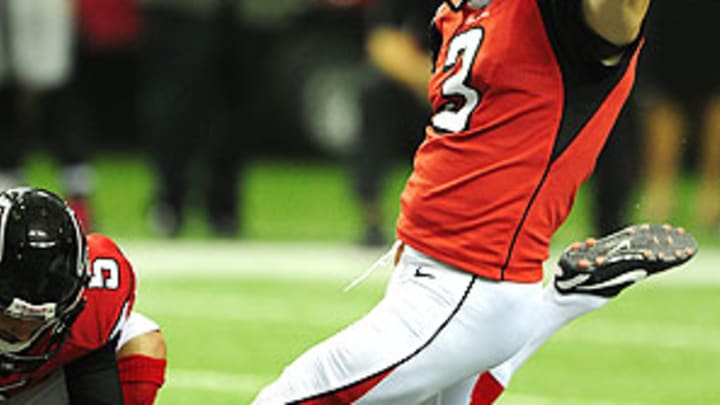
However, toes -- those both educated and illiterate -- have been replaced on the gridiron by soccer-style kickers, who boot the pigskin side-footed. When these guys first started coming into the NFL they were often as not little foreigners, and Alex Karras of the Detroit Lions, who died last week, used to mimic them, calling out in falsetto, "I keeck a touchdown! I keeck a touchdown." Today, though, kickers tend to be good-sized Americans who are more proficient than ever... and so, for that matter, also are the punters.
So far this year, NFL field goal kickers have made 88 percent of their attempts. They've even made two-thirds of their tries from more than 50 yards. That's ridiculous. In any sport, if you have that level of success the game is out of whack. Plus, it's boring. With kicking, football is turning into professional bowling, where most every ball is a strike. And don't get me started on extra points.
I also think the fact that kickers -- placement and punters alike -- are so good that it hurts the game in another way. It encourages football coaches, who are already such cowardly lions, to play even safer. Don't dare go for a first down when it's fourth and short. Bring in the kicker!
Football coaches have more power to affect a game than those in other sports. A baseball manager can change pitchers or put in a pinch hitter. A basketball coach can call time out and set up a play, a hockey coach can pull the goalie. Yes, these coaches in other sports can change strategy, but only football coaches can actually control what's going to happen: keep the ball, go for three points or give it up.
And, as we know only too well, football coaches tend to be scaredy-cats. Fourth and one, everyone is screaming, "go for it," and they send in the kicker. Right? But hey, a coach knows that if he takes a chance and fails, he's going to take heat. If he kicks, he's essentially kicking the can down the road.
Starting several years ago with the work of David Romer, a distinguished economics professor, it's been statistically confirmed that if coaches did go for it more often in short-yardage situations, they'd be more successful over the long haul. But even though the game is more wide-open now, football coaches still use buttoned-down, old-fashioned tactics in those situations. And the fact that the kickers are so much more proficient makes coaches even more prone to turn it over to the highly educated feet on their team.
Come on out there, don't keeck a field goal. Lemme hear it: Go for it!

Frank Deford is among the most versatile of American writers. His work has appeared in virtually every medium, including print, where he has written eloquently for Sports Illustrated since 1962. Deford is currently the magazine's Senior Contributing Writer and contributes a weekly column to SI.com. Deford can be heard as a commentator each week on Morning Edition. On television he is a regular correspondent on the HBO show Real Sports With Bryant Gumbel. He is the author of 15 books, and his latest,The Enitled, a novel about celebrity, sex and baseball, was published in 2007 to exceptional reviews. He and Red Smith are the only writers with multiple features in The Best American Sports Writing of the Century. Editor David Halberstam selected Deford's 1981 Sports Illustrated profile on Bobby Knight (The Rabbit Hunter) and his 1985 SI profile of boxer Billy Conn (The Boxer and the Blonde) for that prestigious anthology. For Deford the comparison is meaningful. "Red Smith was the finest columnist, and I mean not just sports columnist," Deford told Powell's Books in 2007. "I've always said that Red is like Vermeer, with those tiny, priceless pieces. Five hundred words, perfectly chosen, crafted. Best literary columnist, in any newspaper, that I've ever seen." Deford was elected to the National Association of Sportscasters and Sportswriters Hall of Fame. Six times at Sports Illustrated Deford was voted by his peers as U.S. Sportswriter of The Year. The American Journalism Review has likewise cited him as the nation's finest sportswriter, and twice he was voted Magazine Writer of The Year by the Washington Journalism Review. Deford has also been presented with the National Magazine Award for profiles; a Christopher Award; and journalism honor awards from the University of Missouri and Northeastern University; and he has received many honorary degrees. The Sporting News has described Deford as "the most influential sports voice among members of the print media," and the magazine GQ has called him, simply, "The world's greatest sportswriter." In broadcast, Deford has won a Cable Ace award, an Emmy and a George Foster Peabody Award for his television work. In 2005 ESPN presented a television biography of Deford's life and work, You Write Better Than You Play. Deford has spoken at well over a hundred colleges, as well as at forums, conventions and on cruise ships around the world. He served as the editor-in-chief of The National Sports Daily in its brief but celebrated existence. Deford also wrote Sports Illustrated's first Point After column, in 1986. Two of Deford's books, the novel, Everybody's All-American, and Alex: The Life Of A Child, his memoir about his daughter who died of cystic fibrosis, have been made into movies. Two of his original screenplays have also been filmed. For 16 years Deford served as national chairman of the Cystic Fibrosis Foundation, and he remains chairman emeritus. He resides in Westport, CT, with his wife, Carol. They have two grown children – a son, Christian, and a daughter, Scarlet. A native of Baltimore, Deford is a graduate of Princeton University, where he has taught American Studies.