%20%20--%3E%0A%3Csvg%20version%3D%221.1%22%20id%3D%22Layer_1%22%20xmlns%3D%22http%3A%2F%2Fwww.w3.org%2F2000%2Fsvg%22%20xmlns%3Axlink%3D%22http%3A%2F%2Fwww.w3.org%2F1999%2Fxlink%22%20x%3D%220px%22%20y%3D%220px%22%0A%09%20width%3D%2239px%22%20height%3D%2240px%22%20viewBox%3D%220%200%2039%2040%22%20enable-background%3D%22new%200%200%2039%2040%22%20xml%3Aspace%3D%22preserve%22%3E%0A%3Cpath%20fill%3D%22%23FFFFFF%22%20d%3D%22M38.5%2C7H28.2v26h10.3V7z%22%2F%3E%0A%3Cpath%20fill-rule%3D%22evenodd%22%20clip-rule%3D%22evenodd%22%20fill%3D%22%23FFFFFF%22%20d%3D%22M26.1%2C25.5c0%2C5.8-4.1%2C7.5-12.9%2C7.5C3.9%2C33%2C0%2C31.2%2C0%2C25.2v-1.1h11.6%0A%09v2.4c0%2C0.7%2C0.1%2C1.4%2C1.2%2C1.4c1%2C0%2C1.2-0.4%2C1.2-1.3v-0.9c0-1.6-0.9-1.6-3.5-2.2C2.2%2C21.7%2C0%2C19.7%2C0%2C15.3v-0.9C0%2C9.3%2C5.5%2C7%2C12.9%2C7%0A%09c10.2%2C0%2C12.8%2C2.6%2C12.8%2C7.4v1.8h-11v-2.9c0-0.6-0.4-1.1-1.2-1.1c-0.6%2C0-1.2%2C0.4-1.2%2C1.1v0.9c0%2C1.5%2C0.9%2C2%2C3.3%2C2.5%0A%09c8%2C1.6%2C10.5%2C3.3%2C10.5%2C7.5V25.5z%22%2F%3E%0A%3C%2Fsvg%3E%0A)
Are the Lakers Really Better Without LeBron James? Here’s What the Numbers Say
In this story:
The Lakers won their third straight game on Tuesday night, riding a dominant second half to take down the visiting Timberwolves, 120–106. Luka Dončić and Austin Reaves combined for 62 points and the Los Angeles defense, so often a sore spot this year, forced Anthony Edwards into his worst game of the season. It was a very good win for the purple and gold given their slow slide down the Western Conference standings over the last few months.
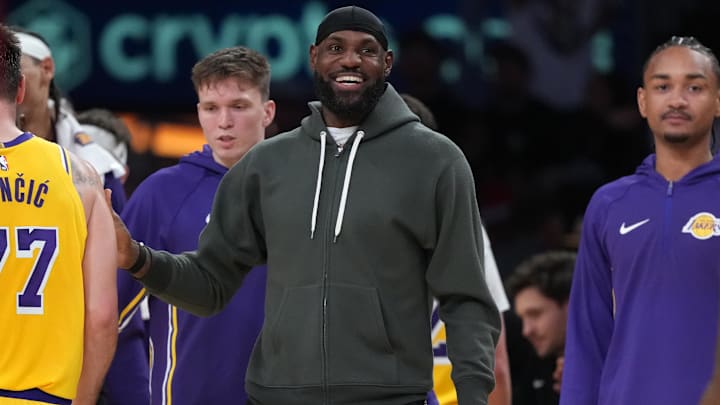
It also represented the continuation of a curious trend that has developed over the course of the season: the Lakers have found success with LeBron James sidelined.
James missed last night’s game with left foot arthritis and a right hip contusion. It was his third consecutive absence and 21st of the season overall. While James hasn’t often missed games throughout his career it’s always been true that his team is worse without him. Last year the Lakers went 6–6 without James in the lineup and finished the season 50–32. The year prior, L.A. went 5–5 without The King with a final record of 47–35. Every iteration of a James-led team is different but clearly his team has always been worse without him in the lineup, whether it’s been in Los Angeles, Cleveland or Miami.
Yet that trend is reversing this year. Tuesday night’s victory brought the Lakers to three straight wins and an overall record of 14–7 without The King. That may not seem particularly surprising on the surface given James is 41 years old and, for the first time ever, not the best player on his own team; that honor belongs to Dončić on these Lakers. Furthermore his skills have undeniably faded on both ends of the court, and the roster around him is more built around Dončić’s play style.
But this is LeBron James we’re talking about. He is one of the most prolific winners in basketball history, ranking second in games won and first in playoff wins all-time. Even with a 21-game sample size that has the Lakers winning at a 66% clip, is his team really better off without him?
The win-loss record says yes. Let’s see what the other numbers say.
Lakers' stats without LeBron James this season
All NBA stats are shaky as pieces of evidence on their own given how much context is required to fully understand a single player’s impact on the court. But they can be used collectively to give a decent understanding of what’s happening on the court when James is out there versus when he is not, a nice pairing to the standard eye test.
The Lakers are 14–7 with James sidelined this season and 36–18 with him in the lineup. In the 21 games without him they average 109 points scored per game, well below their season average of 115 ppg. They also gave up an average of 114 points per game, which is right in line with the season average. In the advanced stat category, the L.A. offense scores 2.65 more points per 100 possessions without James on the floor, per PBP stats. More broadly the Lakers boast a net rating of 2.36 per 100 possessions in James’s 1,664 minutes on the sideline. In his 1,456 minutes played, the net rating drops to -0.23 per 100 possessions. The Lakers’ most-used lineup featuring James has a plus/minus of -25 in 226 minutes so far.
Those numbers broadly suggest the team is worse off with James involved. However, those are narrow margins—narrow enough that one could make the case the Lakers are better off in ways stats can’t describe when one of the greatest players ever is wearing their uniform. And that is a pretty fair case, honestly; even if James’s physical skills have diminished he still thinks faster than everybody else and can see things his teammates do not necessarily see.
But the real issue lies in what happens when he shares the court with his co-stars. In the 855 minutes that have featured both James and Dončić this season the Lakers have been outscored by 47 points. In the 316 minutes James, Dončić and Reaves have all shared the floor they’ve been outscored by two points and own a net rating of 0.04 per 100 possessions. Conversely, with only Dončić and Reaves on the floor, Los Angeles boasts a net rating of 12.16 per 100 possessions. Interestingly, these stats also suggest James is still entirely capable of running the show on his own; in 386 minutes riding solo without either of his star teammates the superstar forward owns a net rating of 7.46 per 100 possessions.
Those are a lot of numbers to throw around and evaluating them on a per-100 possessions basis doesn’t make it the clearest picture. But it paints a conclusion in broad strokes—that James struggles to click with Dončić and Reaves, which leaves the Lakers worse off. The fact that Dončić and Reaves dominate when they’re sharing the floor together makes the contrast all the more stark.
What JJ Redick thinks of the Lakers’ success without James
Redick would obviously never say his team is better off without James. But he did give a pretty in-depth answer when asked why the Lakers have more success with Dončić and Reaves sans James.
“I think when all three of those guys are on the court specifically, again, it goes back to the human element,” Redick said to media, via Daniel Starkland of Lakers Nation. “It's what they're comfortable doing as basketball players, which, for all three of those guys, one of those guys having scored the most points in NBA history and doing it for 23 years, is to have the ball in his hands ... I think losing a training camp and losing the start of the year and then kind of losing [Reaves] then for a long stretch, I think we're starting to get it. But there's a clear pecking order when Luka and AR are on the floor together with guys that are low-usage players. That's just the nature of it. And that's the nature of nearly every big three that's ever existed. We're gonna get there. And I think we've seen some positive signs, and I know LeBron, he recognizes the importance of having Luka as the engine. All he really wants is to impact winning.”
His comments generally align with the eye test. Without James the order of operations is cleaner. Dončić owns the court when he’s out there and Reaves takes over in his stead. But when James comes into the mix it’s not quite as obvious whether he or Reaves is the de facto No. 2 and there’s uncertainty about how best to play the No. 3 role. This could have been fixed early on if James was able to participate in training camp and the early days of the season but at this point Los Angeles is full steam ahead to the playoffs. There’s no time to figure things out. The players just go out there and play, leading to some clunky outings with James in the lineup.
The numbers show the Lakers are better without James
In most sports (but especially the NBA) the truth can be found somewhere between what the stats say and what the eye test says. Thus, in regards to this situation, it is impossible to deny the Lakers are better off without James. The offensive flows smoother with an established pecking order and he is usually replaced by a better defender, which boosts L.A.’s numbers on that end.
It really boils down to this: at this stage in his career, James is still an excellent passer but devolved into merely a good scorer, average rebounder, and poor defender. That kind of player can definitely bring a lot of value to the table, especially when it is accompanied by the amazing basketball IQ James boasts. But on a Lakers roster with not just one but two genuinely great scorers who also struggle defensively, it’s just a bad fit. The trio of Los Angeles stars don’t have complementary skillsets; they largely overlap. Maybe that wouldn’t be as big of a problem with elite role players surrounding them but the Lakers’ roster doesn’t have any of those.
Now, this could end up an Old Take Exposed when the playoffs come around. There are 15 or so games left for James, Dončić and Reaves to figure things out alongside Redick. Moreover the postseason gauntlet transforms the game so completely that James’s gravity and many years of experience could prove more beneficial than it has over the course of 65 regular season games.
But for now, James’s presence interrupts the Lakers’ ecosystem as it stands, and it’s hurting the team. Los Angeles is running out of time to figure it out.
More NBA on Sports Illustrated
Listen to SI’s NBA podcast, Open Floor, below or on Apple and Spotify. Watch the show on SI’s YouTube channel.
 Add us as a preferred source on Google
Liam McKeone is a senior news writer for the NBA team at Sports Illustrated. He has been in the industry covering the NBA and other sports as a content creator starting in 2017. Prior to joining SI, McKeone worked for NBC Sports Boston and The Big Lead. In addition to his work as a writer, he has hosted the Press Pass Podcast covering sports media and The Big Stream covering pop culture. A graduate of Fordham University, he is always up for a good debate and enjoys loudly arguing about sports, rap music, books and video games. McKeone has been a member of the National Sports Media Association since 2020.
Follow liam_mckeone