%20%20--%3E%0A%3Csvg%20version%3D%221.1%22%20id%3D%22Layer_1%22%20xmlns%3D%22http%3A%2F%2Fwww.w3.org%2F2000%2Fsvg%22%20xmlns%3Axlink%3D%22http%3A%2F%2Fwww.w3.org%2F1999%2Fxlink%22%20x%3D%220px%22%20y%3D%220px%22%0A%09%20width%3D%2239px%22%20height%3D%2240px%22%20viewBox%3D%220%200%2039%2040%22%20enable-background%3D%22new%200%200%2039%2040%22%20xml%3Aspace%3D%22preserve%22%3E%0A%3Cpath%20fill%3D%22%23FFFFFF%22%20d%3D%22M38.5%2C7H28.2v26h10.3V7z%22%2F%3E%0A%3Cpath%20fill-rule%3D%22evenodd%22%20clip-rule%3D%22evenodd%22%20fill%3D%22%23FFFFFF%22%20d%3D%22M26.1%2C25.5c0%2C5.8-4.1%2C7.5-12.9%2C7.5C3.9%2C33%2C0%2C31.2%2C0%2C25.2v-1.1h11.6%0A%09v2.4c0%2C0.7%2C0.1%2C1.4%2C1.2%2C1.4c1%2C0%2C1.2-0.4%2C1.2-1.3v-0.9c0-1.6-0.9-1.6-3.5-2.2C2.2%2C21.7%2C0%2C19.7%2C0%2C15.3v-0.9C0%2C9.3%2C5.5%2C7%2C12.9%2C7%0A%09c10.2%2C0%2C12.8%2C2.6%2C12.8%2C7.4v1.8h-11v-2.9c0-0.6-0.4-1.1-1.2-1.1c-0.6%2C0-1.2%2C0.4-1.2%2C1.1v0.9c0%2C1.5%2C0.9%2C2%2C3.3%2C2.5%0A%09c8%2C1.6%2C10.5%2C3.3%2C10.5%2C7.5V25.5z%22%2F%3E%0A%3C%2Fsvg%3E%0A)
2026 NFL Franchise Tag Explainer: Details, Contract Amounts and Potential Targets
In this story:
The games are over. It’s time for the player movement.
NFL free agency doesn’t begin until March 9, but the action heats up well before then. With Super Bowl LX in the rearview mirror, teams can begin re-signing or extending their own players. They can also release veterans in an effort to become cap compliant when the new league year begins on March 11.
However, there’s also the franchise tag window, something we should see used by a decent number of teams this year. Teams can begin tagging players with either a transition or franchise designation (explained below) starting Feb. 17 and finishing March 3.
Finally, free agency begins on March 11 at 4 p.m. ET. However, the legal tampering period arrives on March 9 at 12 p.m. ET.
Last winter, the only two players who received the franchise tag were Bengals receiver Tee Higgins and Chiefs guard Trey Smith. Both eventually got long-term contracts. This year, however, there’s a bevy of potential tag options across the league.
Franchise tag details
The franchise tag is more common than the transition tag, but here’s how each one works:
Transition tag: If applied to a player, he gets the higher figure between either 120% of his previous salary or the average of the top 10 cap hits at his position over the previous five years. The player can negotiate with other teams during free agency and if he receives an offer sheet, his current team can match. If the team doesn’t match, the player leaves for the contract offered and the original team doesn’t get compensation.
Franchise tag: There are the exclusive and nonexclusive franchise tag options. On the exclusive tag, a player can’t negotiate with other teams. However, they also get paid more, either the average of the top five cap hits from the 2025 campaign at the player’s position or 120% of their previous salary. The nonexclusive tag permits a player to negotiate with every other team. If the player signs an offer sheet, his original team can match and retain him on that deal. If that team elects not to match, it receives two first-round picks from the acquiring team. Furthermore, the nonexclusive tag pays the player the average of the top five cap hits over the past five seasons at the player’s position or 120% of their prior salary, whichever is more lucrative.
Below are the projected franchise tag values for 2026:
Quarterback: $47.321 million
Running back: $14.536 million
Wide receiver: $28.824 million
Tight End: $16.319 million
Offensive line: $27.924 million
Defensive end: $27.322 million
Defensive tackle: $26.311 million
Linebacker: $28.197 million
Cornerback: $21.414 million
Safety: $20.876 million
Kicker/punter: $6.9 million
Potential franchise tag targets for 2026
As for the top candidates to be tagged by their respective teams, let’s take a look …
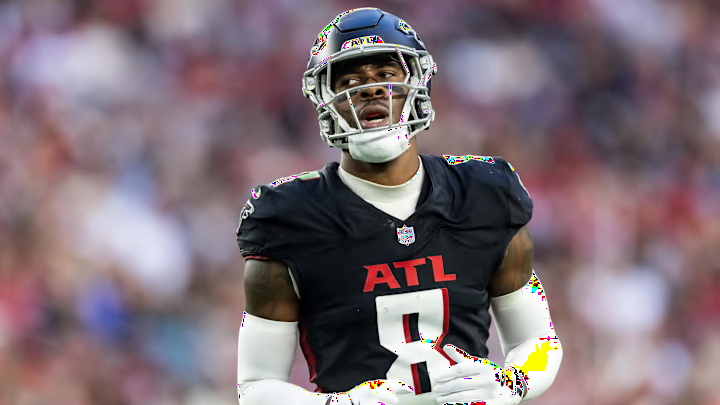
Atlanta Falcons: Kyle Pitts, TE
Going into the final season on his rookie deal, Pitts seemed like he was headed to free agency after a trio of underwhelming campaigns in which he totaled 1,625 yards and nine touchdowns. But in 2025, Pitts began to cash in on the promise which made him the No. 4 pick for Atlanta in ’21.
Earning second-team All-Pro honors, Pitts caught 88 passes for 928 yards and five touchdowns, making him an integral part of the offense alongside star receiver Drake London and All-Pro running back Bijan Robinson. With new coach Kevin Stefanski coming into the fold, the Falcons might see Pitts, only 25 years old, as part of their long-term future.

Baltimore Ravens: Tyler Linderbaum, C
The Ravens declined Linderbaum’s fifth-year option last offseason, largely because the rookie contracts don’t distinguish between centers, guard and tackles. So instead of taking the large financial hit, Baltimore made a bet it could retain Linderbaum without the future security.
After another excellent year in which Linderbaum earned Pro Bowl honors, he’s set to be the best offensive linemen to hit free agency. If Baltimore can’t strike a deal before the franchise tag deadline on March 3, expect the Ravens to place the tag on their star center.
Dallas Cowboys: George Pickens, WR
A year ago, the Cowboys traded a third-round selection for Pickens and chose not to extend the mercurial talent, instead allowing the final year of his contract to play out. Pickens made the most of the opportunity to establish his market value, catching 93 passes for 1,429 yards and nine touchdowns.
Arguably the top free agent on the board, Pickens will have a slew of suitors waiting for him. Of course, the Cowboys can make sure that doesn’t happen by giving the second-team All-Pro the franchise tag, but Dallas needs to trim some money as it’s currently slated to be $39.4 million above the projected cap threshold.
Green Bay Packers: Rasheed Walker, OT
The Packers might let Walker go to free agency, considering they have already invested significantly on the line in Zach Tom and Aaron Banks. That duo is signed on contracts worth a combined $165 million, while Elgton Jenkins is also due $24.3 million against the cap in 2026 if he’s not released or extended.
Walker, 25, is arguably the best tackle on the market and could easily exceed $20 million per year on his next deal. If the Packers slap the tag on him, he’ll earn $27.1 million in 2026, eating away at precious cap space for Green Bay.
Indianapolis Colts: Daniel Jones, QB
The Colts are in a brutal spot. After trading 2026 and ‘27 first-round picks to the Jets for corner Sauce Gardner, Indianapolis announced it was all in for a Super Bowl run. After the trade, the Colts won a single game before losing out to finish 8–9, while Jones tore his Achilles tendon in Week 14 against the Jaguars.
Now slated for unrestricted free agency, Indianapolis can’t allow Jones to leave even if his availability for the start of next season is unclear. Without their top draft capital, the Colts are committed to Jones, but they also might want to get another look at him. The prudent move could be to use the tag before seeing if he can build on what was the best season of his career, throwing for 3,101 yards and 19 touchdowns against eight interceptions.
New York Jets: Breece Hall, RB
The Jets have the cap space to retain Hall, but whether they will is another question. At 24 years old, Hall is coming off a career season in which he rushed for 1,065 yards on 4.4 yards per attempt, while also catching 36 passes for 350 yards with five total touchdowns.
For New York, there’s an argument to be made it should retain Hall and build the next iteration of the offense around Hall and receiver Garrett Wilson. However, there’s also the other path, which is using the $14.1 million (and potential long-term deal) somewhere else on the roster considering the Jets’ myriad needs, and taking a replacement back later in the draft.
Philadelphia Eagles: Jaelan Phillips, edge
Eagles general manager Howie Roseman was aggressive at the trade deadline, landing Phillips from the Dolphins for a third-round pick. He played well in Philadelphia, notching two sacks and seven quarterback hits across eight games.
The big question is whether Roseman wants to commit major money to Phillips, with a franchise tag and/or a long-term deal. Phillips, 26, has been hampered by serious health issues throughout his career, being limited to 12 games across 2023 and ’24 due to Achilles and knee injuries. Going into the offseason, Philadelphia is $10.5 million under the projected cap.
More NFL on Sports Illustrated
 Add us as a preferred source on Google
Matt Verderame is a national NFL staff writer for Sports Illustrated, writing features, columns and more. Before joining Sports Illustrated in March 2023, Verderame wrote for FanSided and SB Nation. He’s a proud husband to Stephanie and father of two girls, Maisy and Genevieve. In his spare time, Verderame is an avid collector of vintage baseball cards.
Follow MattVerderame