%20%20--%3E%0A%3Csvg%20version%3D%221.1%22%20id%3D%22Layer_1%22%20xmlns%3D%22http%3A%2F%2Fwww.w3.org%2F2000%2Fsvg%22%20xmlns%3Axlink%3D%22http%3A%2F%2Fwww.w3.org%2F1999%2Fxlink%22%20x%3D%220px%22%20y%3D%220px%22%0A%09%20width%3D%2239px%22%20height%3D%2240px%22%20viewBox%3D%220%200%2039%2040%22%20enable-background%3D%22new%200%200%2039%2040%22%20xml%3Aspace%3D%22preserve%22%3E%0A%3Cpath%20fill%3D%22%23FFFFFF%22%20d%3D%22M38.5%2C7H28.2v26h10.3V7z%22%2F%3E%0A%3Cpath%20fill-rule%3D%22evenodd%22%20clip-rule%3D%22evenodd%22%20fill%3D%22%23FFFFFF%22%20d%3D%22M26.1%2C25.5c0%2C5.8-4.1%2C7.5-12.9%2C7.5C3.9%2C33%2C0%2C31.2%2C0%2C25.2v-1.1h11.6%0A%09v2.4c0%2C0.7%2C0.1%2C1.4%2C1.2%2C1.4c1%2C0%2C1.2-0.4%2C1.2-1.3v-0.9c0-1.6-0.9-1.6-3.5-2.2C2.2%2C21.7%2C0%2C19.7%2C0%2C15.3v-0.9C0%2C9.3%2C5.5%2C7%2C12.9%2C7%0A%09c10.2%2C0%2C12.8%2C2.6%2C12.8%2C7.4v1.8h-11v-2.9c0-0.6-0.4-1.1-1.2-1.1c-0.6%2C0-1.2%2C0.4-1.2%2C1.1v0.9c0%2C1.5%2C0.9%2C2%2C3.3%2C2.5%0A%09c8%2C1.6%2C10.5%2C3.3%2C10.5%2C7.5V25.5z%22%2F%3E%0A%3C%2Fsvg%3E%0A)
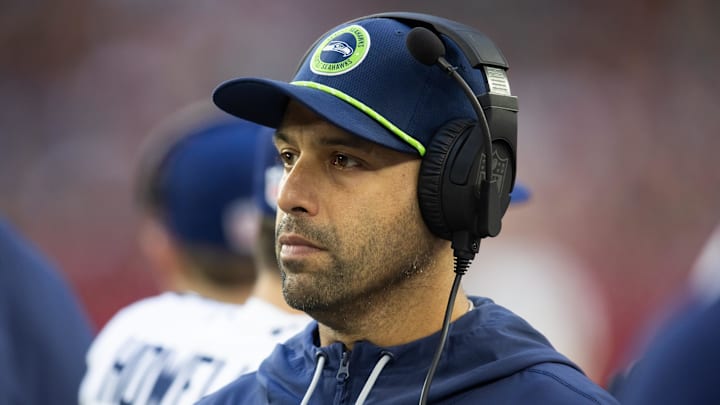
How Seahawks DC Aden Durde Became the Coach Who Could Break a Major Barrier
In this story:
SAN FRANCISCO — As nearly every Seahawks all-defense meeting comes to a close, the coach goes to dismiss the room and yells “BREAK IT UP!”
What follows, admit a number of Seahawks players, is a cacophony of poorly executed British accents repeating the phrase, attempting to match the tone of the man who just ran the presentation.
“We are very unserious,” Seahawks safety Julian Love says, smiling.
“Guys, to this day, still do it,” defensive end Leonard Williams says.
That’s because Seattle defensive coordinator Aden Durde still very much sounds like the kid who grew up in Middlesex, England, clawed his way through the British American Football League, the NFL Europe and NFL practice squads before embarking on a career of coaching, mentorship and, ultimately, a boundless love for a sport he could only see on highlight shows playing weekly on terrestrial television.
Durde worked in football development for the NFL’s international player pathway program, identified a future NFL player (Efe Obada) after just five games for the London Warriors in the BAFA National Leagues and was among the first to lay hands on Jordan Mailata when the mammoth future All-Pro, still unaware of the difference between offense and defense, landed at IMG Academy in Florida, fresh off his rugby career. Durde bounced between NFL coaching internships and fellowships, and spent five years coordinating a semipro defense in London comprised of players with day jobs, which necessitated that Durde spent his time traveling to their respective offices with note cards outlining the intricacies of the coverages he intended to run the following Sunday on their lunch breaks.
But this week, as Seattle prepares to win a Super Bowl title, Durde is much more than a curiosity. He is part architect of the league’s most vaunted defense with a critical role that, in conversations with Seahawks players and staff, crystalizes why he’s become a rising star in NFL coaching circles. After impressing in a pair of head coaching interviews this winter with the Falcons and Browns, Durde is poised to one day become the first NFL coach in modern history to be raised outside the United States, having much of his formal education and training in the sport coming outside of the American football industrial complex. He is already the first full-time British coach in NFL history.
In short, people better get used to the accent.
“He bonded with all of us. Instantly,” Seattle corner Devon Witherspoon says. “You can’t teach nothing like that. We love him.”
For those who grew up as isolated American football obsessives in the U.K., Durde’s reverse Ted Lasso is an emotional breaking down of barriers that many felt existed between a sport that presented uniquely American and its foreign fans. For those who work in the sport, it’s a harbinger of what’s to come as the global pipeline primes itself for more imports. For those who felt a sense of exclusivity around football, it’s proof that the game’s universal concepts are there for anyone, anywhere.
“People won’t understand that, but it’s all relative,” Durde says. “A lot of the things I learned coaching those teams in London, and it’s hard to explain to someone else, but I use them now. The play style is way more complicated here … but the way you play the game should be the same.”
The Seahawks finished the season with nearly 40% of their defensive snaps causing duress for the opposing quarterback, despite blitzing only 19% of the time (the sixth lowest percentage in the NFL), a reflection of chaos that begins with a defensive front that attacks offensive lines with a tactical ruthlessness.
Players credit Durde for being the CEO of this particular area, buoyed by a philosophical shift in how the unit is supposed to function. In the era of the premium pass rusher, many fronts are victim to a kind of domestique mentality, meant to maximize opportunities for elite edge rushers.
Seattle presents something of the opposite; a menu of different stunts, games and alignment variations based on an in-depth study of the opposing offensive line and its habits (how they set, what their protections are, how often and where the running back helps in protections, what other “chip” players offenses might use to help on a block and much more granular information, like why a tackle might have an angular pass stance on one snap and a more vertical stance on another). The rush angles and footwork will change based on how the offensive line reacts. It requires the unit to essentially move as one and surrender individuality, picking, screening and creating space for one another. Seattle’s top five players in quarterback hits are all within 10 logged hits of one another (from 13 to 22), and four players have either six or seven sacks. Compare this with countless other NFL teams, whose defensive statistics more closely resemble a vintage, lopsided NBA box score with LeBron James on the floor taking up all the resources.
“[Durde] has the experience, and it’s really his system of games and how he wants the fronts to work,” says Chris Partridge, the Seahawks’ outside linebackers coach. “He has the overview, the system. We break down the offensive linemen.
“And his system is so collaborative. It doesn’t ask one person to be the guy. It just has answers, which I love. It’s never like, oh s---, the other team is doing this, they got us.”
The result is plays like the knockout blow against the Jaguars in Week 6. Five defensive players—from left to right: Boye Mafe, Ernest Jones IV, Leonard Williams, DeMarcus Lawrence and Uchenna Nwosu—presented in a mixture of three-point and sprinter stances. When the ball was snapped, Jones vanished into coverage, leaving three Jaguars offensive linemen to block just one person (Mafe) while three on the opposite side had difficult one-on-one matchups apiece. In unison, Williams, Lawrence and Nwosu attacked in near perfect lines, giving the play a balletic feel. Williams and Lawrence both fanned out, to take with them any additional blockers or running backs who had stepped up to contain the rush. The corresponding chaos left Trevor Lawrence stranded, attempting a forward escape as three of the five pass rushers crashed on top of him.
In a game against the Cardinals in Week 4, multiple Seahawks were in the backfield so quickly that two players were within a stride’s length of intercepting a flea-flicker pass back in midair.
Because of this, Seattle creates one of its biggest strengths; a kind of gradual narrowing of options at an offense’s disposal. Opposing offensive linemen tighten their splits—the distance between one another—in an effort to minimize the effectiveness of the constant looping, crashing and swerving. But with tighter splits comes the need to keep more players in to help block and create a wider area of protected space for the quarterback. And, with more players in to block, fewer can go out and attempt to catch passes.
Some Seahawks coaches estimate that the team faces significantly fewer routes run than others in the NFL. This, again, despite only using four players to rush, leaving ample bodies to cover whomever is left to try to catch a ball.
“It all ties together,” Patridge says. “It works organically.”
The impetus for the system was based on relationships Durde built with players like Adrian Clayborn, who, when Durde was a younger coach in Atlanta, would provide insight into the individual psyches of pass rushers and their preferences. By combining those conversations with dictatable rush patterns packaged into simple calls, there is less thought and more freedom to plunder.
“If you know someone trusts you,” Love says of Durde’s approach, “it shows itself.”

“Um … wow.”
“I … need to take a moment, because this is an emotional thought.”
The voice on the other end of the phone goes silent for a minute. On the line is Vernon Kay, a star British television presenter, model, host and radio personality who also happened to play semiprofessional American football. Think: Ryan Seacrest with a penchant for laying out receivers.
Kay, like Durde, grew up seeking out American football wherever he could.
Considering the possibility that Durde could one day be the head coach of an NFL team is heavy for him. Kay played strong safety for Durde as a member of the London Warriors while Kay hosted the U.K.’s version of Family Feud called Family Fortunes. Between tapings, Durde would show up, begging him not to bite on shallow crossers, causing the defense to get beat over the top. Now, he’s at the Super Bowl.
“It’s difficult to consider because the love that we have for him as a friend, as a coach, as a colleague, to see someone like that living out their dream is really special,” Kay says.
“Aden and I would sit together. He’d tell me where he wanted my eyes to be in Cover 2. In Cover 4. He’d text me clips. And then he’d expect—and this is the key—he’d expect you to show him the respect of learning and taking on board what he taught you. We ran really complex defenses for an amateur football team.”
Kay’s theory on Durde is an interesting one. That, specifically because Durde grew up obsessed with American football in a nation where football isn’t remotely comparable to the popularity of Premier League soccer, golf, rugby or perhaps even darts—Durde demures following interview questions about soccer fandom—it helped him become something of a savant because he absorbed so much one-on-one instruction, since few others were seeking out the information. England is home to legends of American football coaching, like Tony Allen, considered the nation’s Bill Belichick.
“Back then, if you were into American football in England, you were quite the geek,” Kay says. “But Aden sought out the limited resources. He proved himself by soaking it all up.”
Despite only having weekenders at his disposal, Durde treated his time coaching in England with an almost maniacal seriousness. He could be found at the park running sprint drills, or adjusting someone’s stance and form. Though some of the players were football curious, others were filtered into the program as a means of releasing energy, or simply getting them out of perilous situations elsewhere.
“It’s like, if you’re going to do something, you have to do it the best you possibly can,” Durde says. “You unturn every stone to help the guys.”
By treating his NFL players the same, it allows a baseline of trust in a system that forces players to sometimes defer the possibility of instant gratification via a sack or tackle for loss. Williams says Durde “has been one of my favorite coaches because of the way he cares about the man. There’s times I come to him with off the field stuff. This year, I was going through some stuff as a man and a person navigating through life, and I have so much trust in him that he can give me advice outside of football.”
It has become what he’s most known for on two continents. Something you can sense even clearer than a different accent.
More NFL From Sports Illustrated
 Add us as a preferred source on Google
Conor Orr is a Senior Writer for Sports Illustrated with more than 15 years of experience covering the NFL. His work has been cited in Best American Sportswriting and has won a PFWAA award. Prior to Sports Illustrated, he covered both the Giants and Jets for The Star-Ledger. Conor lives in New Jersey with his amazing wife and three children.
Follow author