%22%3E%0A%3Cpath%20d%3D%22M0%2016.5637V16.5072C0%2010.7264%204.50981%206.41431%2010.2907%206.41431C14.5463%206.41431%2017.4273%208.48562%2019.0561%2011.4514L13.7177%2014.5772C13.0022%2013.1931%2011.976%2012.2234%2010.2059%2012.2234C8.02163%2012.2234%206.58112%2014.1347%206.58112%2016.4508V16.5072C6.58112%2019.0211%208.07812%2020.7911%2010.2059%2020.7911C12.0324%2020.7911%2013.0587%2019.7931%2013.859%2018.3526L19.1973%2021.3654C17.5685%2024.237%2014.857%2026.5908%2010.0459%2026.5908C4.67928%2026.5908%200.00941527%2022.5517%200.00941527%2016.5543L0%2016.5637Z%22%20fill%3D%22white%22%2F%3E%0A%3Cpath%20d%3D%22M20.3838%206H26.6636V13.1084C27.6334%2011.8656%2029.1492%2010.7264%2031.2864%2010.7264C34.4687%2010.7264%2036.4553%2012.8259%2036.4553%2016.2342V26.1859H30.1754V18.249C30.1754%2016.9497%2029.4034%2016.2059%2028.4619%2016.2059C27.5204%2016.2059%2026.6636%2016.9497%2026.6636%2018.249V26.1859H20.3838V6Z%22%20fill%3D%22white%22%2F%3E%0A%3Cpath%20d%3D%22M38.2812%206H44.7776V10.0108H38.2812V6ZM38.3942%2011.0841H44.6741V26.1859H38.3942V11.0841Z%22%20fill%3D%22white%22%2F%3E%0A%3Cpath%20d%3D%22M46.2461%2018.7198V18.6633C46.2461%2014.4359%2049.5602%2010.7546%2054.4843%2010.7546C57.7984%2010.7546%2060.1521%2012.4682%2061.3196%2014.9349L56.8098%2017.477C56.2825%2016.5072%2055.6235%2015.9517%2054.5972%2015.9517C53.2697%2015.9517%2052.2717%2017.1192%2052.2717%2018.6068V18.6633C52.2717%2020.2356%2053.2697%2021.3748%2054.5125%2021.3748C55.6141%2021.3748%2056.2543%2020.8193%2056.8663%2019.8496L61.4326%2022.4481C60.0768%2024.962%2057.7795%2026.5719%2054.183%2026.5719C49.5884%2026.5719%2046.2461%2022.9471%2046.2461%2018.7198Z%22%20fill%3D%22white%22%2F%3E%0A%3Cpath%20d%3D%22M61.9323%2021.902V21.8456C61.9323%2018.8327%2064.173%2017.1474%2067.6849%2017.1474C68.9559%2017.1474%2070.5847%2017.4205%2071.2532%2017.7029V17.4581C71.2532%2016.0741%2070.3964%2015.2738%2068.4569%2015.2738C66.9128%2015.2738%2065.6041%2015.6034%2064.2766%2016.1306L63.1656%2011.9503C64.9074%2011.2819%2066.9034%2010.8394%2069.5302%2010.8394C72.5995%2010.8394%2074.5955%2011.4796%2075.923%2012.8071C77.0528%2013.9369%2077.4954%2015.4057%2077.4954%2017.5899V26.1953H71.2155V24.6701C70.161%2025.7999%2068.7582%2026.5531%2066.8752%2026.5531C63.9753%2026.5531%2061.9229%2024.896%2061.9229%2021.9115L61.9323%2021.902ZM71.3097%2020.6028V19.9625C70.9519%2019.8213%2070.3964%2019.7178%2069.8692%2019.7178C68.6264%2019.7178%2067.9297%2020.4615%2067.9297%2021.403V21.4595C67.9297%2022.3446%2068.5699%2022.9283%2069.3702%2022.9283C70.4811%2022.9283%2071.3097%2022.0433%2071.3097%2020.6028Z%22%20fill%3D%22white%22%2F%3E%0A%3Cpath%20d%3D%22M79.0489%2028.7845L80.9884%2024.9997C82.6737%2025.8847%2084.359%2026.4402%2086.4397%2026.4402C88.7935%2026.4402%2090.0362%2025.2256%2090.0362%2023.1261V22.6835C89.1795%2023.6533%2087.7672%2024.7549%2085.6677%2024.7549C81.7698%2024.7549%2078.9453%2021.9868%2078.9453%2017.816V17.7595C78.9453%2013.5321%2081.8169%2010.7358%2085.3099%2010.7358C87.5224%2010.7358%2088.8217%2011.5644%2089.9327%2012.7036V11.103H96.2125V22.3917C96.2125%2025.188%2095.6288%2027.0898%2094.2448%2028.4738C92.889%2029.8296%2090.8177%2030.6863%2087.4377%2030.6863C84.0577%2030.6863%2081.4874%2030.0179%2079.0583%2028.8033L79.0489%2028.7845ZM90.0551%2017.7783V17.7218C90.0551%2016.4225%2089.0571%2015.368%2087.5413%2015.368C86.0254%2015.368%2085.0274%2016.4508%2085.0274%2017.7783V17.8348C85.0274%2019.1341%2086.0254%2020.1603%2087.5413%2020.1603C89.0571%2020.1603%2090.0551%2019.1058%2090.0551%2017.7783Z%22%20fill%3D%22white%22%2F%3E%0A%3Cpath%20d%3D%22M97.7188%2018.6915V18.635C97.7188%2014.3794%20101.259%2010.7263%20106.239%2010.7263C111.22%2010.7263%20114.704%2014.3229%20114.704%2018.5785V18.635C114.704%2022.8906%20111.163%2026.5436%20106.183%2026.5436C101.202%2026.5436%2097.7188%2022.9471%2097.7188%2018.6915ZM108.678%2018.6915V18.635C108.678%2017.138%20107.567%2015.9517%20106.192%2015.9517C104.818%2015.9517%20103.763%2017.138%20103.763%2018.5785V18.635C103.763%2020.132%20104.865%2021.3183%20106.249%2021.3183C107.633%2021.3183%20108.687%2020.132%20108.687%2018.6915H108.678Z%22%20fill%3D%22white%22%2F%3E%0A%3Cpath%20d%3D%22M123.525%206.82861H134.362C137.045%206.82861%20138.731%207.44059%20139.87%208.5704C140.557%209.2577%20141.056%2010.2557%20141.056%2011.5832V11.6397C141.056%2013.937%20139.672%2015.3492%20137.601%2016.0648C140.086%2016.7803%20141.696%2018.1079%20141.696%2020.7629V20.8194C141.696%2023.9169%20139.154%2026.186%20134.259%2026.186H123.525V6.82861ZM134.701%2013.052C134.701%2012.1952%20134.014%2011.7244%20132.63%2011.7244H129.833V14.436H132.658C134.042%2014.436%20134.701%2013.9652%20134.701%2013.1085V13.052ZM133.101%2018.4185H129.833V21.2901H133.072C134.485%2021.2901%20135.2%2020.7064%20135.2%2019.8779V19.8214C135.2%2018.9929%20134.513%2018.4091%20133.101%2018.4091V18.4185Z%22%20fill%3D%22white%22%2F%3E%0A%3Cpath%20d%3D%22M142.582%2018.7197V18.6632C142.582%2014.1534%20145.821%2010.7263%20150.349%2010.7263C155.716%2010.7263%20158.202%2014.4641%20158.202%2019.0492C158.202%2019.3788%20158.202%2019.7648%20158.173%2020.1037H148.466C148.909%2021.4312%20149.963%2022.1185%20151.319%2022.1185C152.449%2022.1185%20153.391%2021.5913%20154.389%2020.5651L157.759%2023.2483C156.262%2025.1878%20154.134%2026.5436%20150.877%2026.5436C145.924%2026.5436%20142.582%2023.4178%20142.582%2018.7197ZM152.487%2017.3357C152.345%2015.8952%20151.489%2015.0667%20150.387%2015.0667C149.286%2015.0667%20148.589%2015.9517%20148.401%2017.3357H152.496H152.487Z%22%20fill%3D%22white%22%2F%3E%0A%3Cpath%20d%3D%22M159.124%2021.902V21.8456C159.124%2018.8327%20161.364%2017.1474%20164.876%2017.1474C166.147%2017.1474%20167.776%2017.4205%20168.445%2017.7029V17.4581C168.445%2016.0741%20167.588%2015.2738%20165.648%2015.2738C164.095%2015.2738%20162.796%2015.6034%20161.468%2016.1306L160.357%2011.9503C162.099%2011.2819%20164.095%2010.8394%20166.722%2010.8394C169.791%2010.8394%20171.787%2011.4796%20173.114%2012.8071C174.244%2013.9369%20174.687%2015.4057%20174.687%2017.5899V26.1953H168.407V24.6701C167.352%2025.7999%20165.94%2026.5531%20164.067%2026.5531C161.167%2026.5531%20159.114%2024.896%20159.114%2021.9115L159.124%2021.902ZM168.501%2020.6028V19.9625C168.143%2019.8213%20167.588%2019.7178%20167.061%2019.7178C165.818%2019.7178%20165.121%2020.4615%20165.121%2021.403V21.4595C165.121%2022.3446%20165.761%2022.9283%20166.562%2022.9283C167.673%2022.9283%20168.501%2022.0433%20168.501%2020.6028Z%22%20fill%3D%22white%22%2F%3E%0A%3Cpath%20d%3D%22M176.579%2011.0842H182.859V14.1252C183.715%2012.0822%20185.099%2010.7546%20187.585%2010.8582V17.5241H186.916C184.261%2017.5241%20182.849%2018.9928%20182.849%2022.3351V26.1765H176.569V11.0842H176.579Z%22%20fill%3D%22white%22%2F%3E%0A%3Cpath%20d%3D%22M187.698%2024.3592L189.826%2020.7909C191.653%2021.9207%20193.696%2022.4762%20195.409%2022.4762C196.021%2022.4762%20196.322%2022.335%20196.322%2021.9772V21.9207C196.322%2021.6194%20196.049%2021.4217%20194.524%2021.0357C190.711%2020.0942%20188.357%2019.068%20188.357%2015.9422V15.8857C188.357%2012.5621%20191.012%2010.7168%20194.938%2010.7168C197.424%2010.7168%20199.891%2011.357%20201.717%2012.4586L199.731%2016.1964C198.13%2015.3113%20196.191%2014.7841%20194.92%2014.7841C194.308%2014.7841%20194.035%2014.9536%20194.035%2015.2549V15.3113C194.035%2015.6126%20194.364%2015.8103%20195.889%2016.1964C199.702%2017.1379%20202%2018.1829%20202%2021.2899V21.3464C202%2024.6417%20199.542%2026.5435%20195.447%2026.5435C192.519%2026.5435%20189.864%2025.7997%20187.708%2024.3592H187.698Z%22%20fill%3D%22white%22%2F%3E%0A%3Cpath%20fill-rule%3D%22evenodd%22%20clip-rule%3D%22evenodd%22%20d%3D%22M211.368%204.36764C217.191%20-1.45588%20226.632%20-1.45588%20232.456%204.36764C238.279%2010.1912%20238.279%2019.6324%20232.456%2025.4559L221.912%2036L211.368%2025.4559C205.544%2019.6324%20205.544%2010.1912%20211.368%204.36764ZM214.009%207.55761C213.948%207.86849%20213.916%208.39718%20213.916%209.14566V10.4189C213.916%2011.1832%20213.948%2011.7198%20214.013%2012.0267C214.078%2012.3317%20214.278%2012.6168%20214.617%2012.8762C214.956%2013.1376%20215.403%2013.3316%20215.958%2013.4623C216.512%2013.593%20217.1%2013.6584%20217.837%2013.6584C218.573%2013.6584%20219.217%2013.591%20219.769%2013.4524C220.322%2013.3158%20220.761%2013.1178%20221.086%2012.8604C221.411%2012.6029%20221.605%2012.3178%20221.666%2012.0069C221.728%2011.6961%20221.759%2011.1674%20221.759%2010.4189V9.14566C221.759%208.38134%20221.728%207.84473%20221.662%207.53781C221.597%207.23287%20221.397%206.94971%20221.058%206.68834C220.72%206.42696%20220.272%206.23291%20219.718%206.10223C219.163%205.97154%20218.536%205.90619%20217.839%205.90619C217.102%205.90619%20216.459%205.97352%20215.906%206.11213C215.352%206.24875%20214.914%206.44677%20214.589%206.70418C214.265%206.9616%20214.071%207.24673%20214.009%207.55761ZM219.276%2024.8638C222.876%2024.8638%20224.557%2024.2064%20224.557%2021.862V21.858V21.3155C224.557%2019.6581%20223.516%2018.971%20220.252%2018.3136C219.278%2018.1136%20218.908%2017.9136%20218.908%2017.3136V16.9414C218.908%2016.6543%20219.177%2016.5117%20219.413%2016.5117C219.749%2016.5117%20219.918%2016.7137%20219.918%2016.9414V18.1136H224.391V17.3988C224.391%2015.4563%20223.347%2014.4266%20219.177%2014.4266C216.15%2014.4266%20213.896%2015.3414%20213.896%2017.3711V17.7433C213.896%2019.5155%20214.805%2020.3155%20218.201%2021.0303C218.28%2021.0472%20218.355%2021.063%20218.427%2021.0781C219.329%2021.2674%20219.647%2021.3341%20219.647%2021.9174V22.2897C219.647%2022.6619%20219.546%2022.8045%20219.142%2022.8045C218.67%2022.8045%20218.637%2022.5471%20218.637%2022.262V21.2897H213.894V21.7471C213.894%2024.149%20215.476%2024.8638%20219.276%2024.8638ZM225.424%2024.5569H229.925V14.7355H225.424V24.5569ZM226.955%2013.5019H229.925V6.06064H227.092V9.411L225.193%206.06064H222.359V13.5019H225.193V10.1199L226.955%2013.5019ZM218.269%2012.152C218.204%2012.2688%20218.055%2012.3262%20217.825%2012.3262L217.827%2012.3282C217.604%2012.3282%20217.459%2012.2767%20217.398%2012.1758C217.336%2012.0748%20217.305%2011.8074%20217.305%2011.3758V7.90068C217.305%207.51852%20217.352%207.28684%20217.445%207.20962C217.538%207.13239%20217.675%207.09279%20217.851%207.09279C218.059%207.09279%20218.198%207.14031%20218.265%207.23734C218.332%207.33239%20218.366%207.55416%20218.366%207.90068V11.3203C218.366%2011.7579%20218.334%2012.0352%20218.269%2012.152Z%22%20fill%3D%22white%22%2F%3E%0A%3C%2Fg%3E%0A%3Cdefs%3E%0A%3CclipPath%20id%3D%22clip0_15232_2761%22%3E%0A%3Crect%20width%3D%22237%22%20height%3D%2236%22%20fill%3D%22white%22%2F%3E%0A%3C%2FclipPath%3E%0A%3C%2Fdefs%3E%0A%3C%2Fsvg%3E%0A)
Best at Fitting in with the Bears
In this story:
When free agency raged, the debate also did about which players to bring to the Bears.
Ask any fan of the sport about free agency and they want their team paying the biggest names and top free agents.
A determining factor few like to talk about when it comes to this is scheme.
What a team does on the field determines the type of talent they put on it.
For instance, there were social media outcries to get guard Ben Powers and tackle Orlando Brown Jr. to the Bears but this made little sense. Powers is a 337-pound guard and Brown a 6-foot-8, 363-pound tackle.
A team that runs a wide-zone blocking scheme asks their linemen to get up out of a stance and run laterally time after time in games on rushing plays or even on play-action bootlegs. None of that plays to massive players.
The Bears needed somewhat lighter, more athletic linemen and found one guard in 6-3, 316-pound Nate Davis. GM Ryan Poles reportedly tried to get 6-8, 306-pound tackle Mike McGlinchey but found the bidding went too high.
You don't get a clarinet player for the band when you need someone to play the tuba. You don't hire a brain surgeon when you've got a bunch of heart patients.
It's not as simple as get the best players. That's the kind of thinking they use at lower levels, like high school or Pop Warner ball.
Especially on defense, it's important for players to fit coach Matt Eberflus' scheme.
With so much riding on wins there are coaches and schemes and players who fit the schemes.
Heading into this draft scheme matters as much as it does in free agency.
Here are the best and worst fits for the Bears at their positions of need heading to the 2023 NFL Draft.
Defensive End
Best Bears Scheme Fit
1A. Tyree Wilson
He's explosive, athletic, needs to improve his technique and no one would begrudge him the time to learn it considering the tools he brings to the job. You don't find defensive ends who stand 6-foot-6 1/8, have 35 5/8-inch arms and are 271 pounds, with his quickness very often. He has the athletic skills to be dominant to an even greater degree than he has while piling up 17 sacks and 32 tackles for loss at Texas Tech. This wasn't an edge who just tried using his speed to get around tackles. He was mindful of the run and had a Pro Football Focus run-stopping grade nearly as high as his grade for pass rush. So of course he would interest the Bears, who had him at Halas Hall for a visit
Tyree Wilson is more than an upright athlete. Yes, he's raw as hell. But he has stupid athletic gifts and a fierce determination to the pocket, and he'll wreck multiple guys on the way to the quarterback if he has to. pic.twitter.com/niSoQjO1Jp
— Doug Farrar ✍ (@NFL_DougFarrar) April 8, 2023
1B. Lukas Van Ness
His name at the top will no doubt meet with disapproval based on social media reaction to his name because he isn't a speed rusher who has flashy play with countless sacks. Instead, he is a system fit as a stout defensive end who protects the edge in running situations but also maintains gap integrity in the pass rush to keep mobile passers from straying outside containment All the while he pushes back the tackle to get sacks or pressure. The fact he didn't start a lot of the time at Iowa is part of the reason he's not ahead of Wilson, but looking down on his skills is a big mistake.
This is just one play but Peter Skoronski gets bullrushed by Lukas Van Ness 👀
— Sidelines - Eagles 🦅🏈 (@SSN_Eagles) March 22, 2023
pic.twitter.com/bUAnweGV30
Worst Scheme Fit
Nolan Smith, Georgia
This isn't to say Smith is bad. He just doesn't fit what the traditional Eberflus defensive scheme has been. Almost all their edge players with the Colts were 240 or higher and those who weren't were guys who barely made the roster. Most were 250-255 or heavier. Smith didn't produce a lot of sacks in college, but this is beside the point. Smith has the physical ability to do it except not as a starting conventional defensive end in a scheme like the Bears use. At 238 pounds he's built to be an edge in a three-man line or only a situational pass rusher in a 4-3.
However, defensive schemes morph.
If the Bears drafted him, you could almost see his fit being as a Micah Parsons type, a wild card who lined up all over the place from edge to off-ball outside linebacker to blitzing inside linebacker. This wasn't part of the Eberflus' approach in Indy but no one wants to stay too predictable in the NFL.
It would be a much better way to show off Smith's skills than by locking him up on a tackle with his hand in the dirt.
Sometimes you just have to laugh at how silly #UGA EDGE Nolan Smith’s athleticism is. Bends with so much fluidity, elite first step quickness and closes pockets at an insane level.
— Devin Jackson (@RealD_Jackson) March 29, 2023
Even though he missed games, his presence was always felt.
pic.twitter.com/CyoHfb0R2O
Defensive Tackle
Best Scheme Fit
Jalen Carter, Georgia
He does everything the Bears ask for from a gap-shooting three technique and lined up most of the time in the B gap like they want. Yet, he's not confined to be that type of tackle. He's so talented that he can occupy blockers in a two-gap approach, as well. He might not have the flat-out speed of Adetomiwa Adebawore or Calijah Kancey, but makes up for it with perfect defensive tackle instinct and technique.
Worst Scheme Fit
Mazi Smith, Michigan
At 6-3, 326, he'd have to be a one technique for the Bears and wouldn't necessarily be good at this in their scheme. He's better off in this league head up over a center in a three-man line, the traditional nose. With only half a sack and five tackles for loss in his career, he's the guy who occupies blockers so others make the tackles and not acting as a gap-shooter.
DT Mazi Smith, Michigan
— Erik Turner Cover 1 (@ErikJTurner) April 3, 2023
*Wide stance and base
*Plays into OL
*POWERFUL
*Stack and shed ability with very good hand placement
*Gets under OL’s pads
*SHOCK in his hands
*Versatility and athleticism to align at NT and some 3t situations
*Consistently creates stalemates on combo… pic.twitter.com/TCAJ8bvYUc
Off-Ball Linebacker
Best Scheme Fit
Trenton Simpson, Clemson
Sports Illustrated's Gilberto Manzano agrees with this, calling him the best Bears scheme fit in the draft while acknowledging they really don't need him now after the free agency signings of Tremaine Edmunds and T.J. Edwards.
Trenton Simpson re-aligning & coming off the right edge:
— Anthony Cover 1 (@Pro__Ant) April 8, 2023
-crashes down
-chucks the tight end
-reads the mesh point
-gets a tackle for loss
pic.twitter.com/wjPWOeLQGT
Worst Scheme Fit
LB Ivan Pace Jr., Cincinnati
At 5-10, 231, he can play in the NFL but his role needs to be the classic, downhill attacking linebacker in run situations. He could do what Danny Trevathan did in the old Bears 3-4. He's going to have a tougher time dropping in zone-heavy schemes like the Bears use and even could have trouble in man-to-man coverage at that height. He could be on the weakside in some schemes but too many other linebackers who are rangier could do that job better, as well.
Cincinnati LB—Ivan Pace Jr is an interesting prospect to study. He doesn’t meet the physical thresholds at Mike LB.
— Full-Time Dame 💰 (@DP_NFL) April 6, 2023
5’10 1/2
231 lbs
30 1/4
He’s a physical downhill player with speed and production. He knows how to pressure QBs (12 sacks). #2023NFLDraftpic.twitter.com/8e5DAm801V
Cornerback
Best Scheme Fit
Julius Brents, Kansas State
The Bears are heavily slanted on defense to zone coverage.
"Brents spends most of his time operating as a boundary corner in zone coverage for Kansas State," NFL Draft Bible wrote. "The former three-star recruit is at his best when he's allowed to keep his eyes on the quarterback, which might explain why he frequently uses the bail technique."
He'd be doing exactly that in the Bears scheme except when they had to match up against multiple-wide receiver formations on obviousl passing downs. At 6-2 1/2, 198, he's got that Charles Tillman lanky look and a nose for the football.
I really really like emmanuel forbes BUT if not… Julius Brents 👀 or both 😂 pic.twitter.com/80yl4KQpIg
— BackPack TOO $HoRT 🥶 (@westsidewhodey) April 6, 2023
Worst Scheme Fit
Kelee Ringo, Georgia
Ringo excelled in press coverage. All NFL cornerbacks are going to need to do this at times but by and large it's not the Bears' cup of tea.
"In press man coverage, Ringo was elite against short routes where he could overwhelm wideouts," NFL Draft Bible wrote.
They went on to add, "In zone coverage, Ringo looks lost at times and doesn’t have a natural feel for where to be. This caused him to be a step late and forced him to rely on his natural tools to make up for his mistakes."
It's not a good situation if you specialize in zone and label your team a Tampa-2 style.
Kelee Ringo (CB, #5, Georgia)
— Nate Christensen (@natech32) April 8, 2023
- One of the strongest CBs I've ever watched
- Tremendous tackler
- Contact through catch point, makes tough to finish
- Ridiculous build-up speed
- Excellent jammer (projection)
- Ball skills/tracking
- Peels off routes in zone well
Underrated pic.twitter.com/wN9dikyF49
Safety
Best Scheme System Fit
Sydney Brown, Illinois
The Bears would like to play their safeties with both equally capable of dropping down shorter in coverage or in the box, but with Eddie Jackson strong deep and Jaquan Brisker still learning as a pass defender but good as a hitter, they're using Brisker up close more now.
Brown is a 4.47-second guy in the 40 so he's capable of covering most receivers in deep situations. He's also a real ball hawk with four interceptions, three forced fumbles and 13 pass deflections. It's what Eberflus wants to see from his defenders. He has, at times covered in the slot, so he has versatility with coverage in this way.
#Illinois safety Sydney Brown…
— Matt Bowen (@MattBowen41) March 4, 2023
5-foot-10, 211.
4.47 speed. Explosive traits (40.5 vertical).
Saw the coverage skills in Mobile at the Senior Bowl.
Plays with a tone-setting demeanor on the tape. pic.twitter.com/fNBOrMqj9X
Worst Scheme Fit
Jordan Battle, Alabama
Most safeties in this draft have coverage ability in zones double or even single-high. Battle, a 6-1, 209-pounder, seems to be more suited to playing other styles of defense in the NFL than the Bears use.
"Lacks instincts as a playmaker with his eyes on the quarterback, he fails to anticipate routes or throws to make plays on them," NFLDB wrote in a summary that doesn't describe a good two-deep zone cover guy. "Even when he has a chance to make a play, he just bats the ball down."
#Alabama S Jordan Battle.
— Matt Bowen (@MattBowen41) April 8, 2023
Play top-down on the ball. pic.twitter.com/ICvImMGnSa
Running Back
Best Scheme Fit
Israel Abanikanda, Pitt
The Bears offense operates better with one-cut runners, players who can run at high speed laterally behind the wide zone, have vision for where the holes open and then make the cut upfield with good acceleration. A back like Bilal Robinson will operate in any system. He's that good. But there are other backs who can be at their best specializing in one system and in the Bears' case it's backs with that ability to find the hole, then surge upfield quickly. NFL Next Gen stats has a metric for determining who runs with the least wasted steps and both Khalil Herbert and D'Onta Foreman ranked top six at this last year.
"Abanikanda is a one-cut running back who displays elite acceleration and burst, but he lacks the playing strength to operate as physically between the tackles as he wants to," was NFL Draft Bible's summation.
Every team likes a back who can operate between the tackles but the Bears blocking scheme works better to the outside and Abankianda has 4.3-plus speed in the 40 when he makes that cut.
"Abanikanda is an explosive home run hitter who quickly blows past the defense’s second level," NFLDB said.
The draft has a number of decent one-cut runners who can get to the outside in wide zone and could be taken at any point. Abanikanda is just one.
Israel Abanikanda seems to do this nearly every week🔥💨
— PFF College (@PFF_College) October 8, 2022
pic.twitter.com/ZDt5ZLsdqF
Worst Scheme Fit
Chris Rodriguez Jr.
A 5-11 1/2, 217-pounder, Rodriguez runs with great power and NFLDB refers to him as "...a human battering ram, Rodriguez is best suited as a downhill runner in power-gap schemes. ... Don't see him as a perimeter runner. Doesn't have the speed to get to the edge or the agility to hit backside cutoffs."
This pretty much eliminates most of the carries he'd have in the Bears offense.
His 40-yard time of 4.6 is the same as David Montgomery's.
Where do you rank Chris Rodriguez Jr. in this RB class? pic.twitter.com/bhYswLNtXw
— Nick Penticoff (@NickPenticoff) April 3, 2023
Wide Receiver
Best Scheme Fit
Kayshon Boutte, LSU
Boutte played every receiver position and that's a huge asset in the Bears offense, which rquires this. He played them well and the best thing about his play is he's a hands catcher who runs routes and knows how to adjust his speed.
Then there is this one line from NFLDB's assessemtn that has to put a smile on the faces of Bears offensive coordinator Luke Getsy and receivers coach/passing game coordinator Tyke Tolbert: "Willing blocker, looking to finish defensive backs, and dig out safeties, validating his competitive stamina."
The Bears want receivers who block, bottom line, no ifs or buts.
Kayshon Boutte continued his ascension in 2021 putting up 38 recs, 509 rec yds, 9 TDs in 6 GAMES!
— Unending Rebuild (@UnendingRebuild) April 7, 2023
He was the favorite to win the BELITNIKOFF.
And many thought he was the best WR in the country making plays like this 🔽
3/18 pic.twitter.com/whtGlmU92h
Worst Scheme Fit
Josh Downs, North Carolina
The Bears trained Darnell Mooney to be a blocker in the slot and it's not an easy assignment for a smaller guy but Downs is even smaller than Mooney at 5-9, 171. He is fast at 4.48 seconds in the 40 but maybe not fast enough in the Bears offensive scheme to make up for deficiencies.
"Downs is a somewhat unreliable blocker," NFLDB wrote. "Finally, he has been called on too many false starts and should have been called on even more."
The last criticism runs contrary to the Eberflus HITS principle. The "S" stands for smart play.
🧵JOSH DOWNS🧵
— JC (@JCJDynasty) April 4, 2023
Downs feels like the guy that just isn’t talked about enough in the consensus top 5 WRs
Idk if it’s because he’s viewed as so safe we don’t have to talk about him, but I want to put a little spotlight on some fun Josh Downs stuff.
pic.twitter.com/cV93asdahj
Tight Ends
Best Scheme Fit
Payne Durham, Purdue
The 6-5 1/2, 253-pounder was at Halas Hall on a visit and played for Getsy's team in the Senior Bowl.
"A well-rounded tight end with suitable blocking, sure hands, and a wide catch radius," NFLDB concluded about Durham, who was described as a cross between Cole Kmet and Robert Tonga Jr., which would indeed be an asset.
"In-line 'Y' alignment along with offset H-back and sniffer roles," NFLDB said, adding, "Excellent blocker. Kicks out linebackers in the run game, terrific on the perimeter when leading on screens."
#NFLDraft2023 Sleeper
— Draft Hub (@DraftHubNFL) April 4, 2023
Payne Durham, TE Purdue@pdurham22
In an all-time TE class Durham stands out as one of the best of the bunch.
He is a complete package TE with size, routes, hands, RAC, blocking, and IQ.
The NFLs best TEs usually emerge from the mid rounds… watch out😳 pic.twitter.com/kXD662kbmm
Worst Scheme Fit
Cameron Latu, Alabama
Some teams might not be bothered by some of the perceived weaknesses to his game seen in NFLDB's assessment but the Bears would probably rather have someone else chosen later in the draft if possible.
"As a blocker, Latu has the size to be effective but his technique is all over the place," NFLDB determined.
As for catching passes, it's the invasion of the body catchers.
"His hands are inconsistent and he isn't a natural pass catcher," NFLDB said. "At times he'll bobble the football or catch it with his body and Latu struggled to pluck the football out of the air or make catches in stride on film."
Still, he has been productive at a major SEC power and, especially later in the draft, many teams would take a chance on his development.
Bryce finished the drive with this touchdown pass to Cameron Latu!
— PlayerProfiler College (@Profiler_CFB) December 31, 2022
14-10 Tide pic.twitter.com/wGcJSTAmVd
Tackle
Best Scheme Fit
Paris Johnson Jr., Ohio State
Playing out of position at guard as a junior actually may have helped him in the eyes of the Bears because they saw him in a right-handed stance and have a right tackle opening. They've seen his power and explosiveness as an athlete and his measurements at the combine say he's a starting tackle.
"His ability to pull and seal, lead block, climb, reach, and get to space indicates he can be used liberally," NFLDB said, which basically describes what tackles must due as run blockers in the Bears offense.
NFLDB's assessment also brought up one other coveted trait and that's leadership.
"A high-character individual, the Cincinnati native is referred to by coaches as the "father" of the offensive line room because his teammates gravitate toward him," NFLDB said.
Paris Johnson Jr. - #77 Ohio State
— Landon Oliver (@Landon3MR) December 6, 2022
6’6 310lbs
- Projects as a starting LT
- Great athlete who fires into his sets.
- Physicals are ideal. Massive wing span at almost 36”
- Plays with controlled hostility. Loves to finish blocks.
- Strong core and functional flexibility. pic.twitter.com/V9qqBuxKLH
Worst Scheme Fit
Dawand Jones, Ohio State
If Orlando Brown Jr. didn't fit the system as Poles said, then definitely Jones doesn't. He's 6-7 1/2, 360 and although he shows good technical blocking ability it's difficult to see him fitting into a wide zone scheme and taking down the defense's edge. He would be better suited to inside zone or gap scheme.
Dawand Jones is this good without being a finished product. He’s 21 years old. There are areas he shows good technique and strong instincts, but other areas he will learn to execute better.
— Chris Kouffman (@ckparrot) April 8, 2023
Credit to @JomboyMedia and @VochLombardi for the All-22 footage on their YouTube pages. pic.twitter.com/5hfMa4yEZd
Interior Offensive Line
Best Scheme Fit
Peter Skoronski, Northwestern*
Although he's a tackle and would be the best Bears tackle, he would be their best guard as well. And at guard, he'd never have to battle the problem shorter arms (32-1/4 inches) can cause for a tackle with that handicap. Skoronski is worth drafting just for his technical blocking skill. Maybe some of it will rub off on other players from seeing it. When he was able to replace Rashawn Slater without skipping a beat, it showed his skills at all phases of blocking. His playing speed is faster than his 5.16 time in the 40 and 30 reps in the bench press with 34 1/2 inches for a vertical leap confirms overall athleticism. If you're not sold on Paris Johnson and you're the Bears, then taking Skoronski and starting him at tackle with a possible plan to try him in the future at guard makes sense.
Two games into Northwestern OL Peter Skoronski and I completely get the appeal. Here's a minute of highlights: pic.twitter.com/EHocoFVxqI
— Nick Falato (@nickfalato) February 27, 2023
Worst Scheme Fit
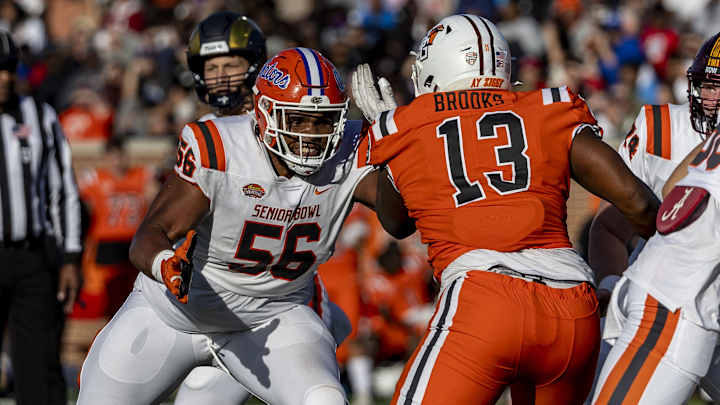
G O'Cyrus Torrence, Florida
At 6-5 1/2, 330 and with a 5.31-second 40 time, he's not getting out and leading the wide zone scheme any time soon. Guards in this offense need to be downrange of 315 and have an ability to show either a fast 10-yard split or outright fast 40 time. Torrence would be a tremendous fit for any team not using wide zone.
Jalen Carter on O'Cyrus Torrence (RG #54)👀🔥#Eagles pic.twitter.com/monS3s3zWg
— Thomas R. Petersen (@thomasrp93) April 6, 2023
*Played tackle and not guard at Northwestern, projects as NFL guard.
Twitter: BearDigest@BearsOnMaven
 Add us as a preferred source on Google
Gene Chamberlain has covered the Chicago Bears full time as a beat writer since 1994 and prior to this on a part-time basis for 10 years. He covered the Bears as a beat writer for Suburban Chicago Newspapers, the Daily Southtown, Copley News Service and has been a contributor for the Daily Herald, the Associated Press, Bear Report, CBS Sports.com and The Sporting News. He also has worked a prep sports writer for Tribune Newspapers and Sun-Times newspapers.