%20%20--%3E%0A%3Csvg%20version%3D%221.1%22%20id%3D%22Layer_1%22%20xmlns%3D%22http%3A%2F%2Fwww.w3.org%2F2000%2Fsvg%22%20xmlns%3Axlink%3D%22http%3A%2F%2Fwww.w3.org%2F1999%2Fxlink%22%20x%3D%220px%22%20y%3D%220px%22%0A%09%20width%3D%2239px%22%20height%3D%2240px%22%20viewBox%3D%220%200%2039%2040%22%20enable-background%3D%22new%200%200%2039%2040%22%20xml%3Aspace%3D%22preserve%22%3E%0A%3Cpath%20fill%3D%22%23FFFFFF%22%20d%3D%22M38.5%2C7H28.2v26h10.3V7z%22%2F%3E%0A%3Cpath%20fill-rule%3D%22evenodd%22%20clip-rule%3D%22evenodd%22%20fill%3D%22%23FFFFFF%22%20d%3D%22M26.1%2C25.5c0%2C5.8-4.1%2C7.5-12.9%2C7.5C3.9%2C33%2C0%2C31.2%2C0%2C25.2v-1.1h11.6%0A%09v2.4c0%2C0.7%2C0.1%2C1.4%2C1.2%2C1.4c1%2C0%2C1.2-0.4%2C1.2-1.3v-0.9c0-1.6-0.9-1.6-3.5-2.2C2.2%2C21.7%2C0%2C19.7%2C0%2C15.3v-0.9C0%2C9.3%2C5.5%2C7%2C12.9%2C7%0A%09c10.2%2C0%2C12.8%2C2.6%2C12.8%2C7.4v1.8h-11v-2.9c0-0.6-0.4-1.1-1.2-1.1c-0.6%2C0-1.2%2C0.4-1.2%2C1.1v0.9c0%2C1.5%2C0.9%2C2%2C3.3%2C2.5%0A%09c8%2C1.6%2C10.5%2C3.3%2C10.5%2C7.5V25.5z%22%2F%3E%0A%3C%2Fsvg%3E%0A)
Debating the Tush Push’s Lasting Legacy
In this story:
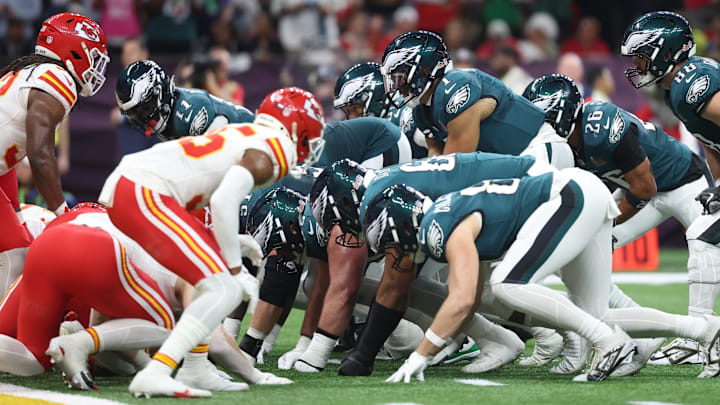
The Tush Push, a quarterback sneak used to great effect in professional football—also known as The Brotherly Shove, Organized Mass and many of its other nicknames—will die at the end of this 2025 NFL season. The causes of death will include: Its otherworldly effectiveness; a severe lack of understanding; shifting, unwritten, vague rules on what differentiates innovation from cheating (there are rules, but they’re deployed in myriad ways, with various interpretations); and a groundswell of support from franchises that lobbied for its death, starting after last season.
The Tush Push will have only turned 4 when—educated guess here—it is banned from professional football, never to return.
This will happen in the months after another NFL champion is crowned at Super Bowl LX.
Which could be the No. 3-seeded Eagles, who invented the Tush Push, dominated behind it and, more recently, faltered in maintaining its effectiveness. At the same time bearing all criticism directed at the play. Despite not being the only team that runs a version of it.
R.I.P. Tush Push.
You entered the NFL like a comet born from offensive schematics. You should be forever known as a true, league-changing innovation. Yes, you were misunderstood. But that, too, is part of your legacy, which is short but massive in reach.

The history of the QB sneak
The quarterback sneak—quick, effective and boring as all hell—has existed as long as quarterbacks have crouched behind offensive lines. Innovations happened over time, like in San Francisco (1980s), when the West Coast offense—with its sped-up tempo—tasked quarterbacks Joe Montana and Steve Young with a higher volume of sneaks meant to demoralize already tired and confused defenses.
No sneak is quite as revered as the one Bart Starr delivered in the Ice Bowl, as the 1967 league championship is called, where his sneak score catapulted the Packers to their triumph over the Cowboys. This sneak generally lands on the top 100 plays in NFL history lists, in part because it vaulted Green Bay into the final game of the season, where the Packers won their first—and the NFL’s first—Super Bowl.
As the Eagles toiled on the first iteration of the Tush Push in private throughout the 2021 season, those involved couldn’t halt their excitement. Even then, no one involved considered its mainstream crossover appeal, nor the stunning, endless debates ahead, as possible.
In those practices, long before the Tush Push debuted, the Eagles rehearsed this new play for a full season before using it in a game. They saw the play as an attack on an attack, the kinds that defenses have long utilized to stop whatever sneaks they must. Soon, Philly added a second pusher. Then, Richie Gray, a contact/collision specialist who has consulted NFL teams for a decade, while based in Scotland, to help the franchise refine the techniques in play.
The Eagles flew Gray in for a consult on tackling techniques. They also told him they wanted to spend one day on a specific play that nobody else knew about. The team’s performance director, Ted Rath, told Gray, “I want to show you a play that we’ve kind of perfected over the last year or so.”
After studying the play, Gray told Eagles coaches that the premise of the Tush Push was and would always be simple. Action would always beat reaction,” he said. “Guys, you cannot stop organized mass,” Gray said. “This is going to be unstoppable, if it’s organized.” Gray also noted the body types of Eagles’ players presented an ideal fit for this new sneak.
NFL defenders cannot link in the same way that blockers in the Tush Push do, leaving NFL defenses at a massive disadvantage in stopping organized mass that their coordinators could not fully match, as the play’s baseline.
The Eagles began to push Jalen Hurts’s tush in 2022. And, soon, retired center Jason Kelce let slip on his New Heights podcast about some “Scottish rugby dude/guy” and his impact on the play, which direction(s) Philly’s offensive linemen blocked in, for instance, the angles blockers took and the role of the pushers, which, in reality, isn’t much of a role at all.
During the 2022 opener, as time wound down, the Eagles clung to a 38–35 lead over Detroit and faced a fourth-and-1. Quarterback Jalen Hurts lined up for a sneak and plunged behind the Eagles’ elite organized mass up front. He picked up a first down, as the team’s coaches had designed. What happened next: everything no one had anticipated.

The single-most effective ‘sneak’
The “sneak” in this play became an oxymoron: Everyone knew what was coming—but no one could stop it. In 2022, the Eagles used it 41 times during the regular season and converted on 37 of those attempts. During the Super Bowl, the Eagles went to it six times, twice scoring touchdowns. That meant it was 90.2% effective.
Which made it the single-most effective QB sneak in the genre, which, it should be noted, has a high floor of effectiveness for any iteration. This dominant reinvention of the sport’s most boring and most effective play powered the Eagles’ run to Super Bowl LVII. As mentioned above, Philly converted The Brotherly Shove six times, scoring touchdowns twice. They lost by three points. In Super Bowl LIX last February, the Eagles deployed one Brotherly Shove. It produced the game’s first score and a 7–0 lead that only grew larger.
Any deeper analysis hammers this theme in more depth:
- TruMedia: Of 122 1-yard-and-go situations since the start of 2022 before the beginning of this season, Philadelphia recorded 30 touchdowns and gained 75 first downs.
- Pro Football Focus: The Eagles more than doubled the next team’s tally of QB sneaks since the start of 2021 (145 compared to 77 for Buffalo).
- The Athletic: A record 233 QB sneaks were called in 2021—and that number, already impossibly high, only went up in each subsequent season as the copycats came to push some tushes of their own. Philly, from 2021 to ’24, added almost twice as many expected points on QB sneaks as Denver, the next-highest team.
Soon, Philadelphia wasn’t even the team attempting the most QB sneaks. By 2024, the Eagles had fallen to fourth but still ranked higher in effectiveness. Even then, the Bills had become more effective at sneaks with a running back or fullback depth of three yards or fewer, with two yards to go. No other franchise deployed such sneaks so often or converted at a rate of 80% or higher.
But while debates raged over Tush Push injury rates—still far from definitively proven, early data suggests little to no uptick—and the play design’s unstoppable nature, many missed the changes in effectiveness for all franchises. Before 2025, Pro Football Focus noted the conversion rate for QB sneaks with two yards or fewer to go, regardless of whether any player or players stood right behind the quarterback, had been 81% effective in 2024. Which wasn’t as high as Buffalo (84%) and Philadelphia (83%), with the players close behind. Even then, converting a sneak vs. converting a Tush Push was almost even.
By this point, the Eagles were no longer the primary beneficiary of the sneak that they invented. They continued to rule, anyway, in tush pushing but primarily by volume. They leveraged their sneak into a defining characteristic of their offense, and they continued adding variations and fakes to the playbook.
‘It’s nowhere near a rugby play’
What’s fundamentally misunderstood about the Tush Push is what made it so effective. Many billed this sneak as a rugby play for starters. It did include principles from rugby that Gray and Eagles offensive line coach Jeff Stoutland discussed often. (He cannot discuss these in great detail for proprietary reasons.) But, Gray says, “It’s nowhere near a rugby play.” Definitely not a “scrum,” as scrums are pre-bound, meaning players link arms, as most often described. Closer to a “maul” in rugby, where one or more defenders and a teammate hold the ballcarrier before a tug-of-war ensues.
Other common misconceptions related to this sneak:
- That has led to more injuries. The sample size, for one, remains incredibly small. Plus, data on all sneaks has long shown that any version carries a higher risk of injury. Nothing Gray has seen so far places the Tush Push above more typical QB sneak-injury rates.
- That any team could do it well, and more have than Philadelphia. But other offenses have struggled to make the play effective, period.
It was poorly named. The “push” in this sneak accounts for at most 3% of its effectiveness, according to Gray and other sources in Philadelphia. The two players behind Hurts aren’t there to push him forward, necessarily. They’re there, Gray says, to guide him into open space, which leads to forward movement—more cocoon than snowplow, in other words.
Real experts in QB sneaking never really agreed with complaints against the Tush Push. When I wrote about it in 2023, longtime offensive line czar Dante Scarnecchia took no issue with what he saw as only innovation in Philadelphia. “Did the Eagles invent the best way possible to run a quarterback sneak?” he asked then. Sure seems like it.
This sneak was effective, especially at its peak in 2023 and ‘24, because:
- Hurts ranks among the strongest quarterbacks in football, was a power-lifter in high school, is a natural and skilled runner, squats 600 pounds, and presents the league’s most pushable backside.
- The Eagles’ offensive line, especially in 2022 to ’24, featured some of the NFL’s strongest players, period, alongside tons of skill.
- Philadelphia employs Jeff Stoutland as its offensive line coach, and he, like Scarnecchia, ranks among that position group’s best-ever coaches.
Technical accuracy born from that proprietary information.

May the Tush Push rest in power
The misconceptions, combined with the effectiveness of placing the Tush Push in the NFL’s crosshairs after the 2023 season, are a concern. There was a vote on whether to ban the play. The Eagles pushed back, fairly and with as much strength as the team could muster. The Packers, um, pushed the ban forward. But they were joined by nearly two-thirds of NFL teams in the vote to ban.
Nearly is the operative word. The ban fell just two votes short.
Gray was delighted with the outcome. So were the Eagles. All see this sneak as brilliance, an innovation. “So the Brotherly Shove lives on for another year!” he said in late March. “I genuinely don’t think the sport understands the play.”
Those invested in the Tush Push surviving another season or surviving in perpetuity don’t think that will matter in the next vote. They don’t believe that the play’s diminished effectiveness this season, most notably for Philadelphia, will impact the vote, either. Some wonder if the counters to this counter to defensive mass on sneaks caught up to the initial innovations.
This sneak had an uneven 2025. One fake Tush Push yielded a walk-in score for Eagles running back Saquon Barkley in late September. The Eagles conversion rate dropped below 80% earlier this season, then below 70%. The Bears and the Giants forced fumbles on a Tush Push this season. The Giants’ fumble was nullified, sparking widespread consternation. In early December, Hurts turned the ball over twice on a single Tush Push in a close defeat to the Chargers. Debates percolated over whether the play itself was often no more than a false start. The NFL sent a video, reportedly 19 minutes long, to officials to clarify what was and wasn’t a penalty for tush pushes. At the same time Packers edge rusher Micah Parsons expressed displeasure with a four consecutive Tush Push sequence that included false starts.
The best teams, Gray says, find a way to evolve, regardless. He doesn’t say the quiet part out loud. But perhaps Tush Push detractors should be working on their own evolutions, rather than banning a play they’ve struggled to stop for three seasons.
Make no mistake, though. The Tush Push has created its own legacy. It’s part of the Eagles’ most recent stretch of dominance, including a triumph in last season’s Super Bowl and a close loss two years before that win in the same game.
Gray hears all this and laughs. There are worse things to be remembered for. Consider the flip side, he says. A Tush Push that wins a title. Imagine that? It’s possible this season. Not likely. But possible.
The Tush Push is survived by its innovators. Chief among them: Shane Steichen, Stoutland, Nick Sirianni, Brian Johnson, Hurts, Kelce and the rest of those Eagles’ offensive linemen from that stretch and this season.
It should be remembered as a stroke of genius. It could eventually be viewed that way. For now, its legacy is complicated and confusing. But the conversions that it yielded, the games it helped win and its peak effectiveness should be the real remembrance of the Tush Push.
May it rest not in peace but in power—the power of a good, even brotherly shove.
More NFL on Sports Illustrated
 Add us as a preferred source on Google
Greg Bishop was a senior writer for Sports Illustrated and has covered every kind of sport and every major event across six continents for more than two decades. He previously worked for The Seattle Times and The New York Times. He is the co-author of two books: Jim Gray’s memoir, “Talking to GOATs”; and Laurent Duvernay Tardif’s “Red Zone”. Bishop has written for Showtime Sports, Prime Video and DAZN, and has been nominated for eight sports Emmys, winning two, both for production. He has completed more than a dozen documentary film projects, with a wide range of duties. Bishop, who graduated from the Newhouse School at Syracuse University, is based in Seattle.
Follow GregBishopSI