%20%20--%3E%0A%3Csvg%20version%3D%221.1%22%20id%3D%22Layer_1%22%20xmlns%3D%22http%3A%2F%2Fwww.w3.org%2F2000%2Fsvg%22%20xmlns%3Axlink%3D%22http%3A%2F%2Fwww.w3.org%2F1999%2Fxlink%22%20x%3D%220px%22%20y%3D%220px%22%0A%09%20width%3D%2239px%22%20height%3D%2240px%22%20viewBox%3D%220%200%2039%2040%22%20enable-background%3D%22new%200%200%2039%2040%22%20xml%3Aspace%3D%22preserve%22%3E%0A%3Cpath%20fill%3D%22%23FFFFFF%22%20d%3D%22M38.5%2C7H28.2v26h10.3V7z%22%2F%3E%0A%3Cpath%20fill-rule%3D%22evenodd%22%20clip-rule%3D%22evenodd%22%20fill%3D%22%23FFFFFF%22%20d%3D%22M26.1%2C25.5c0%2C5.8-4.1%2C7.5-12.9%2C7.5C3.9%2C33%2C0%2C31.2%2C0%2C25.2v-1.1h11.6%0A%09v2.4c0%2C0.7%2C0.1%2C1.4%2C1.2%2C1.4c1%2C0%2C1.2-0.4%2C1.2-1.3v-0.9c0-1.6-0.9-1.6-3.5-2.2C2.2%2C21.7%2C0%2C19.7%2C0%2C15.3v-0.9C0%2C9.3%2C5.5%2C7%2C12.9%2C7%0A%09c10.2%2C0%2C12.8%2C2.6%2C12.8%2C7.4v1.8h-11v-2.9c0-0.6-0.4-1.1-1.2-1.1c-0.6%2C0-1.2%2C0.4-1.2%2C1.1v0.9c0%2C1.5%2C0.9%2C2%2C3.3%2C2.5%0A%09c8%2C1.6%2C10.5%2C3.3%2C10.5%2C7.5V25.5z%22%2F%3E%0A%3C%2Fsvg%3E%0A)
After Playoff Exit, Eagles Must Ask Questions About Their Very Identity
In this story:
In what felt like record time, club music faded into boos. The visual of Quinyon Mitchell picking off a Brock Purdy pass, running into the end zone to celebrate and firing the football 13 rows into the stands with the veracity of a cricket bowler, was followed shortly by another slow trot off the field by Jalen Hurts. Then the Eagles’ defense—clearly the fun parent—having to make another appearance to quell the emotional damage brought on by the take-your-medicine offense; a nonstop array of steamed vegetables and early, sensible bedtimes that, at best, provided a respite for those who needed time at the concession stand.
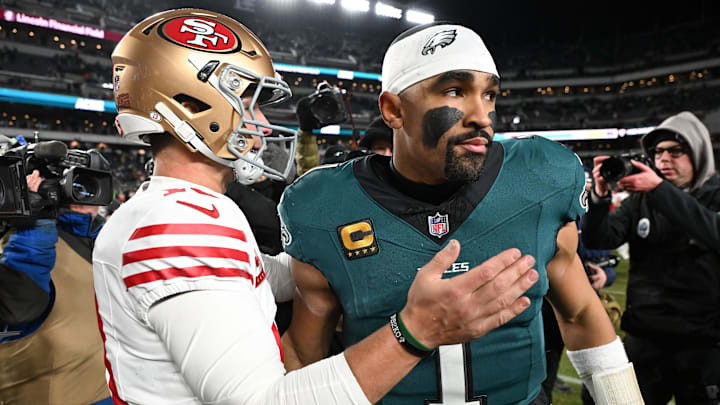
Here lies the confounding nature of the Eagles’ offense in one truncated segment after a disappointing 23–19 loss to the 49ers in the NFC wild-card round of the playoffs—especially what the offense turns into once it grasps even the thinnest modicum of a lead. Up three points at the half, Philadelphia came out and ran the ball twice in 11-personnel before being boxed into a third-down pass, which was dropped by Saquon Barkley.
The Eagles ran the ball in the second half on second-and-18, second-and-10, third-and-13 and second-and-20.
The out-of-half calls were eerily similar to a set of play calls—at least in tenor—when the Eagles came out of halftime with a lead against the Bills in Week 17, the Lions a few weeks before that, the Giants before that and the Buccaneers before that. In a season-ending loss that sends home one of the most emotionally charged and potentially fragile teams in the NFL (A.J. Brown and Nick Sirianni were jawing at each other on the sideline during the first half of this one, though Sirianni said after the game that they love each other) it is the ethos of the team’s head coach and offensive coordinator that will take center stage.
Around a somber Eagles locker room, it was couched in terms of what we can and cannot understand. Sirianni called the idea that the Eagles are conservative offensively a misnomer. Landon Dickerson said that whoever is not in the locker room cannot possibly understand the nuances of the decision making spearheaded by the coach and play-caller. DeVonta Smith said he did not agree with the idea that the offense sat on its hands.
Of course, none of that went toward answering the pressing questions: If all a team aspires to be is a mistake-averse, road grating offense so afraid of turnovers that it almost always pivots toward the least dangerous scenario, what happens when a quarterback needs to be spectacular but doesn’t have the muscle memory?
What happens to a franchise that is famous for noticing ailments a season early, with an NFL draft and free agency coming up, and some intrigue at the quarterback position already brewing?
What happens to the offensive coordinator, so instrumental in building this staff and the day-to-day foundation of a Super Bowl champion, with a coaching carousel having been thrown into chaos and a handful of talented play-callers with no connection to the Sirianni hive available?
There are offseasons for teams that produce microscopic questions about various personnel changes. Then, there are offseasons that produce questions about identity altogether. The Eagles are entering the latter.
Saying that the Eagles never threw when coming out of halftime is incorrect. In games against the Cowboys, Raiders, Vikings and Broncos, the team came out of halftime with both a lead and a determination to push the ball downfield via the pass. When it was at its most successful, though—think Smith’s 79-yard bomb against Minnesota that floored an excellent Brian Flores defense—it was the running game in the first half that provided the Eagles with inspiration to run a deep passing play out of the same look, almost guaranteeing that Smith would have single coverage and Hurts would have an empty swath of the field with which to miss (he didn’t).
Minus that built-in advantage, the Eagles remain like a hermit crab, wishing away their fears like a nyctophobe wearing a flashlight at all hours.
Going into this game, Philadelphia was 26th in the NFL in second-half points (9.9). The Jets averaged 10.6. Three teams that fired their head coach at season’s end and two that fired their offensive coordinators sat ahead of Philadelphia in those rankings.
And what a stark contrast it was to San Francisco on Sunday; a team that had lost George Kittle in the first half. The 49ers are a run-based offense as well, but one that can still produce explosive plays out of its most banal looks. One of the 49ers’ touchdowns came on an inside jet sweep handoff to a slot receiver, who flipped the ball to receiver Jauan Jennings, who threw downfield to a wide-open Christian McCaffrey, springing open the same route concept we’ve seen from the same offense a hundred times this season. All of the boring little movements, the slow creep of this Kyle Shanahan offense, sprang alive like some twisted jack-in-the-box.
Shanahan, interestingly enough, used to be known for a similar kind of backing down. When it came to a play call he needed to have, the structured nature of his offense rarely provided answers. He broke out of that creative barrier with a divisional round berth on the line.
Predictably for the Eagles, after falling behind in the second half as one offensive drive after another stalled to an expedited end, it all came down to a moment when Philadelphia needed to remember what it could do in the shotgun, with Hurts standing there against a pitch-black Philadelphia skyline. The stadium, quiet as the arctic predawn, watched as an armada of the league’s best skill-position players trotted themselves out for a sack, followed by two straight incompletions. There was zero backfield motion. Zero attempts to mismatch personnel. Zero glimpses of the few inventive drives the Eagles had the same night; the ones where Smith would stand in the backfield then follow Tank Bigsby out into the flat. The same drive when the Eagles could manufacture Smith in isolation, leaving him to simply make a move against an inferior defender in space.
But by then, Hurts and the Eagles’ offense, as predictable as ever, was met with the most predictable of fates. San Francisco defensive coordinator Robert Saleh walked nearly all of his defenders to the line of scrimmage and then, right after the snap, dropped just enough into coverage to muddy the picture Hurts was trying to paint in his mind.
Because the Eagles’ offense had remained so static, because it had remained so dependent on what it wanted to be, it couldn’t also be heroic.
More NFL From Sports Illustrated
 Add us as a preferred source on Google
Conor Orr is a Senior Writer for Sports Illustrated with more than 15 years of experience covering the NFL. His work has been cited in Best American Sportswriting and has won a PFWAA award. Prior to Sports Illustrated, he covered both the Giants and Jets for The Star-Ledger. Conor lives in New Jersey with his amazing wife and three children.
Follow author