%20%20--%3E%0A%3Csvg%20version%3D%221.1%22%20id%3D%22Layer_1%22%20xmlns%3D%22http%3A%2F%2Fwww.w3.org%2F2000%2Fsvg%22%20xmlns%3Axlink%3D%22http%3A%2F%2Fwww.w3.org%2F1999%2Fxlink%22%20x%3D%220px%22%20y%3D%220px%22%0A%09%20width%3D%2239px%22%20height%3D%2240px%22%20viewBox%3D%220%200%2039%2040%22%20enable-background%3D%22new%200%200%2039%2040%22%20xml%3Aspace%3D%22preserve%22%3E%0A%3Cpath%20fill%3D%22%23FFFFFF%22%20d%3D%22M38.5%2C7H28.2v26h10.3V7z%22%2F%3E%0A%3Cpath%20fill-rule%3D%22evenodd%22%20clip-rule%3D%22evenodd%22%20fill%3D%22%23FFFFFF%22%20d%3D%22M26.1%2C25.5c0%2C5.8-4.1%2C7.5-12.9%2C7.5C3.9%2C33%2C0%2C31.2%2C0%2C25.2v-1.1h11.6%0A%09v2.4c0%2C0.7%2C0.1%2C1.4%2C1.2%2C1.4c1%2C0%2C1.2-0.4%2C1.2-1.3v-0.9c0-1.6-0.9-1.6-3.5-2.2C2.2%2C21.7%2C0%2C19.7%2C0%2C15.3v-0.9C0%2C9.3%2C5.5%2C7%2C12.9%2C7%0A%09c10.2%2C0%2C12.8%2C2.6%2C12.8%2C7.4v1.8h-11v-2.9c0-0.6-0.4-1.1-1.2-1.1c-0.6%2C0-1.2%2C0.4-1.2%2C1.1v0.9c0%2C1.5%2C0.9%2C2%2C3.3%2C2.5%0A%09c8%2C1.6%2C10.5%2C3.3%2C10.5%2C7.5V25.5z%22%2F%3E%0A%3C%2Fsvg%3E%0A)
How Charles ‘Peanut’ Tillman and His Unique Technique Revolutionized the NFL
Before he became one of the NFL’s premier, yes, punchers, Fred Warner grew up in a household he describes as “anti-violence, violent sports … aside from football.” Warner still gravitated toward the gridiron, and by his third or fourth youth season, he connected how the other combat sports applied to his. “There’s tons of stuff that can be applied,” Warner says. “That’s why I still [train in striking] to this day.”
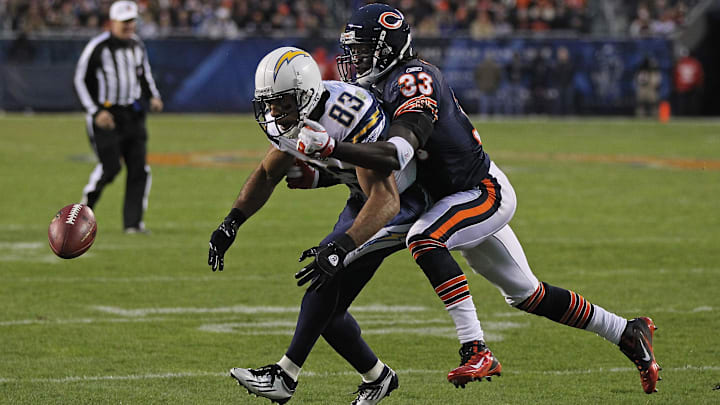
The 49ers selected Warner in the third round of the 2018 draft. And in his rookie season, Warner first heard about a technique he hadn’t yet considered. It dislodged footballs from the muscled arms of ballcarriers: the Peanut Punch. Warner, studious by nature, watched clips and began to practice his own strikes. He also familiarized himself with the technique’s namesake, Charles “Peanut” Tillman, and saw the best puncher “to ever do it, just the pinpoint accuracy and trying to replicate that.”
The Peanut Punch has its own Wikipedia entry, separate from Tillman’s personal iteration. Dozens of montages of Peanut’s punches live on YouTube, Instagram and TikTok. But the story of this technique and how it has evolved in recent years speaks to far more than Peanut’s punch origin story. His punching changed football—by an organic, skilled emphasis alone.
Now, players punch footballs out so often, linebackers and defensive backs recall a video game that defined a generation: Mike Tyson’s Punch-Out!! Only these practitioners are too young to be familiar with the game. They’re punching out footballs. On NFL fields. With proven methods and refined techniques that have advanced far beyond those Tillman deployed.
Von Miller, the Commanders’ edge rusher who ranks 10th all-time in sacks (136.5), happened to catch Warner this season before the 49ers star went on injured reserve, after fracturing and dislocating his right ankle in Week 6. What stood out to Miller, beyond what always stands out with Warner, who is exceptionally gifted, one of football’s best players, was his strikes.
“That man … can … punch!” Miller says. “He’s one of the greats at punching the ball out. You can see him, the intention; like, he wound up and went for it. So accurate. Impressed.”
This skill—and its evolution—have altered the modern landscape of defensive football, in an NFL where turnovers decide games, especially in the NFL playoffs, more often than any other factor. Asked where he would rank this particular skill, Warner says, “It’s right there at the top. It’s something that separated me. I try to be a complete player. But the fact that I have [elite striking] in my tool bag separates me from a lot of other guys in the league.”
The origin of the Peanut Punch
Tillman, who did not respond to multiple interview requests, has told the origin story of the Peanut Punch consistently for years. While in college at Louisiana–Lafayette, he obsessed over forcing fumbles. He began taking “bad angles” in order to force more via strike. But those same angles wouldn’t work in the NFL, not with universal speed at every position. Peanut continued punching anyway, finding new ways to dislodge footballs with fists.
Miller isn’t a puncher, unlike Tillman. Miller’s mindset was the primary mindset for defenders until Peanut started punching. In 2019 to ’20, Vic Fangio was Miller’s head coach in Denver. He presented, specifically, the finer points and best practices for striking. Miller says Fangio broke down the physics, detailed the science of force and explained different types of strikes—the Ice Pick, the Straight Punch and the Rip.
Richard Sherman’s pro career overlapped some with Tillman’s 13 NFL seasons. Tillman spearheaded this evolution, Sherman says, through the awareness of his effectiveness alone. Before the Peanut Punch, he cannot recall any coach emphasizing this technique in practice.
Tillman punched a football, not like Mike Tyson, but Floyd Mayweather Jr.—accurate beyond belief. Even then, Warner didn’t see any emphasis on this technique early in his career, which started two seasons after Tillman’s ended. “There was a period of time where it kind of went away. Like you didn’t really hear about it.”
He pins the start of his understanding to his 2018 rookie season. That’s when Warner noticed one draft classmate, linebacker Darius “Shaquille” Leonard, punching balls loose for Indianapolis, en route to first team All-Pro. Oh, my gosh, Warner thought. This guy is so disruptive. Why can’t I add that to my game?
Warner took notice. Other players took notice. Coaches took notice. Soon, even specialists, like Richie Gray, a former rugby development officer who now consults for two-thirds of the NFL on collisions and tackling, noticed coaches incorporating strikes into their methodology.
Gray understood how to tackle—he is known as the Collision King. But after shifting to the NFL, starting as a consultant for Miami a decade ago, another related realization dawned. Takeaways, Gray came to understand, were the “absolute gold medal” of defensive football.
That realization, combined with more and more punches, reminded Gray: In rugby, they practiced this specific skill. They called their punches a reef or a chainsaw. These drills wouldn’t necessarily translate to pro football—rugby players can tackle in pairs and start their tackles lower to halt momentum. Surely, though, principles applied to the NFL.
And, yet, Gray also says, forcing turnovers this way “wasn’t actually trained a lot.” He saw punches that traveled and connected more like weak slaps. They weren’t aggressive enough, intentional enough, targeted enough.
Now, Warner says, “I practice it every single day, all offseason in my drill work, all practice[s] and during the season.” In games, he’s not thinking about striking.
He’s striking.
A handful of teams, including the Eagles and Vikings, had highlighted their emphasis on striking and punchouts before this season. Tillman didn’t force 44 fumbles, many via Peanut Punch, by luck or even typical techniques. He didn’t climb into the top 10 all-time, becoming the only defensive back to rise that high, without those celebrated strikes. Warner said it. This specific skill isn’t a bonus.
It’s a separator.
The influence of combat sports
Blame age, boxing’s slow and endless decline or NFL contracts that limit activity in other sports (especially the other dangerous ones). Most of the NFL’s best punchers hardly follow the other combat sports.
Like Chiefs linebacker/defensive heartbeat Nick Bolton. He caught an occasional Mayweather bout. But he neither watches nor trains in boxing, MMA or anything else outside of football. He didn’t learn the technique until his rookie season (2021) in Kansas City.
Gray was right. Principles of boxing, MMA and other sports where strikes are expected do apply to football. For one, tracking, or precise footwork, that puts defenders in position to punch. “You’re looking for the right momentum, really, more than the right punch,” Gray explains. “When you’re talking to boxing coaches, they want you to punch an inch or two inches into the body, [where the punch is aimed] and it’s identical with this takeaway. You’ve got to punch down and through. You can’t just jab it or fold [your arm/fist] through. It’s power, yes, but it’s accuracy and connection, too.”
To evolve, these NFL punchers turned not toward boxers nicknamed Peanut—17 in total, according to our Fight Hunters; a Davis, Dubay, McGilray, McKinney, two named Willis, two Wrights, 13 fighters nicknamed “Peanuts” and one Kid Peanuts Jurkovich. No, the NFL strike specialists turn toward the only punching Peanut who matters in pro football.
Dissecting the Peanut Punch
What follows is a roundtable dissecting technique, culled from six separate interviews.
Warner: “The footwork of it all, staying light on your feet, the conditioning, the hand-eye coordination.”
Gray: “You’re keeping all your power in line with the shoulder. It’s not flying arms. Tight. You don’t just tap. You’re trying to put your first through.”
Bolton: “We’re taught to attack the points of the ball, the top or the bottom, to cause the ball to turn, rather than pulling at the ball.”
Warner: “I always tell guys to have that elbow [the one punching] above the wrist to make sure you have that angle of going down and through the football, rather than trying to create space for the ball to go through.”
Bolton: “Just the short punch. You want a firm wrist. The guys who get the ball out make good, solid contact.”
Freddie Roach, the best trainer in boxing history, after reviewing NFL punchouts for Sports Illustrated: “Right hand. Right in the middle of the ball.”
Rams linebacker Nate Landman: “You want to hit the leather. I’m way better at it with my right hand, moving to my right, because I’m more comfortable.”
Bolton: “When we get multiple guys to the ball, attacking the points of pressure, you put your wrist or elbow through the pocket, using your velocity and force.”

Refining the Peanut Punch
Most teams, the punchers surmise, practice dislodging the football with strikes at least weekly. Technique is preached inside defensive meeting rooms. There’s even equipment and drills specifically designed to sharpen this skill. “Which,” Warner says, “I’m sure wasn’t the case even a few years ago.”
Bolton cites outside linebackers coach Rod Wilson as an example. Wilson slaps together montages for a group dissection, urging his backers to adopt a fistic mindset, to consider punches two or three steps before reaching the intended target, ascertaining the right angle or hunting for clues—a ballcarrier falling down, getting up, off-balance.
All of which has led to more technical punches, more types, more practice time, and, in lockstep, more footballs punched out. “If it helps win, they’re going to become adept at it,” Sherman says. “And that’s what happened.”
Roach, the boxing trainer whose football “career” ended in childhood with, yes, a fumble at the goal line—no punch!—wonders why running backs switch hands, period. “There’s just so much exposure,” Roach says.
He believes the effect of switching is partly psychological. When shifting the ball, the brain shifts, too, from security to movement.
“Human nature,” Bolton says.
Even runners who excel at security, who pin footballs to their bodies like their livelihoods depend on it (which they do), move at such high speeds that Bolton looks for when they change their stance. They might shift into running more like a sprinter. They might not see him. That’s precisely when he’ll apply a punch or punches with maximum force. “Fumbles happen that way,” he adds. “Ballcarrier changes hands to his outside hand, and a guy comes over the top and then hits the ball as he’s running full speed.”
SI asked one offensive coordinator in the NFC if he had considered this or the countering of punches in general. “No,” he responded via text message. “But ball security has mattered as long as football.”
Gray advocates for one process some NFL punchers have already begun. On one Baltimore television broadcast this season, the analyst noted that cornerback Marlon Humphrey—a four-time Pro Bowler—studied individual ballcarriers to understand how they preferred to hold the ball, then adapted his punches and other techniques to exploit each player’s weaknesses.
NFL punchers have reached the refinement stage of strike development.
Landman, the Rams’ power puncher, hasn’t visited an arcade in a minute. But the last time he did, with friends from his hometown in California, he swaggered up to what’s called, alternately, a Boxer, a Boxing Machine, a Punching Bag Machine or a Strength Tester. You know: The bag hangs from the machine, and customers punch once to measure their strength.
He scored a 980 out of 1,000. Wonder where all the great American heavyweight champions have gone? Start there. Maybe they’re playing linebacker in the NFL. And now they’re punching out footballs, to boot.
This Rams backer is known for striking. Landman and Warner appear to stand apart as heirs to the Peanut Punch throne. Sometimes, Landman admits, he’ll even watch the montage videos of his punchouts. He primarily tracks the ball and where the ballcarrier is holding it. If the ball rests, secure, in their inside arm, he’ll throw a cross-body punch at the top or bottom of the ball itself. If the runner is attempting to break a tackle, he’ll punch while they’re falling or flailing.
That’s the evolution, in one player. Strong enough to punch with power that maxes out one of those arcade strength-measuring machines. But also steeped in the technical nature that’s specific to forcing fumbles via strike in football games.
The best punchers? Warner cites Leonard as the “best I’ve seen with my own eyes.” He also points to Landman, who, in a separate interview without prompting, points back to Warner, who saw Landman punch out a fumble in person this season. “[Landman] has been popping up on the tape consistently,” Warner says. “He’s consistently attacking it. I don’t know if anybody else is, like, super intentional [like Landman] about it.”
Bolton adds another candidate to the mix, pointing to Trent McDuffie, who, apparently, is one of the NFL’s best defenders and best strikers. “He’s our franchise, enforcer DB,” Bolton says. “He’s up there, one of the best.”
McDuffie, at 5' 11" and 193 pounds, could trim, fairly easily, to, say, meet the middleweight division limit of 160 pounds. He’s fast. He’s twitchy. He would, Bolton surmises, “be a pretty decent boxer.” That sentiment applies to all of them.
The future of punchouts
For all his exuberance over watching NFL players strike, Roach also notes that, while he has met with players and teams, no coach or player has ever descended on his famous Wild Card Boxing Club for punch-specific instruction. This, despite his mid-career turn to teaching MMA superstars, like Georges St.-Pierre, that specific skill.
That may change in future seasons. Many of the players who spoke to SI said they’d welcome a coach or consultant specializing in punches and strikes.
For now, Bolton says, the art of punching footballs from arms that started with Peanut Tillman will “be one of those overlooked things in terms of winning and losing.”
Beyond that, not all refinement methods have necessarily been explored. Gray wonders, for instance, if smaller players may be the most effective punchers and, thus, the most ripe for development. That they’re not rangy or gangly means their punches feature shorter windups—as Roach prefers for power generation.
Gray has also begun developing equipment—as he has done through his GSI Performance company for dozens of tackling and collision aids—that is specific to punching out footballs. He fashioned two iterations of a device that helps punchers punch more accurately and effectively. The Giants and Jaguars both use this equipment.

Gray throws out a scenario: What if NFL defenders worked in tandem to force fumbles in this specific way? Maybe one lifts another off the ground, just for a split second, to allow for a better angle to strike.
The future of punchouts in pro football must also incorporate unforeseen consequences. In October, the NFL sent a memo to every team to clarify its punching rules. It cited Lions linebacker Jack Campbell to make the delineation clear—or attempt to, anyway. The league said Campbell’s strikes crossed the boundary of the rules for striking. He was too aggressive, not aimed at the ball. The memo reminded Campbell and all defenders that they could punch only at the ball, not at other players. But Campbell had punched at the ball. And in a game where large men move at uncommon speed, the line between accuracy and inaccuracy is fractions of fractions. Defenders “punch” opponents, often by accident but not always, in every game of every week of every season. The memo, then, wasn’t clear at all.
Another example: NFL punchers wonder whether punching footballs out will ultimately prove more effective than stripping or ripping them from players’ arms. In which case, their art, the evolved one, would assume primary importance.
‘He really revolutionized, really changed the game’
In 13 (mostly) glorious NFL seasons, Charles “Peanut” Tillman made first team All-Pro, played in two Pro Bowls, collected 930 tackles and intercepted 38 passes. He’ll be remembered as Peanut, the cornerback who punched with accuracy, creativity and verve. He ensured defensive backs—and, to some extent, even linebackers—could join the NFL’s forced fumbles party more overtly.
Miller considers such an impact. He is one of the few humans to understand what that feels like, to do one football skill so well that he becomes known for it. That applies to his ghost technique for rushing quarterbacks and to Tillman as well. “He really revolutionized, really changed the game,” Miller says, his voice quieter, as if hit by the significance.
The modern punchers aren’t sure whether there’s another, similar innovation that will alter defensive football across the NFL anytime soon. “Unless I invent some rip tackle that’s super effective,” Warner says with a laugh.
At least he and the other NFL ball strikers understand the baseline. In this new, evolved world, each stands, at least, a puncher’s chance.
More NFL on Sports Illustrated
 Add us as a preferred source on Google
Greg Bishop was a senior writer for Sports Illustrated and has covered every kind of sport and every major event across six continents for more than two decades. He previously worked for The Seattle Times and The New York Times. He is the co-author of two books: Jim Gray’s memoir, “Talking to GOATs”; and Laurent Duvernay Tardif’s “Red Zone”. Bishop has written for Showtime Sports, Prime Video and DAZN, and has been nominated for eight sports Emmys, winning two, both for production. He has completed more than a dozen documentary film projects, with a wide range of duties. Bishop, who graduated from the Newhouse School at Syracuse University, is based in Seattle.
Follow GregBishopSI