%20%20--%3E%0A%3Csvg%20version%3D%221.1%22%20id%3D%22Layer_1%22%20xmlns%3D%22http%3A%2F%2Fwww.w3.org%2F2000%2Fsvg%22%20xmlns%3Axlink%3D%22http%3A%2F%2Fwww.w3.org%2F1999%2Fxlink%22%20x%3D%220px%22%20y%3D%220px%22%0A%09%20width%3D%2239px%22%20height%3D%2240px%22%20viewBox%3D%220%200%2039%2040%22%20enable-background%3D%22new%200%200%2039%2040%22%20xml%3Aspace%3D%22preserve%22%3E%0A%3Cpath%20fill%3D%22%23FFFFFF%22%20d%3D%22M38.5%2C7H28.2v26h10.3V7z%22%2F%3E%0A%3Cpath%20fill-rule%3D%22evenodd%22%20clip-rule%3D%22evenodd%22%20fill%3D%22%23FFFFFF%22%20d%3D%22M26.1%2C25.5c0%2C5.8-4.1%2C7.5-12.9%2C7.5C3.9%2C33%2C0%2C31.2%2C0%2C25.2v-1.1h11.6%0A%09v2.4c0%2C0.7%2C0.1%2C1.4%2C1.2%2C1.4c1%2C0%2C1.2-0.4%2C1.2-1.3v-0.9c0-1.6-0.9-1.6-3.5-2.2C2.2%2C21.7%2C0%2C19.7%2C0%2C15.3v-0.9C0%2C9.3%2C5.5%2C7%2C12.9%2C7%0A%09c10.2%2C0%2C12.8%2C2.6%2C12.8%2C7.4v1.8h-11v-2.9c0-0.6-0.4-1.1-1.2-1.1c-0.6%2C0-1.2%2C0.4-1.2%2C1.1v0.9c0%2C1.5%2C0.9%2C2%2C3.3%2C2.5%0A%09c8%2C1.6%2C10.5%2C3.3%2C10.5%2C7.5V25.5z%22%2F%3E%0A%3C%2Fsvg%3E%0A)
The Benefits and Drawbacks of Trading for a ‘Golden Goose’ Like Maxx Crosby
In this story:
When an elite talent is available on the market in the NFL, we—meaning both the people who cover the league and the executives who struggle to sit on their hands—tend to dive into the hype stream and get taken with the current. This is no different from the phenomenon associated with someone arriving at a car dealership merely out of a lack of complacency and leaving with a brand-new military-grade Tahoe and a car payment larger than their mortgage.
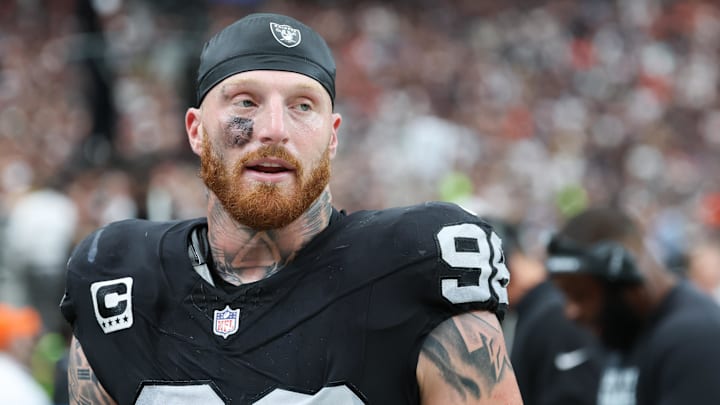
As humans, we can convince ourselves so quickly that we can’t live without something, even while simultaneously knowing that isn’t true. This is what makes the practice of pausing all the more critical. I’d like to apply that practice to Maxx Crosby in particular, as the NFL (and gambling) world zeroes in on the very real possibility that a team will trade two first-round picks and a player for Crosby, a player who will turn 29 before the season and has made five consecutive Pro Bowls despite being on a slew of mediocre Raiders teams.
It’s particularly worth wondering whether the Super Bowl taught us anything about the need to spend premium capital on what coaches call a “golden goose” pass rusher, given that the champion Seahawks did not have one. For the faint of heart, yes, this is basically the defensive version of the No. 1 wide receiver argument that devoured our souls for the better part of the 2000s (which, I believe, settled with us admitting that it’s great to have an elite wide receiver but that winning is possible without one).
A few days before the Super Bowl, Seahawks linebackers coach Chris Partridge told me that Seattle’s defense was an outlier because it did not exist to service one elite pass rusher. Many NFL schemes are set up that way, which offers distinct advantages and disadvantages, according to coaches.
The benefit: Having one elite edge rusher allows a defensive unit to more easily anticipate which direction an offensive line is going to slide its protection, and how and where the unit will allocate its “chip” player (an ancillary blocker, usually a tight end or running back but more increasingly a sixth offensive lineman, who can help bottleneck the pass rush). It also includes the baked-in possibility that one singular person can take over a game.
The drawback: The impact of an injury becomes more consequential, and injuries tend to accumulate more in pass rushers who bear an almost every-down burden in the defense (and tend to get targeted more schematically, either by plays that zap their energy and force them to run sideline to sideline or with multi-blocker run plays designed to wear away at a pass rusher’s will over time). Of the league’s six best non-Crosby pass rushers at the moment (Myles Garrett, Aidan Hutchinson, Will Anderson Jr., Micah Parsons, Nik Bonitto and Danielle Hunter), most have missed at least a large chunk of one season due to a serious injury or injuries.
There is also, coaches believe, a cultural balancing act that needs to take place with a defense that centers around one elite pass rusher. In a defense like Seattle’s, for example, which offered four players the chance to accumulate six or seven sacks apiece, compared to Cleveland’s, where one player accumulated 23 sacks and only three players had more than three, there needs to be a concerted effort in preaching the value of service and balancing said idea with a financial package that makes helping an elite pass rusher more palatable.
In reality, if you’re a player whose best attribute is clearing the runway for an edge rusher, you’re going to be pigeonholed much like an expert blocking running back. There is a financial ceiling that is hard to digest, along with an imbalanced proportion of injury toll to one’s body for taking on constant double teams versus a (relatively) paltry salary.
The TL;DR version: Seattle’s defense offers a cultural upside and better mitigates the risk of one injury wiping out the entire structure. But the elite edge defense offers more schematic predictability and the upside of having a complete tyrannosaurus when the game is on the line.
Here is where one NFL coach cautioned me: Building what Seattle has is just as difficult as finding a golden goose edge rusher, especially being as cost effective as Seattle was in doing so (the Seahawks committed about $40.7 million in cap dollars to their top four defensive linemen during their Super Bowl run). In the case of the Seahawks, the team needed the right coaching staff and four players who accepted that they may not be the star of any given game plan; four “alpha” type people who buy into a single idea. You don’t have to be an expert on the Beatles to realize how difficult that is.
So the question, now that we’re in the car dealership being upsold on the Tahoe is this: Having considered the important factors, would a team be better off spending two first-round picks on defensive building blocks who could play together on the line versus acquiring Crosby?
Before we answer that, there is one more fascinating caveat: As one talent evaluator noted, Crosby is not the same as, say, Garrett, even if we tend to lump all of them into a golden goose category. Someone like Crosby may come around once every three or four years, whereas someone like Garrett comes around once in a football lifetime. Garrett is more scheme versatile and is, essentially a monolith (for those who are fans of the Pokemon video game series, Garrett is the special legendary Pokemon you can only get after beating the game, whereas Crosby is one of the strongest Pokemon you can acquire before facing the Elite Four, which was not a comparison given to me by any NFL personnel but simply the best way my eighth-grade brain can explain the difference). However, Crosby and Garrett, because of production, would cost about the same in terms of trade value, the floor of which was set by Dallas haphazardly during the Micah Parsons negotiation.
For the teams that are betting favorites to sign Crosby—the Bears, Rams, Cowboys (lol), Ravens, Bills and Eagles—this should be the central question. Everyone would take Crosby, but are you confident enough in your organization to build something that is more sustainable, injury-averse and cost effective than Crosby?
And if not, perhaps that says more about a given team’s operation than the inherent value of the player.
More NFL From Sports Illustrated
 Add us as a preferred source on Google
Conor Orr is a Senior Writer for Sports Illustrated with more than 15 years of experience covering the NFL. His work has been cited in Best American Sportswriting and has won a PFWAA award. Prior to Sports Illustrated, he covered both the Giants and Jets for The Star-Ledger. Conor lives in New Jersey with his amazing wife and three children.
Follow author