%20%20--%3E%0A%3Csvg%20version%3D%221.1%22%20id%3D%22Layer_1%22%20xmlns%3D%22http%3A%2F%2Fwww.w3.org%2F2000%2Fsvg%22%20xmlns%3Axlink%3D%22http%3A%2F%2Fwww.w3.org%2F1999%2Fxlink%22%20x%3D%220px%22%20y%3D%220px%22%0A%09%20width%3D%2239px%22%20height%3D%2240px%22%20viewBox%3D%220%200%2039%2040%22%20enable-background%3D%22new%200%200%2039%2040%22%20xml%3Aspace%3D%22preserve%22%3E%0A%3Cpath%20fill%3D%22%23FFFFFF%22%20d%3D%22M38.5%2C7H28.2v26h10.3V7z%22%2F%3E%0A%3Cpath%20fill-rule%3D%22evenodd%22%20clip-rule%3D%22evenodd%22%20fill%3D%22%23FFFFFF%22%20d%3D%22M26.1%2C25.5c0%2C5.8-4.1%2C7.5-12.9%2C7.5C3.9%2C33%2C0%2C31.2%2C0%2C25.2v-1.1h11.6%0A%09v2.4c0%2C0.7%2C0.1%2C1.4%2C1.2%2C1.4c1%2C0%2C1.2-0.4%2C1.2-1.3v-0.9c0-1.6-0.9-1.6-3.5-2.2C2.2%2C21.7%2C0%2C19.7%2C0%2C15.3v-0.9C0%2C9.3%2C5.5%2C7%2C12.9%2C7%0A%09c10.2%2C0%2C12.8%2C2.6%2C12.8%2C7.4v1.8h-11v-2.9c0-0.6-0.4-1.1-1.2-1.1c-0.6%2C0-1.2%2C0.4-1.2%2C1.1v0.9c0%2C1.5%2C0.9%2C2%2C3.3%2C2.5%0A%09c8%2C1.6%2C10.5%2C3.3%2C10.5%2C7.5V25.5z%22%2F%3E%0A%3C%2Fsvg%3E%0A)
His Classmates Were Ticketed for Wall Street, but He Became a Brilliant NFL Coach
In this story:
Back in their undergraduate days at Georgia, two friends who partook in the Greek system went on a date night for her sorority and his fraternity in November 2009. The theme: famous couples. They got creative, borrowing from popular Mac commercials at the time that sought to differentiate cool vibes from those of boring, old PCs. She went with the Mac computer.
Her date already struck everyone as analytical, this finance major who crunched numbers for fun, who legitimately adored equations. He intentionally donned dorky glasses and an even dorkier plaid tie, which together formed a playful nod to his general nerdiness. This showcased his dry sense of humor; he was, in fact, hilarious, not to mention self-deprecating, authentic and brilliant. So brilliant, he never needed to stand on chairs and announce the depth of his intellect. He wore it subtly, which made him and it more effective.
“If coaching doesn’t work out,” the Mac sometimes thought to herself, “he could make tons of money on Wall Street.”
Both the Mac, then Jori McMurtrey (now Jori Palmer), and the PC, Mike Macdonald, had applied to the same program within Georgia’s Terry College of Business, while undergraduates, in 2008. The program’s name came from its benefactor Earl T. Leonard Jr. He graduated from UGA with a bachelor’s in journalism in 1958, then launched a career as a journalism professor, earned a law degree, served as press secretary for a U.S. senator, founded the Senate Press Secretaries Association and became a powerful executive at Coca-Cola.
He also helped endow the Leonard Leaders Scholars Program at UGA. It wasn’t as simplistic as its name. It is nestled within UGA’s Institute for Leadership Advancement and accepts only 30 students per year, all undergrads, at a university where, in 2024, there were 32,399 undergrads. Those Leonard Scholars—four classes at any given time—represented just 0.37% of the undergraduate population, ranking this program among the hardest in the country to get into for any student at any school.
Both Mac and PC checked all three boxes for ideal Leonard Scholars candidates: passionate about leadership and growth; conscientious, driven and focused on developing positive relationships; committed to becoming values-based, impact-driven leaders. Both also met the basic requirements: Terry College majors, a G.P.A. of 3.2 or higher, and 45 hours of UGA credit.
Which matters because both Mac and PC got in.

Scholars program at Georgia launched Macdonald’s coaching career
Paul Shoukry joins a Zoom call from a conference room at Raymond James, not at the football stadium nearby, where he sits in Tampa, but at the financial company that sponsors that very stadium. He is both the CEO of Raymond James Financial, Inc., and a Leonard Scholar from the program’s inaugural class.
Shoukry keeps pointing the interview back to values; his, like Macdonald’s, were shaped by UGA’s vaunted leadership program. He mentions four core values. They’re spelled out in (mostly) white letters over a blue background directly behind him:
We put clients first.
We act with integrity.
We think long-term.
We value independence.
Like Shoukry, McMurtrey and Macdonald formed an elite-among-elites cohort with 28 other business school classmates in their junior and senior years. Their cohort was the Leonard Scholars, class of 2010.
Even within that smallest of small groups, Mac and PC stood out. Their classmates wanted to run companies, like Shoukry, and create businesses and become entrepreneurs.
They both wanted to work in sports.
Both ascertained this through two years in that program. All Scholars read leadership textbooks, explored case studies and embarked on individual service-learning projects. At the beginning, though, officials challenged them to define core values specifically related to leadership. Those values could inform the bigger questions: What did they enjoy doing? Why not make that their career?
“That’s what I found most valuable,” McMurtrey tells Sports Illustrated. “And I know Mike said the same thing.”
All Scholars were given flashcards; each card featured one core value. They chose five. McMurtrey enjoyed playing and watching sports and selected integrity first when making her selections. Macdonald, she says, “Always thought the coaching side of things could be really interesting.” He also chose the “integrity” card.
Unlike their classmates, their internships often paid minimum wage, at least when they paid anything at all. They wouldn’t receive five-figure bonuses to apprentice on Wall Street. Macdonald became a coach, loosely, helping with the Cedar Shoals High School football program in Athens, Ga., located near campus. McMurtrey wrote several articles for the weekly independent student-run newspaper at UGA, The Red & Black.
McMurtrey soon drove to Cedar Shoals to interview the head coach there about her college classmate. To ask why he’d allow a 21-year-old college kid who did not play college football on his staff. To glean what this coach saw in her friend. The coach told McMurtrey that he found Macdonald poised, mature, a leader—and he was all of these things, already, even then.
Macdonald had been the defensive coordinator for the freshman team the previous season, leading it to six shutouts. He won the program’s Coach of the Year award and graduated to varsity assistant, working with linebackers and fullbacks, according to her piece, published in November 2009. “If you make an impact on one guy and change his life, you know it’s all worth it,” the PC told her then.
Leonard Scholars are also tasked with writing their own obituaries and essays that paint their future selves, inside their future offices, at the pinnacles of their respective careers. The assignment: What’s on the walls? Awards? Family photos?
Macdonald, McMurtrey says, wrote of winning championships, plural, of becoming an incredible coach and leading men to where they could not go alone. McMurtrey had already come to her own conclusion by that point: “He’s got what it takes to really make that happen.”
That left one central question for both Mac and PC. How?
Macdonald’s trip to Falcons’ headquarters
Each semester, all Leonard Scholars classes embark on corporate site visits, another program staple, as Mac and PC did in February 2010, a transformative experience for both of them. They toured the Falcons’ headquarters in Flowery Branch, Ga. They drove there early before an entire day stuffed with meetings, not wanting to miss a single second. Macdonald dressed up; alas, not in nerdy glasses or a dorky plaid tie this time.
The Scholars met with the Falcons’ then general manager, Thomas Dimitroff; Roddy White, but not the star receiver, believe it or not; this Roddy White was the director of event marketing; then team president Rich McKay; the head of HR; and Greg Beadles, who ran the finance department then but was named Falcons president and CEO last week. Macdonald also met with members of that coaching staff.
Both left that building, on that day, with motivation teeming, spilling from their souls, their chosen career paths fully solidified as possible, as real targets. “So jazzed up,” McMurtrey says. “Like: I can’t believe that happened. O.K., we are following our passions.”
‘He’s going to win multiple Super Bowls in his career’
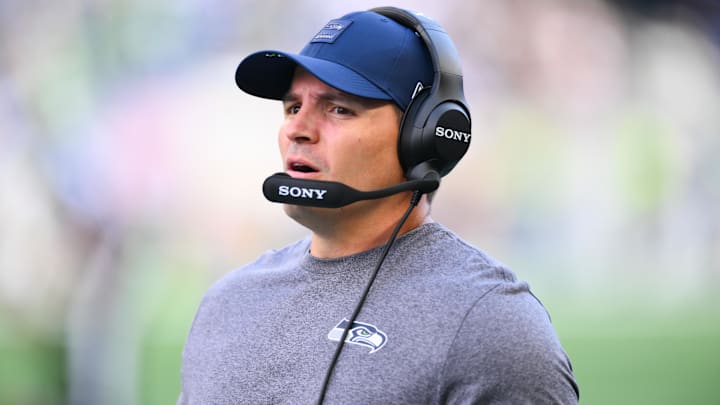
Macdonald’s path to the NFL, especially his time at UGA, has been well-chronicled ever since he entered the conversation for head coaching candidates a few years back. That ramped up when Seattle hired him as its head coach before last season. But this part of his college experience, becoming a Leonard scholar, has never before been explained in much depth. It’s typically a passing mention. Which is wild, because his time in that program seems to explain not only Macdonald and his philosophy, but also the Seahawks’ 2025 season.
In a group interview with two UGA employees who are intimately familiar with that program—Dr. Stacy Campbell, who runs the university’s Institute for Leadership Advancement (I.L.A. for short) and Courtney Aldrich, I.L.A.’s associate director—they laid out more of its actual heft. Everything that follows here is from them.
Last year, the broader Institute ensured Time named Georgia as one of the top 50 universities in America that developed leaders. The program itself is so exclusive that many at Georgia don’t even know it exists. It started through Leonard, after he met with the dean of the business school and said that Coca-Cola loved hiring UGA students but found that many, too many, lacked a professional edge. He wished they had more, better leadership skills, specifically.
Chick-fil-A became a sponsor, as did other major companies. Graduates, like Shoukry, became benefactors themselves. They’ve had more than 600 Leonard Scholars since the first one. They’re looking for students like, well, Mike Macdonald. The man led an NFL team with modest but growing expectations to the NFC’s No. 1 seed this season. They’ll host the 49ers on Saturday at Lumen Field in Seattle. And, if they win, they’ll play for the conference championship next week, also at home.
Both Leonard/UGA employees point to his LinkedIn profile. It must be noted: the head coach of an NFL football team still has a LinkedIn profile. His skills and that program still appear to mean that much to him. It notes his undergraduate GPA (3.9), his master’s GPA (4.0) and his current job “Head Coach, (line space), Seattle Seahawks.” Under “EDUCATION,” the certificate Macdonald earned from the I.L.A. is given its own entry; he did not, notably, include it in his “Activities and societies” list section. There, his first entry is, of course, the Leonard Leadership Scholars Program.
All Scholars must also complete service projects. Which is by design—to ensure a cycle of growth within that specific program. Scholars return to speak on campus. Scholars help other scholars land jobs or navigate complex terrains. (The Seahawks did not respond to interview requests for Macdonald to address any of this.)
In 2010, Mac and PC both earned their undergraduate degrees after completing the Leonard Scholars program. On graduation day, jazzed once more, Mac and PC sped toward UGA’s most famous campus landmark—the Arch. Built in 1857, it towers at the intersection of Broad Street and College Avenue, connecting the campus to Athens’s glorious downtown. Three pillars hold up the Arch. They symbolize wisdom, justice and moderation; principles that pay homage to their state’s seal. Most follow the same superstition, refusing to walk beneath the Arch until the day they graduate. Then they “pass” beneath and into, metaphorically, whatever’s next.
The 2010 Leonard Scholars passed together, then crowded into a group photo. Palmer still looks back at this image from time to time. Twenty-nine scholars stand shoulder-to-shoulder, each beaming, arms held high in the air. The other member of this class stands high above them. It is Macdonald, who had climbed atop The Arch.
Palmer looks at that image now because it’s surreal, the faces in that frame, the youth on all those faces, in stark juxtaposition to where they went, where they’re headed, what they’ve done and what it meant.
“If you actually know Mike, you’re not surprised he’s where he’s at,” Palmer says. “He’s going to win multiple Super Bowls in his career.”
Perhaps even the first, this season.

What elevated Macdonald’s candidacy with the Seahawks
For Macdonald, next meant staying at UGA and toiling toward a master’s degree in sport management, which he completed in 2013. The Mac did become a sports executive and did ascend into a front office. Palmer is now the Braves’ senior director of marketing and advertising. She’s also a dual threat who cohosts the podcast Braves Country Convos. One guest for an episode released as a batch in late September: Mike Macdonald.
They taped last June, connecting from opposite sides of America. He defended the weather in Seattle, which locals are not supposed to do in public, telling a cute story about a boat ride with his son, Jack, from early 2025.
Jack was born in early December 2024, before Seattle finished 10–7 but didn’t make the playoffs. Macdonald’s wife, Stephanie, was pregnant all season, which forced both to confront what they’d do if she went into labor. Mike knew, immediately, that he would put his family first, if humanly possible. That he would be at his son’s birth.
This was the Leonard Scholar in him—those values, still at the forefront.
Macdonald went deep on his own background: the move from Boston, growing up in Atlanta, Little League baseball, travel baseball, falling for football, not quite good enough to play for a major college. “I didn’t really know what to do,” he said.
He revealed the questions he asked himself while in the Leonard program. If he turned 40, and he hadn’t at least tried to coach, would he regret that? Yes, which is why he ensured he would pass the test to become a GA for the Bulldogs. He made sure to bump into coaches at the campus Starbucks, which sometimes made him late for the 8 a.m. classes he still aced. Eventually, one told him he could join the staff if he got into grad school there, which Macdonald did, taking out a $20,000 loan to wait for that gig to open.
It did, and he spent three years there, getting a second master’s degree, his first next-level leadership education. After graduating, the second time, he applied for a coaching internship in Baltimore, was accepted and took a pay cut before he started, joining the Ravens staff in 2014 for $35,000 a year, or $20,000 less than the job he had already lined up.
Thus he continued his leadership studies. In Baltimore, surrounded by the titans of professional football—Ozzie Newsome, general manager; John Harbaugh, head coach; Dean Pees, defensive coordinator—he didn’t yet know how many exceptional leaders already populated the same building. By 2015, Macdonald had been promoted to defensive assistant. By 2023, he had worked as the Ravens’ defensive backs coach and linebackers coach, Michigan’s defensive coordinator under Jim Harbaugh, and Baltimore’s DC.
The Harbaugh brothers taught Macdonald invaluable lessons about leadership, and how they ran their respective “programs.” The preferences each held changed their respective approaches.
Macdonald began developing his own leadership style, with an eye on becoming a head coach. Both Harbaughs were connected, both networked, both ran football teams with enviable blueprints that basically summarized what they shared as football coaches and what differentiated them. They weren’t clones, and that part resonated most deeply with Macdonald. His takeaway, shared with Palmer on that podcast: “You need to be true to how you operate.”
Those Ravens never did win a Super Bowl in his time there. But John Harbaugh had imparted another vital lesson. “Trust the process,” Macdonald said. “Trust the decision-making. Stick to your guns. Trust people around you, and hire great people to work with them.”
Macdonald pivoted back to Palmer and their shared experience on that podcast. “All those principles we learned back in the day. And that’s exactly what happened. It’s more than [just getting] a leadership title. We manage leaders.”
The UGA employees heard this, in real time, and both thought the same thing: That’s precisely what the program’s leaders designed it to create. It’s also what elevated Macdonald’s candidacy above all others with one specific team: the Seattle Seahawks.
Seahawks GM found the right coach
Macdonald’s leadership skills and bona fides caught the attention of one of the NFL’s longest-tenured and most respected executives in football. Seahawks GM John Schneider describes Macdonald as someone “who leads with intelligence, direct honesty and authenticity.” Schneider understood elite leadership in coaches, having seen it up close from Mike Holmgren, Marty Schottenheimer, Andy Reid, Jon Gruden, Mike McCarthy and “obviously Pete Carroll and this young man.” All elite. And, more critically, elite in their own way. Which way is what delineated them. But each shared a distinct style, organizational alignment, football knowledge and confidence.
Schneider tells Sports Illustrated that he knew what most in football already knew; that Macdonald was legitimately brilliant in defensive football and schematics. He needed more than that. In Macdonald, he saw that leadership ethos. And Schneider got more, from recognizing this specific quality; much more, much faster, in Macdonald.
Hence, one part of a larger blueprint for NFL success that Schneider yielded in Seattle. Find the right head coach. Align there. The Seahawks have had two of those since the start of 2010.
On the podcast, Macdonald detailed the mindset of most first-timers. They go in all jazzed, like on graduation day, assuming they have all the answers and leaving less room to grow than necessary. His lifelong study of leadership taught Macdonald to avoid that in Seattle. He wanted to create a collaborative mentality, with everyone growing and evolving together, just like in the Leonard program.
Macdonald focused on narrowing his scope of responsibilities to increase the potency of his overall leadership. He had always loved drawing up plays, schemes, many of which helped the Ravens contend for almost a decade. This was his, was theirs. He defined the most critical directives together with Schneider and others, all focused on alignment, which all hoped would speed their build.
The head coach saw his forever-warming chair as one with a primary responsibility that had nothing—and everything—to do with winning games. “This job is about aligning people and getting going in a certain direction,” he said. “And that’s where most of my growth is.”
Intentional leadership, borne from collaboration, netted team-wide alignment in 2024. Mostly. Seattle still shipped star wideout DK Metcalf to Pittsburgh back in March, while hoping it could bolster existing vibes by reducing drama in its locker room. Additional alignment yielded wins and then more wins and then an NFC West crown, amid one of the strongest collective years in the division’s history. Three NFC West teams are still alive. They form three-quarters of the NFC’s playoff bracket.

Macdonald on the cusp of fulfilling his dreams
The circle of growth UGA designed for its Leonard Scholars continues now, in 2025, with Macdonald and his Seahawks on the cusp of everything he ever wanted—all those dreams he discussed with Palmer, only now, ahead of schedule, even.
Macdonald has returned to Georgia’s campus to speak to students in the business school and to interview Benjamin Watson, a retired NFL tight end who married one of the initial Leonard Scholars. Kirsten Watson was in the same class as Shoukry, who more than made it, endowing a Leonard Leadership speaker series, which featured Macdonald quizzing Watson on topics ranging from his time in New England to his social justice efforts.
The coach also returned to address the scholars at a recent graduation. He told them that leadership, not X’s, not O’s, made him better at building and shaping teams.
On Dec. 7, in this season, Seattle flew across the country to play the Falcons, in a game with existential postseason implications for Seattle. Some of the Leonard Scholars from the class of 2010 gathered at the football stadium in Atlanta, cheering on one of their own, accepting that he didn’t coach the Falcons but hoping that one day he just might. The Seahawks won, marking their third consecutive victory in what’s now a seven-game winning streak.
No definitive word on whether the Scholars snapped a photo afterward, just like at the Arch 15 years earlier. But they were right where they expected to be, leaders who led and managed other leaders, career scopes trained on world domination, even in pro football.
More NFL on Sports Illustrated
 Add us as a preferred source on Google
Greg Bishop was a senior writer for Sports Illustrated and has covered every kind of sport and every major event across six continents for more than two decades. He previously worked for The Seattle Times and The New York Times. He is the co-author of two books: Jim Gray’s memoir, “Talking to GOATs”; and Laurent Duvernay Tardif’s “Red Zone”. Bishop has written for Showtime Sports, Prime Video and DAZN, and has been nominated for eight sports Emmys, winning two, both for production. He has completed more than a dozen documentary film projects, with a wide range of duties. Bishop, who graduated from the Newhouse School at Syracuse University, is based in Seattle.
Follow GregBishopSI