%20%20--%3E%0A%3Csvg%20version%3D%221.1%22%20id%3D%22Layer_1%22%20xmlns%3D%22http%3A%2F%2Fwww.w3.org%2F2000%2Fsvg%22%20xmlns%3Axlink%3D%22http%3A%2F%2Fwww.w3.org%2F1999%2Fxlink%22%20x%3D%220px%22%20y%3D%220px%22%0A%09%20width%3D%2239px%22%20height%3D%2240px%22%20viewBox%3D%220%200%2039%2040%22%20enable-background%3D%22new%200%200%2039%2040%22%20xml%3Aspace%3D%22preserve%22%3E%0A%3Cpath%20fill%3D%22%23FFFFFF%22%20d%3D%22M38.5%2C7H28.2v26h10.3V7z%22%2F%3E%0A%3Cpath%20fill-rule%3D%22evenodd%22%20clip-rule%3D%22evenodd%22%20fill%3D%22%23FFFFFF%22%20d%3D%22M26.1%2C25.5c0%2C5.8-4.1%2C7.5-12.9%2C7.5C3.9%2C33%2C0%2C31.2%2C0%2C25.2v-1.1h11.6%0A%09v2.4c0%2C0.7%2C0.1%2C1.4%2C1.2%2C1.4c1%2C0%2C1.2-0.4%2C1.2-1.3v-0.9c0-1.6-0.9-1.6-3.5-2.2C2.2%2C21.7%2C0%2C19.7%2C0%2C15.3v-0.9C0%2C9.3%2C5.5%2C7%2C12.9%2C7%0A%09c10.2%2C0%2C12.8%2C2.6%2C12.8%2C7.4v1.8h-11v-2.9c0-0.6-0.4-1.1-1.2-1.1c-0.6%2C0-1.2%2C0.4-1.2%2C1.1v0.9c0%2C1.5%2C0.9%2C2%2C3.3%2C2.5%0A%09c8%2C1.6%2C10.5%2C3.3%2C10.5%2C7.5V25.5z%22%2F%3E%0A%3C%2Fsvg%3E%0A)
2026 NFL Quarterback Carousel Preview: 24 Players Worth Monitoring
In this story:
Welcome to the 2026 NFL offseason. With respect to the quarterback position specifically, we have learned three critical lessons from the 2025 season: It’s important to hoard, it’s important not to let one’s own status as a quarterback whisperer inspire hubris, and it is especially important to create an environment that veteran quarterbacks deem attractive, as keeping one in the holster in case of emergency can be an absolute job-saver.
This is why we’re already seeing Kyle Shanahan say Mac Jones is unlikely to be traded, making Jones one of the most valuable assets in the NFL. Dependable, low-cost quarterback play is very hard to come by. Jones now knows the 49ers’ system and, in 2025, went 5–3 as a starter with a completion percentage near 70% and a touchdown to interception ratio of better than 2:1.
In terms of the market itself, I’m conservatively looking at anywhere from nine to 12 teams that are going to be actively looking at the position this offseason, and that’s not counting teams like the Rams, who could re-sign Jimmy Garoppolo but are a destination for veteran quarterbacks either searching for career rehab or a one-year stint in a wonderful locale with a head coach who can use them effectively in spot duty. The Rams should be considered as serious contenders as, say, the Steelers, Cardinals or Jets, given that most quarterbacks would probably prefer to enhance their stock for 2027 with Sean McVay than get railroaded by the clearly rebuilding Jets and their puzzling assemblage of coaches.
With that in mind, let’s break the market into a few categories and examine what might happen next.
Established, brand-name starters with strings attached
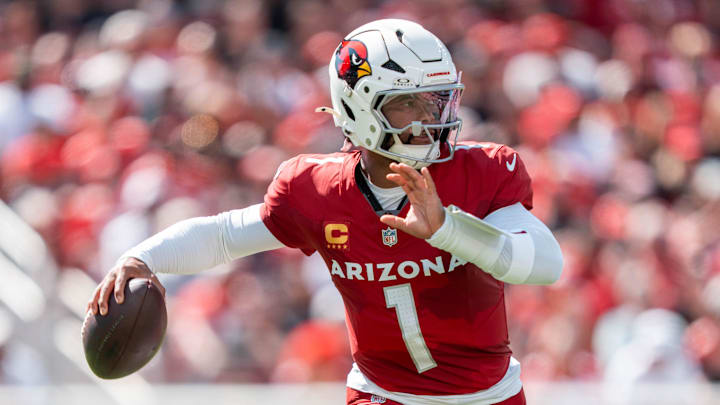
Kyler Murray, Tua Tagovailoa
Murray (28) and Tagovailoa (who turns 28 in two weeks) are both now on their third head coaches and have had multiple offensive coordinators. Both have time and money remaining on long-term deals and both have what I would comfortably describe as a hard ceiling that prevents them from being seen as a face-of-the-franchise player worth sacrificing real draft capital for. Murray has struggled with health issues and has clear limitations as a durable runner who can operate a hybrid offensive scheme. The Arizona offense was more efficient and streamlined without Murray in the lineup and Drew Petzing, his offensive coordinator, was hired for a premium role as the Lions’ offensive coordinator this offseason, indicating to me that the league clearly does not see Petzing as the issue. Tagovailoa had an offense tailored to his exact skill set in Miami with a pair of elite wide receivers and one of the best play-callers in the NFL. His height was a 29-touchdown Pro Bowl season in 2023, though Tagovailoa’s production tumbled steeply from then.
With new head coaches Mike LaFleur (Arizona) and Jeff Hafley (Miami) trying to wipe a slate clean, it would be hard to imagine either making the mistake of their predecessor and believing that the solution at quarterback is already on the roster.
The Cardinals would seem to have an easier time getting rid of Murray, whose dead cap hit is a fraction of what the Dolphins would face with Tagovailoa. The Jets and Murray feel destined for one another and both teams’ circumstances match up eerily well. The Jets have a trove of cap space over the next two years that can absorb Murray’s contract, and they likely won’t be in the rookie quarterback business until the far more heralded 2027 draft. Murray can provide a fan-pacifying bridge and has—you guessed it—two years left on his contract. He can transition into a spring competition/bridge option for the team’s 2027 draft selection.
Murray would also serve to pacify Aaron Glenn, who is in full-on desperation mode as his facade crumbled over the back half of his inaugural season. Getting, in theory, the “best” quarterback would obscure the fact that the Jets are clearly pivoting to a youth-focused rebuild.
The Dolphins, meanwhile, would have to decide between the quiet discomfort of a hold-in, or the gutting pain of an outright release. In theory, the Dolphins could find a suitor interested in a Brock Osweiler–type contract absorption, though Miami needs as much draft capital as possible and the money remaining on Tagovailoa’s contract trumps what Cleveland took on to essentially purchase the Houston quarterback for a second-round pick in the infamous 2017 trade.
While both players’ abilities to lead has been questioned, Tagovailoa suffers from a recency effect. Those around the league who know Mike McDaniel know the care and effort he poured into Tagovailoa only to have his coaching abilities—intentionally or not—questioned at the podium. This is obviously a concern for Hafley and will absolutely be a concern for any coach starting over and trying to build a program in 2026.
Possible-upside prospects age 27 and under
Malik Willis, Tanner McKee, Trey Lance, Davis Mills, Justin Fields, Anthony Richardson
Willis and Lance are the only pair in this group that are truly hitting free agency. McKee has a year left on his contract with the Eagles, as does Mills with the Texans. To be clear off the bat, there are absolute tiers to this list and age is the main factor grouping these quarterbacks together. With the success of Sam Darnold and Baker Mayfield, I believe there will be increased curiosity in trying to find quarterbacks with a higher volume of professional reps who can play serviceable football and be signed to more affordable long-term contracts. Even though some of these quarterbacks have had what we would consider a fair shake at a starting job, offensive coaches are eternal optimists and dreamers.
What is most interesting about Willis in particular is that he is closely tied to both the Cardinals and Dolphins, given that one team (Arizona) is coached by his former head coach’s brother and another team (Miami) is coached by his former defensive coordinator. However, as we noted above, both of those teams have gigantic contracts lingering over their books before they can consider doling out a 2025 Justin Fields–plus contract ($20 million to $30 million per year) to another quarterback. Willis needs a team with a synthesized run-pass attack, which would seem to disqualify him from Pittsburgh, though the Jets and OC Frank Reich make an oddly sensible pairing along with the Cardinals and Dolphins.
McKee, with 88 pass attempts in two seasons, is not only a pet fascination among Eagles fans but, if we’re being realistic, would absolutely be one of the five best quarterbacks in this year’s draft class if he was coming out in 2026. This is a down year at the position and for the class in general, making something even as high as a third-round pick seem sensible to offer for the former Stanford standout. I wonder if Reich, the former interim head coach at Stanford, who also has access to McKee’s former position coach (and Reich’s replacement at Stanford, Tavita Pritchard), will seek out some intel on McKee. I wonder if Colts coach Shane Steichen will call his former team as well. Mike McCarthy in Pittsburgh could also use a failsafe option if Aaron Rodgers decides to hang up his spikes.
Mills, while we’re talking about freakishly tall Stanford quarterbacks, had a better EPA per drop-back over his three weeks as Houston’s starter last year than Bo Nix, Justin Herbert or Baker Mayfield. Mills has almost two seasons’ worth of starting reps on horrendous Texans teams that were designed to lose games and still came out with a positive touchdown to interception ratio and had a positive EPA per drop-back. Interestingly enough, Mills’s EPA was almost identical to Sam Darnold’s in his final Jets season and first Panthers season. I doubt Houston wants to move on with him given the uncertainty of C.J. Stroud but, as we noted with McKee, Mills would be a more appetizing prospect than a number of current incoming rookies.
Fields will almost certainly be released back onto the market as the Jets clear the decks and look to balance the books before 2027. While his 2025 season was undoubtedly bad (Fields was among the worst quarterbacks in the NFL in terms of EPA per play, though that ranking had him squarely in the Joe Flacco–Geno Smith category), Fields is a playmaker with solid instincts who can hurt opponents on the ground. He’s not a primary option but is quality depth.
Lance, who is still just 25 has not impressed statistically during his spot starting duty—his lone 2025 start was against Denver, one of the best defenses in the NFL—but may be worth a flier after spending a year with noted quarterback expert Jim Harbaugh in Los Angeles. Lance’s preseason stats were also uneven, but he has connections with the ever-widening Shanahan tree as well as McCarthy in Pittsburgh. I don’t view him as a starting option, but Lance is absolutely worth a developmental roster spot.
That’s also why Richardson lands here. Indianapolis has been aggressive under the latest generation of Irsay ownership, and with GM Chris Ballard facing increased pressure to justify his lengthy tenure,I wonder whether Ballard will either feel pressure to see that Richardson is developed or if it’s more beneficial for the team to make a clean break and recoup some late-round draft capital. Richardson and Fields, like the Seahawks’ Jalen Milroe, represent a group of quarterbacks whom I think would succeed as change-of-pace red zone options, or are still good enough to take over a game with their physical traits under the right circumstances. That kind of potential doesn’t simply get thrown away; however, it’s very difficult to imagine Richardson getting significant reps in 2026.

Veterans with immediate starting capabilities
For this section—since we already know a ton about these quarterbacks and given that most of them will have a significant and possibly immediate impact—let’s play a matchmaking game. To be clear, this is not “reported” speculation, merely matchmaking based on what feels sensible to me.
Though veterans tend to linger on the market after the draft, whether to avoid the monotony of mandatory minicamp, to convince themselves to give it one more run or to wait out the ideal situation, I think this class in particular, given the climate of the league, could be quicker to sign.
For each player, I’ll list where I could envision them ending up, ranked most likely to least.
Derek Carr: Raiders, Steelers, Dolphins, Colts
Daniel Jones: Colts, Rams
Kirk Cousins: Falcons, television, Vikings, Dolphins
Aaron Rodgers: Vikings, Steelers, Rams, retirement
Jimmy Garoppolo: Rams, Titans, Patriots
A few thoughts here:
• Tom Brady has been adamant about the perils of having a rookie quarterback start right away. If he is indeed drafting Fernando Mendoza with the No. 1 pick, will he back up those words? I have Carr returning to the Raiders as a first option, which would pair Carr with Klint Kubiak again (and interestingly, pair Carr with Brady, who may or may not have once famously referred to Carr as “that motherf-----”). Carr sold his home in Vegas back in 2024, but was drafted by the Raiders and spent the first nine seasons of his career with them.
• I feel like Aaron Rodgers isn’t done playing. That’s just a personal feeling and nothing more. I also think that Mike McCarthy is saying all the right things about a possible Rodgers reunion to avoid the quarterback’s ire (taking the antithetical approach to Aaron Glenn), but the possibility of whizzing past Peyton Manning on the all-time touchdown list by throwing to Justin Jefferson would be too good to pass up.
• Why is Kirk Cousins in Atlanta still? My friend Mike Garafolo mentioned this the other day and it makes sense. The Falcons can afford to pay Cousins to basically assume the same role he has now. Cousins is familiar with Kevin Stefanski, and Matt Ryan’s involvement in the front office should smooth over any hard feelings lingering from the Terry Fontenot regime. Michael Penix Jr. sustained his third ACL tear in November and there’s no guarantee he’s a scheme fit in Stefanski’s offense … period. While Minnesota has some options to open up its salary cap with more space, is the team going to want to spend the lion’s share on a quarterback that team brass would hope will lose the job in training camp (and is Cousins wary of going down that road again?). This is one of the game’s savviest players when it comes to personal finance.
Call and see what happens
C.J. Stroud, Jalen Hurts, Mac Jones
• The Eagles struggled to find an offensive coordinator this offseason and, while this was not expressed publicly, I imagine that Jalen Hurts has something to do with it. Hurts is a fine quarterback who—at least to me—seems to be undergoing a shift similar to what we saw with post-let-me-cook-era Russell Wilson. After Wilson won a Super Bowl, he began to idealize the kind of football that Tom Brady played, which involved a quicker release time and fewer shots taken. Indeed, Hurts’s runs have dropped off a cliff year-over-year and the number of first downs he picked up on the ground in 2025 was nearly half of what it was during the 2022 season. However, the number of first downs Hurts is picking up via the pass game did not double. Hence, part of the reason we’re seeing a stagnation in Philadelphia (in addition to an aging-out offensive line and a post-peak Saquon Barkley).
Hurts also prefers a specific type of offense which, to me, seems to limit options in the play-callers’ arsenals. That’s what made Philadelphia’s pivot to Barkley so brilliant during their championship season, though it only served to mask the bigger issues moving forward.
Hurts is now one season away from seeing the dead money on his contract cut by more than 50%. Though the Eagles are not averse to taking on significant dead money, as we saw with the Carson Wentz trade, taking on more than $100 million would be irresponsible for a team that still has a very good chance of winning the NFC East.
All of that said, everything beyond this year is in flux. Lane Johnson. Vic Fangio. Nick Sirianni. Howie Roseman and Jeffrey Lurie are better than any tandem in the NFL at sensing stagnation before it causes organizational rot. I would not be surprised if we see the team leaning into moves that facilitate the post-Hurts era already. If you’re a team desperate to make a splash at the position, do you at least start the process of feeling out the Eagles now?
• As for Stroud, we’ve been writing and talking about this for almost a year now. Following his disappointing playoff appearance, Stroud’s rookie year equity has all but dried up just as he’s supposed to be entering a prime negotiating window. I imagine the Texans are going to rush to the altar with Will Anderson Jr., which leaves the team with the optical Rubik’s cube of how to handle Stroud, who was selected in the same class.
The Texans moved on from Bobby Slowik as offensive coordinator after Stroud’s statistics plummeted in Year 2, and Slowik immediately became a critical part of Mike McDaniel’s staff in Miami (and eventually the Dolphins’ new offensive coordinator). Now, a second, equally talented coaching staff, led by Nick Caley, is under the microscope when, ultimately, we may have just gotten ahead of ourselves on Stroud.
With Davis Mills already on the roster and some talented bridge veterans on the market, could Houston draw interest from some QB-needy teams who prefer a younger quarterback but don’t care for what’s available via the draft?
• I would not trade Jones if I were Kyle Shanahan. I would also not trade a high pick for Jones, understanding that, when he gets into my building, he won’t be able to take Shanahan and Christian McCaffrey with him. I would be dubious of a coach who comes into my office and demands of the general manager a second-round pick that we must use on Jones. For all of these reasons, I think he’ll remain in San Francisco, though that won’t stop teams from chasing their collective tails and acting irresponsibly. This season showed us what we also saw in New England when Jones’s offensive coordinators were not a defensive coordinator and special teams coach. And even during his stint in Jacksonville, if you were paying attention. Jones is a gamer; like one of those guys during pickup basketball who somehow always remains on the floor thanks to a strange combination of shooting skills and the ability to trip anyone who beats him to the hoop (and get away with it). He’s perfect in a process-oriented offense like San Francisco’s, which builds in a lot of safeguards. If I were the 49ers, I wouldn’t just give him to another team that could put him in a similarly advantageous position (like the Vikings, who are in the same conference).

Consolation prize veterans
Geno Smith, Russell Wilson, Jameis Winston, Tyler “Snoop” Huntley, Tyrod Taylor, Jake Browning, Jacoby Brissett, Joe Flacco
You can attempt the Giants’ strategy from 2025, which is to literally just sign all these people. But, to close the loop on my point from above, because of the aura presented by great coaches of the quarterback position and great play-callers (you can read a longer story about this here), at least one sensible starting option is likely going to accept a backup role to be with one of them. That would leave a team that really, really needs a starting quarterback to have to settle on a less-than-appetizing option. Mark my words: One of these quarterbacks will start at least six games for an NFL team in 2026.
This is a group that ranges from momentary juice (Flacco, Brissett) all the way down to a commitment to performance art over victory (Winston).
More NFL From Sports Illustrated
 Add us as a preferred source on Google
Conor Orr is a Senior Writer for Sports Illustrated with more than 15 years of experience covering the NFL. His work has been cited in Best American Sportswriting and has won a PFWAA award. Prior to Sports Illustrated, he covered both the Giants and Jets for The Star-Ledger. Conor lives in New Jersey with his amazing wife and three children.
Follow author