%20%20--%3E%0A%3Csvg%20version%3D%221.1%22%20id%3D%22Layer_1%22%20xmlns%3D%22http%3A%2F%2Fwww.w3.org%2F2000%2Fsvg%22%20xmlns%3Axlink%3D%22http%3A%2F%2Fwww.w3.org%2F1999%2Fxlink%22%20x%3D%220px%22%20y%3D%220px%22%0A%09%20width%3D%2239px%22%20height%3D%2240px%22%20viewBox%3D%220%200%2039%2040%22%20enable-background%3D%22new%200%200%2039%2040%22%20xml%3Aspace%3D%22preserve%22%3E%0A%3Cpath%20fill%3D%22%23FFFFFF%22%20d%3D%22M38.5%2C7H28.2v26h10.3V7z%22%2F%3E%0A%3Cpath%20fill-rule%3D%22evenodd%22%20clip-rule%3D%22evenodd%22%20fill%3D%22%23FFFFFF%22%20d%3D%22M26.1%2C25.5c0%2C5.8-4.1%2C7.5-12.9%2C7.5C3.9%2C33%2C0%2C31.2%2C0%2C25.2v-1.1h11.6%0A%09v2.4c0%2C0.7%2C0.1%2C1.4%2C1.2%2C1.4c1%2C0%2C1.2-0.4%2C1.2-1.3v-0.9c0-1.6-0.9-1.6-3.5-2.2C2.2%2C21.7%2C0%2C19.7%2C0%2C15.3v-0.9C0%2C9.3%2C5.5%2C7%2C12.9%2C7%0A%09c10.2%2C0%2C12.8%2C2.6%2C12.8%2C7.4v1.8h-11v-2.9c0-0.6-0.4-1.1-1.2-1.1c-0.6%2C0-1.2%2C0.4-1.2%2C1.1v0.9c0%2C1.5%2C0.9%2C2%2C3.3%2C2.5%0A%09c8%2C1.6%2C10.5%2C3.3%2C10.5%2C7.5V25.5z%22%2F%3E%0A%3C%2Fsvg%3E%0A)
What a Super Bowl Title Means to Seattle—and Why the Seahawks Are Primed for More
In this story:
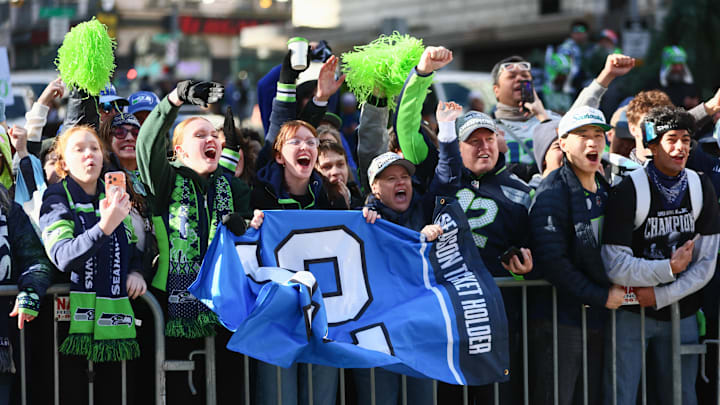
SEATTLE — On Wednesday morning, frigid temperatures gave way to tolerable cold and crowds on top of crowds on top of crowds. The local sports fan base descended anyway, despite dizzying logistical hurdles and ever more density, in human form, waving away responsibilities like work and school in order to congregate in the rarest possible way. These fans, proud and sensitive, had a major championship to celebrate.
My, oh, my.
We haven’t had a lot of those around here, where it’s beautiful and rainy and close to nature, where you can soak in pretty much anything—except for these exact parades. The first moved through downtown in 1979, after the SuperSonics gave Seattle its first major sports championship. The next, best I can tell, didn’t wind through these streets for 35 years. Not until the Seahawks won their first Super Bowl after the 2013 season. As Seattleites, we understand that weather cannot scuttle plans, so more than 700,000 showed up in sub-freezing temps for that one. Two smaller parades—for two WNBA titles won by the Storm, in ’18 and in ’20—followed.
Followed by, well, this.
Seattle’s professional sports history dates back to the Metropolitans, who began play in the Pacific Coast Hockey Association in 1915 and won the Stanley Cup two seasons later. Those Metropolitans folded in ‘24, which left Seattle without a pro team, in any major sport, until the late 1960s. Several franchises—SuperSonics (’67–68), Pilots (’69, became the Mariners), Sounders (’74), Seahawks (’76)—were soon created.
Whether counting the entire history or the fuller, more recent version, the point remains the same: That’s a lot of teams and a lot of seasons and, until Wednesday, four total championship parades. Four!
Which is why upwards of one million people descended upon downtown on a random weekday in mid-February: for another Parade Day in Seattle sports history. Every kind of person, speaking every kind of language, all ages, all sizes, all ethnicities … arriving via bus or light rail or car or train or taxi or electric scooter or motorbike or electric bike or regular bicycle or pedicab or on foot or, in at least one instance, on an electric unicycle … every strand of humanity forming streams of sports fans, forming seas of the same … all combining, as humans crowded onto and around every sliver of Fourth Avenue, climbing atop light poles and hanging from apartment railings, forming a citywide Blue Fan Group, dah-dah-dee-dump-do.
Because this is Seattle, there were roughly as many coffee cups as plastic ones.
Because this is Seattle, even the motorized scooters and bicycles are primarily lime green.
Because this is Seattle, anyone who happened to be downtown Wednesday, like my son and I, couldn’t turn their heads in any direction and not spy a No. 12. On our light rail train into downtown from Lynwood, 12s filled the car a little more each stop, until it was stuffed, then over-stuffed, then dangerously stuffed—and those closest to the doors had to turn into bouncers when masses at subsequent stops tried to push their way onboard.
“You know, I’ve never been to a parade before,” said one teenager, seated two rows behind us.
Join the club, buddy. Hence, the size of this celebration, which owed to the rarity involved. One dude wore a BabyBjörn, in which he’d carefully placed his adorable Shih Tzu, but not before adorning even the dog in a No. 12 jersey. My son, Blake, pointed at another couple nearby us—him, sporting a spiked mohawk dyed neon green; her, clad in neon green faux leggings and a neon green wig.
Because this is Seattle, she apologized for crowding us. No need.
We walked those downtown streets for two hours. Saw four generations of one family locked in a poetic embrace. Passed Seahawks sweaters, hats, gloves, sunglasses, leggings, tights, jerseys, T-shirts, Dri-Fits, sweatshirts, bomber jackets, beanies, socks, track jackets, leather jackets, scarves, Christmas sweaters and even one Seahawks-themed bicycle.
What we saw—educated guess here—was the dawn of the very first golden age of Seattle sports. The Mariners and Seahawks had never made the postseason in the same year before this one. The Mariners came one victory from making their first World Series. The Seahawks lugged their second Lombardi Trophy down Fourth Avenue on Sunday afternoon. There’s no reason to think both those teams won’t contend in 2026. Meanwhile, the rest of the scene could be described as promising—Washington football appears to be on an upward trajectory, the Storm are young and talented and made the playoffs last season, and the World Cup will feature games here in the months ahead.
At one point, amid the blue lipstick and painted faces and the baby sucking on, yes, a No. 12 pacifier, after a few thousand “SEA! HAWKS!” chants … before a few thousand more … Blake turned to me. The crowd was getting rowdier; available space was shrinking.
“Is this why people love sports?” he asked.
I choked back a few old man tears. I lost my fandom a long time ago, and that Mariners run last season served as a reminder that my kids should experience sports fandom, whether I ever will again or not. I hugged the boy. He seemed embarrassed by my affection. He’d clearly already forgotten about our gelato-for-breakfast incentive.
“Yes,” I finally choked out. “This is it. This. Exactly.”
“Can we go to my Valentine’s Party now?” he asked.
See? That’s the dawning. He thinks there will always be another parade.
What follows is a compilation of what we couldn’t fit into this Super Bowl cover story and what wasn’t written up before the game but stands out now, after a brief review of 250-plus pages of notes and transcripts reported for Super Bowl LX. Consider these “leftovers” in name only. The depth of the reporting for this cover story was among the deepest I’ve had in 12 versions, each reported both ways. To wit:
The Pete and John Story, in Brief
Pete Carroll and John Schneider partnered in early 2010. They shared a vision for professional football in Seattle that stood in stark contrast to the Seahawks’ history, with one run and one championship game appearance, a loss, in Super Bowl XL—interrupting 35 years that otherwise played out like a sad trombone.
Seattle’s sports scene had plummeted to its nadir only two years before this football partnership. In 2008, Washington’s once-mighty college football team finished 0–12, losing as many games as the Seahawks, who at least won four. The Mariners finished in last place in their division, too, extending what would become the longest drought without a postseason appearance in all of professional sports. Even the SuperSonics left for Oklahoma City that year.
Still, Schneider sensed momentum building at Seahawks headquarters; in fact, he applied for that GM gig in 2005. Seattle hired Tim Ruskell, whom Schneider replaced five seasons later. At the outset, Schneider wanted home games to feel the way they did in his home state of Wisconsin, where fans owned the Packers, brats sizzled in freezing temps, and a collegial atmosphere engulfed the professional sports scene, a rarity that grows rarer each season.
For 14 years, this partnership doubled as a potential Netflix buddy comedy. It worked—and not fairly well, but exceptionally so. Only the most spoiled of 12s would gripe about 137 regular-season wins, 10 playoff berths and two Super Bowl appearances—plus, of course, the Seahawks first and then-only championship, a decimation of the Broncos in XLVIII.
That said, the following Super Bowl and especially how it ended, with Malcolm Butler intercepting Russell Wilson in the end zone, combined with the longevity of Carroll’s messaging, forced the need for a new voice at the helm. From 2016 through ’23, Seattle presented as a good team whose best skill was treading water. High floors, low ceilings—that was the general calculus each season. The Seahawks still made five playoff appearances in that eight-season, post-interception stretch. They won two playoff games, too, but never advanced beyond the divisional round until ‘25.

Carroll soon became one of the NFL’s oldest head coaches, and Schneider, 38 years old when the Seahawks hired him, knew that Carroll retained the final say for as long as he remained head coach. There wasn’t any blow-up between the partners; Carroll, those close to him say, is nonconfrontational at his core. But rumors began swirling—Seattle might move on.
They first surfaced after 2017, when the Seahawks missed the playoffs for the first time in six seasons. Paul Allen, Seattle’s owner—and the strongest Carroll advocate—died of septic shock the next October, which threw the franchise’s ownership structure into flux. His sister, Jody Allen, would take over. And, after three middling seasons, from ‘21 through ‘23, rumors transformed into reality.
The official line was that Carroll would become an advisor, helping Schneider and the new head coach, in roles not defined in the initial news release. The move was announced by Jody Allen. Carroll’s role remained undefined because, for him, in Seattle, it was never real. Not to him. Carroll never returned to the Seahawks waterfront headquarters again after that press conference, according to three of his confidants.
In the years after the back-to-back Super Bowl appearances, Schneider had proven adept at moving on from established players, even superstars, before the wider football world considered them in decline. Seahawks past and present consider their general manager to be more human than many of his counterparts. But as he jettisoned superstars, cornerstones, legends—Richard Sherman and Michael Bennett (2018), Earl Thomas (’19), even Wilson (‘22)—Schneider proved he could be cutthroat when necessary, too.
None of that was easy. All came with the gig, which pointed toward only one goal: another title. Even Legion of Boom–era Seahawks understood the decisions Schneider had to make, those he describes in one word, s—ty. “Did he make decisions that I would, at the time, think, ‘What the f— are you doing?’ Yes,” retired wideout Doug Baldwin says. “The thing I love about John is that he humanized that world as best he could. He’s making really, really tough decisions. And he [has] been very honest and explicit about that. And he’s managed it, at least from my vantage point—I don’t know if everybody feels this way—to the best of his ability.”
Baldwin also says that Schneider “made the right decision—for the organization and for Pete.”
Once Seattle hired Macdonald, the bridge between these eras opened once again, which was natural, owing to a fuller turnover. From XLIX, only Schneider and a handful of other team employees remained. Fresh faces helped the former players ease “the tension.” Less-fresh faces helped current players understand that they’re not done yet.
Baldwin disdained that play call. But he never allowed one play to define his opinion of Carroll, as a human being or as a coach. “I love Pete,” Baldwin says. “I know what type of team Pete was trying to build, what he was trying to do. The team that is going to the Super Bowl … I see a lot of Pete Carroll in them.”
Rashid Shaheed Can’t Make Sense of the Saints’ Decisions This Season, Either
After the NFC championship triumph, I squatted before Rashid Shaheed, the Seahawks’ all-purpose speedster who had already changed games with returns and explosive offensive plays, which, in turn, shifted the tenor and top trajectory of Seattle’s season. I asked how a team could employ him, before the trade to Seattle at the deadline, and decide to not deploy Shaheed on kickoff returns, punt returns or both. “I just do my job,” he responded that night. “Our coaches here put us in position to succeed. [The Seahawks] knew what I was capable of, put me in early and in a position to succeed.”
Read between the lines there.
SI: “Has special teams ever played as big a role for a Super Bowl contender as this one?”
RS: “It’s a big phase for us. We win because we play together. All three phases.”
The Prayer That Would Be Answered
Only 18 days after the greatest era in Seahawks history officially ended with Carroll’s awkward departure, Schneider took great interest in a playoff game that didn’t involve his Seahawks and yet, sorta … did. He didn’t just like Baltimore’s young, nerdy, analytical defensive coordinator. He wanted Mike Macdonald. And to hire Mike Macdonald, Schneider needed the Ravens to lose the AFC Championship game, at home, against the Chiefs. They did. Schneider hired Macdonald three days later.
Those who understood football at its deepest schematic depths knew Macdonald was different. The easy comparison was to Sean McVay; both young, both brilliant, both far ahead of every schedule except their own. Older readers might want to skip this next sentence. Macdonald is a legitimate millennial, born in 1987, only 36 when Seattle hired him, the youngest head coach in the league.
Even Tom Brady loved the hire. While in Tampa, he’d played against Baltimore in 2022—and found the Ravens defense, coordinated by Macdonald, to be swarming, unyielding and perplexing. Macdonald presented varied looks. He minimized explosive plays and made quarterbacks read defenses after the ball snapped. “His players in Seattle are actually a bit bigger, faster, a little more athletic,” than the Legion of Boom defense that Brady faced, he says. “Mike’s into the nuances. He reminds me a lot of Josh McDaniels—on defense.”
Shaheed’s Lead-Up Loss
I spoke to Rashid’s father, Haneef, on Tuesday of game week. We’d had trouble connecting, because the Shaheed family was dealing with far more than football. Rashid’s grandfather—Haneef’s father-in-law—had died from the exacerbation of a longtime illness. It wasn’t sudden, Haneef says, but after fighting this illness for a few years, his father-in-law’s further deterioration had happened “very, very rapidly.”
“We have not actually talked to (Rashid) about it yet,” Haneef says Tuesday.
Which is how I came to sit on this information until after I could speak with Shaheed during the post-game celebration last Sunday night. Haneef said his son could tell something was up; their family is close—so much so that in the cover story, we reported that Rashid calls his parents over video before he runs out of the tunnel and the game starts every week, and Rashid could tell by hearing his mother’s voice that something wasn’t right. His grandfather was a Marine, not huge into football but a steady presence in Rashid’s life. When I caught up with him the night he became a Super Bowl champion, he dedicated the triumph to his grandfather’s memory.
I also liked this stuff, on the family’s speed, from that same interview:
His son’s speed starts with an exceptional range of motion, Haneef says. Rashid projected as a natural 400-meter runner, meaning he embraced the pain of sprinting all the way around the track, in part because his natural stride length and strength improvements allowed him to reach maximum velocity quickly and maintain it through longer sprint distances.
Rashid was never timed in the 40-yard dash, his father says. He played in college at Weber State and wasn’t invited to the Combine, which should tell you how much those 40 times actually matter. Just a speed guy was his ghost.
This bothered Haneef, who knew Rashid had grown up playing running back. As an introvert, he immersed in football studies. He slid through tight spaces, embraced contact. He wasn’t simply outrunning his opponents. (Although he did that, too.) Like Darnold, Rashid needed “a team that really showcases his ability,” Haneef says.

More Darnold
Sam Darnold is not a Samuel. Even his name reclines. He’s like a La-Z-Boy, minus the laziness, or the surfer dudes who flock to his hometown of San Clemente, Calif. Except Darnold has only tried surfing once. And that might have been the only time in his life he didn’t get up. It wasn’t for lack of trying.
Canvas his inner circle, which is limited in general and severely limited in terms of people who will talk. When his father, Mike, called last week, he started by saying he hadn’t done an interview since the Jets days. Crack? Not Sam. His lowest point came during the global pandemic, when the Jets finished 2–10 in games he started, while he isolated.
It wasn’t all that low. He dresses like his friend, Olympic surfer Kolohe Andino. A Day 1 Darnold fan, he is. For years, whenever a friend said, “Darnold sucks,” Andino lost his mind. He drafted Darnold for his fantasy teams, believing when the bandwagon had all but emptied. (This year, for the record, Andino was not able to draft his buddy, finished in last place, and will soon film a video of himself surfing while wearing a bikini as penance.)
“(Darnold) doesn’t act like American sports royalty,” Andino says. “He’s wearing surf-brand flannels when he’s signing with the Seahawks.”
Sam, not Samuel, helped his parents endure the roughest years, the miserable Jets seasons from 2018 through ’20 and two more in Carolina, where it seemed hopeful, for a week or two. But nothing ever worked. This is why Mike Darnold has avoided even meeting Schneider. He says he doesn’t want another GM to lie to him.
Connective Tissue
From Nick Emmanwori, to Sports Illustrated, regarding Cooper Kupp, Schneider and the connectivity ever-present in the Seahawks locker room this season: “Cooper’s addition to the team is one of those crazy, underrated, perfect moves—like every piece of this team that John’s built. The locker room here is second to none. Like, every day is fun—we laugh and joke and shadow box, we’re playing games, home run derby. It feels like college locker rooms, and most miss that when they go to the NFL.”
Future Forecast (Not Rainy in Seattle):
From the Dynasty That Never Was to this, the Dynasty That Now Can Be, most look at this Seahawks roster—the number of young players still on team-friendly contracts, the ability to bolster depth in the upcoming draft, and the number of cornerstones locked in for the next few seasons—and see a franchise with a better-than-average chance to repeat. Which has only happened twice this century—with the Patriots in the mid-2000s and the Chiefs more recently.
I was texting with Jeff Ament, the Pearl Jam bassist and co-founder, before kickoff. He already believed those sentiments before the triumph. “Feeling great about the next few years,” writes one of Seattle’s celebrity sports fans, “We young :)”
That’s true. Seattle has also pointed toward a path forward that runs counter to the NFL’s modern offensive explosion. In an NFC West— football’s strongest division in 2025—dominated by offenses that amass points as if they’re trying to break scoreboards, the Seahawks didn’t ignore their offense. Still, Schneider chose disruption. He hired a defensive-minded head coach, who brought with him an evolved and evolving scheme—multiple looks, two safeties back, a front that must stop the run without a ton of extra blitzers, five defensive backs on 92.5% of all defensive snaps and endless versatility. Other teams will scour for similarly brilliant defensive-minded coaches—Mike Vrabel is one of those, too. Whether they can emulate these Seahawks will be answered next season and in subsequent seasons after that.
Either way, Seattle’s football team will have first-mover advantage, the ability to build on what they did in 2024 and ’25, not implement what they have already implemented.
More NFL on Sports Illustrated
 Add us as a preferred source on Google
Greg Bishop was a senior writer for Sports Illustrated and has covered every kind of sport and every major event across six continents for more than two decades. He previously worked for The Seattle Times and The New York Times. He is the co-author of two books: Jim Gray’s memoir, “Talking to GOATs”; and Laurent Duvernay Tardif’s “Red Zone”. Bishop has written for Showtime Sports, Prime Video and DAZN, and has been nominated for eight sports Emmys, winning two, both for production. He has completed more than a dozen documentary film projects, with a wide range of duties. Bishop, who graduated from the Newhouse School at Syracuse University, is based in Seattle.
Follow GregBishopSI