%20%20--%3E%0A%3Csvg%20version%3D%221.1%22%20id%3D%22Layer_1%22%20xmlns%3D%22http%3A%2F%2Fwww.w3.org%2F2000%2Fsvg%22%20xmlns%3Axlink%3D%22http%3A%2F%2Fwww.w3.org%2F1999%2Fxlink%22%20x%3D%220px%22%20y%3D%220px%22%0A%09%20width%3D%2239px%22%20height%3D%2240px%22%20viewBox%3D%220%200%2039%2040%22%20enable-background%3D%22new%200%200%2039%2040%22%20xml%3Aspace%3D%22preserve%22%3E%0A%3Cpath%20fill%3D%22%23FFFFFF%22%20d%3D%22M38.5%2C7H28.2v26h10.3V7z%22%2F%3E%0A%3Cpath%20fill-rule%3D%22evenodd%22%20clip-rule%3D%22evenodd%22%20fill%3D%22%23FFFFFF%22%20d%3D%22M26.1%2C25.5c0%2C5.8-4.1%2C7.5-12.9%2C7.5C3.9%2C33%2C0%2C31.2%2C0%2C25.2v-1.1h11.6%0A%09v2.4c0%2C0.7%2C0.1%2C1.4%2C1.2%2C1.4c1%2C0%2C1.2-0.4%2C1.2-1.3v-0.9c0-1.6-0.9-1.6-3.5-2.2C2.2%2C21.7%2C0%2C19.7%2C0%2C15.3v-0.9C0%2C9.3%2C5.5%2C7%2C12.9%2C7%0A%09c10.2%2C0%2C12.8%2C2.6%2C12.8%2C7.4v1.8h-11v-2.9c0-0.6-0.4-1.1-1.2-1.1c-0.6%2C0-1.2%2C0.4-1.2%2C1.1v0.9c0%2C1.5%2C0.9%2C2%2C3.3%2C2.5%0A%09c8%2C1.6%2C10.5%2C3.3%2C10.5%2C7.5V25.5z%22%2F%3E%0A%3C%2Fsvg%3E%0A)
The History of the Hail Mary and the Play That Keeps It Alive
In this story:
It’s a mall now. No marker for the occasion, likely because it was a painful memory for most who witnessed the moment in person.
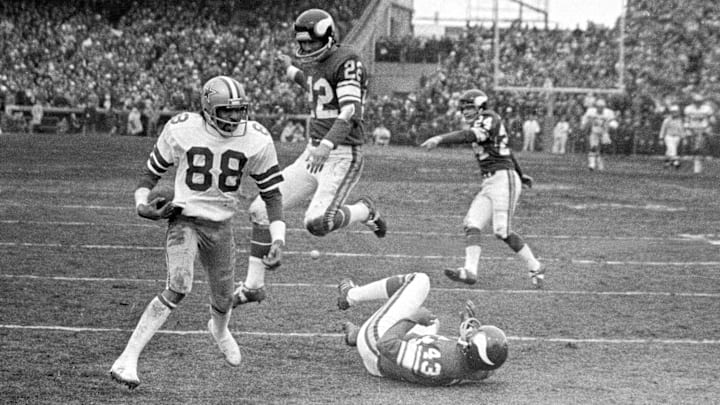
On Dec. 28, 1975, Drew Pearson caught a touchdown pass, one of 56 in his career, including the postseason. It won a game for a team that didn’t win the Super Bowl that year, but is primarily remembered as the most iconic six points of the decade this side of the Immaculate Reception.
Pearson’s 50-yard touchdown catch gave his Cowboys a 17–14 win over the Vikings in the NFC divisional round, helping an underdog Dallas team reach Super Bowl X. It also provided a generational highlight, a play referred to annually when a miracle is required on a football field.
“Life after the Hail Mary, after that play, that term has been brought up so many times. But also the controversy surrounding the play, whether I pushed [Vikings cornerback] Nate Wright or not, whether it’s a pass interference or not. That debate keeps the play alive.”Drew Pearson
“Life after the Hail Mary, after that play, that term has been brought up so many times,” Pearson says. “It’s been brought up in reference to politics, charity, personal lives and things like that. So that keeps it alive—people talking about it and referring to their own personal situations as Hail Mary situations. But also the controversy surrounding the play, whether I pushed (Vikings cornerback) Nate Wright or not, whether it’s a pass interference or not. That debate keeps the play alive.”
After the game, star quarterback Roger Staubach was asked by the media about the play. The devout Catholic said he threw the ball and recited the Hail Mary prayer, asking the Virgin Mary for a gift from above. Since then, the play has become part of the American lexicon forevermore, spawned by a pair of Hall of Famers hooking up for an impossible play in the throes of desperation.
But the story doesn’t end there. As it turns out, it doesn’t begin there, either.
The Hail Mary in its earliest form
R.C. Owens isn’t a household name, but he should be. He was inducted into the 49ers’ Hall of Fame in 2011 and, during his playing days, was a second-team All-Pro in 1960. He played for the Colts, Giants and San Francisco, and totaled a respectable 3,285 receiving yards and 23 total touchdowns over his eight-year NFL career (1957 to ’64).
Yet Owens should be remembered as a legend, helping launch the Hail Mary in its earliest form. A play known then as something which would later earn fame in another sport: the alley-oop.
Perhaps Owens’s claim to football lore should be rooted in what has become basketball language. He was a star on the basketball court at the College of Idaho, sharing the court with Elgin Baylor, an eventual Los Angeles Lakers legend who was named one of the 50 greatest players in NBA history by the league in 1997. With Idaho, the 6’3" Owens was a rebounding machine, grabbing 21.6 rebounds per game over his career, helping him notch an incredible 99 consecutive double-doubles for the Coyotes.
In the NFL, Owens used his exceptional leaping ability as a wide receiver. As a rookie in 1957, the Niners twice connected on the alley-oop to win games, against the Rams and Lions, helping San Francisco go 8–4 before losing a tie-breaker playoff game in the Western Conference to Detroit.
Unlike Pearson’s play, there’s no seminal moment for Owens. He never won a postseason game, and most of his alley-oop greatness has been lost to time, as NFL Films didn’t regularly cover games until 1963, the year after he scored his last touchdown.
Yet Owens and his 49ers were innovators—coach Red Hickey is also credited with bringing the shotgun formation to the NFL—setting the stage for Pearson and the Cowboys to change the game.

‘It was a perfect pass’
Staubach was out of ideas. Trailing 14–10 with 1:51 remaining in the fourth quarter, Dallas was 75 yards away from the end zone at Metropolitan Stadium in Bloomington, Minn., against the 12–2 Vikings, an eight-point favorite.
In the huddle, Staubach had a simple question: “Drew, what do you have?”
The first answer was a comeback route, gaining nine yards on first down. Two plays later, Golden Richards caught a ball on the left side, gaining seven yards and a fresh set of downs at the 32. After a seven-yard loss on a bad snap and two incompletions, Dallas had a fourth-and-17 from its own 25-yard line with 44 seconds left. Again, Staubach asked Pearson what play he wanted to run.
Pearson’s choice was a deep square out on the right side against Wright. While Pearson was running his route, Staubach was loading up from the left hash before firing, nailing Pearson between the numerals at midfield. Wright forced Pearson out of bounds while airborne, but by the rules of the time, the catch counted and gave the Cowboys a second life.
The play was instructive. Pearson and the Cowboys believed they could take advantage of Wright, a seven-year veteran who went on to play 156 games and started in three Super Bowls. However, Wright tended to plaster routes as a man-cover corner instead of allowing routes to develop in front of him, even when in zone coverage. On fourth-and-17, Pearson felt confident he could find room.
“The last thing Roger said when we broke the huddle, he said, ‘Drew, make sure you get enough for the first down,’” Pearson says. “And so we hit that for 25 yards and the first down. Roger was on the far hash mark when he threw that ball across the field. I was on the other side. He threw that ball across the field. It was a perfect pass.”
After a drop by running back Preston Pearson on the ensuing first down, Dallas had second-and-10 from the 50. Once more, Staubach asked his future Hall of Fame receiver what he wanted.
This time, the answer was a long one.
Warren Wells and the alley–oop
Before Pearson but after Owens existed a man few modern fans remember. A man who only lasted five seasons in pro football before legal troubles and personal demons took away what could have been a Hall of Fame career.
When thinking of the 1960s and star receivers, the name Warren Wells doesn’t come to mind for many, but it should. Wells spent one season with the Lions in 1964 before military duty took him out of the NFL and into the AFL in ’67, where he spent four glorious seasons with the Raiders.
In Oakland, Wells became a star, earning two trips to the Pro Bowl and a second-team All-Pro honor. In 1969, Wells led the AFL in receiving with 1,260 yards and 14 touchdowns on 47 receptions, giving him an absurd and league-leading 26.8 yards per reception. If Wells qualified, his career mark of 23.1 yards per catch would have shattered the recognized mark of 22.3 by Homer Jones (the qualification is 200 career receptions; Wells had 147). Only six players in league history have eclipsed 20.0 yards per catch.
“When Warren Wells was with the Raiders running that alley-oop, it was just him and the defender man-to-man,” Pearson says. “He would go up and get that great pass from Daryle Lamonica or later [Ken] Stabler and make those plays. But it was a man-to-man situation.”
In 1970, Wells contributed his portion to Hail Mary fame, well before it was known as such. That season, the Raiders were viewed as miracle workers, winning a multitude of games on the strength of wild endings and George Blanda kicks.
Facing the Jets at Shea Stadium in Week 12, the Raiders needed a win to stay in the hunt for the AFC West title. Trailing 13–7 at New York’s 33-yard line with time for only one play, Lamonica went skyward for Wells in the end zone. Wells, triple-covered in the left corner, caught the deflected pass before tumbling to the ground, giving Oakland a 14–13 win. Eventually, the Raiders won the division for the third time in four years.
For a brief period, Wells was the ultimate deep-ball threat—a wideout who stretched the field in a way few had prior and few have since. And in the age of Hail Mary attempts that look more like a heave to one man than to a crowd, he was the prototypical weapon to use.
Wells finished the 1970 season—the first after the AFL-NFL merger—as a Pro Bowler with 935 yards and 11 touchdowns. In the ensuing offseason, Wells was arrested and served time in jail, then never played another down.

‘The guy we wanted to attack’
With 32 seconds remaining, Pearson once again lined up to the right, covered by Wright. The choice wasn’t accidental.
“We knew through our preparation, and what they were doing that particular day, the guy to attack with the routes we needed with the counter routes was Nate Wright’s side of the field,” Pearson says. “And the reason is that even though they played a zone defense, when you came into Wright’s area, he picked you up, man. And so we knew the counter routes would work on Wright’s side, rather than on the other side with Bobby Bryant.
“[Bryant] was a cluer. He’s not looking at you. You can do all the routes you want. He’s not looking at you. He’s looking through you to the quarterback. When he sees the quarterback raise to throw the ball to you, that’s when he jumps around.
With Wright, even though it’s zone, he played it like man if you came into his territory. So that’s the guy we wanted to attack.”
On the snap, Staubach took the shotgun snap and pumped left toward wideout Golden Richards in an attempt to hold safety Paul Krause. The pump-fake worked, as Staubach then wheeled his body to the right and threw deep for Pearson, with Krause in a desperate pursuit.
“If you use your inside arm, which is right next to the defender, you turn right into the defender. In doing that, when I brought my arm around, yeah, I hate Nate Wright. I’ve bumped him, sure. This is football. This was not golf or tennis.”Pearson on his Hail Mary catch
“Again, I’m up on the right side on Wright,” Pearson says. “This time, instead of running a post corner, I run a turn-in and take off. The turn-in was my bread-and-butter route. I’m sure that’s a route they studied when they prepared for me in that game, because I used to run that route, and most of the time I ran it was on third down. So we knew he might bite on the turning, and he did. And then we took the deep [shot]. And when I took it deep, Wright and I were even going down the field, but I knew I had another gear to shift into if that ball was thrown out there. I wasn’t very fast, but I had great speed to the football. I could outrun Bob Hayes [known as the ‘World’s Fastest Human’ after winning the gold medal in the 100 meters at the 1964 Olympics] to the football.
“I was expecting Roger to throw it out there, but because he pumped Golden Richards so hard that by the time he brought it back to me, I was way downfield, and I could see that it was on the throw, and I knew I had to come back to the football, and in doing that, Wright and I are even. In doing that, I knew to get inside position to get to that football. I had to use my outside arm. If you use your inside arm, which is right next to the defender, you turn right into the defender. In doing that, when I brought my arm around, yeah, I hate Nate Wright. I’ve bumped him, sure. This is football. This was not golf or tennis.”
After Pearson went into the end zone, chaos reigned. Minnesota defenders went berserk, claiming Pearson had committed offensive pass interference by shoving Wright. While the Vikings screamed, the Cowboys exalted. Pearson took the ball and threw it over the scoreboard and into the parking lot. A horde of teammates streamed onto the field to mob him under the uprights.
After the kickoff, Minnesota ran a play that resulted in a sack of quarterback Fran Tarkenton. Right afterward, a fan launched a bottle at official Armen Terzian, striking him in the head, causing the public-address announcer to implore fans not to throw objects.
The season was over for the Vikings, victims of divine intervention.

How the Hail Mary has evolved
In the 50 years since Pearson broke 46,425 frozen hearts at Metropolitan Stadium, the Hail Mary has evolved, and maybe not for the better.
Over that half-century span, there have been some more miracles performed that would show up on any highlight reel. In 1980, ironically also at The Met, the Vikings won the NFC North crown when Tommy Kramer connected with Ahmad Rashad on a Hail Mary play called “Squadron Right.” In ’83, the Falcons upset the 49ers on a 47-yard bomb to Billy Johnson. Those two teams had a similar play again at Fulton County Stadium in ’91, when Michael Haynes came down with a 44-yard prayer from Chris Miller, helping Atlanta reach the postseason for the first time in 10 seasons.
Last year, the Commanders launched their improbable run to the NFC championship game when Jayden Daniels and Noah Brown connected on a 52-yarder at the gun in Week 8, giving Washington an 18–15 triumph over the Bears.
Of course, nobody has thrown the Hail Mary better than Aaron Rodgers, who famously found Jeff Janis against the Cardinals in a 2015 divisional round contest, tying the game at 20–20 on the final play of regulation. That same season, Rodgers found tight end Richard Rodgers in Detroit on a Thursday night with a 61-yard spiral, beating the Lions 27–23.
Yet there’s an open question of whether the Hail Mary is executed wisely. When Pearson, Owens and Wells made their names, they were running single-man routes to the goal line. Now, the play is almost universally about creating a crowd of receivers and defenders, oftentimes with the latter group composed of both offensive and defensive players.
Essentially, it’s a jump ball relying on a deflection. Pearson, for one, says he’s surprised teams employ the strategy they do in the current NFL.
“You know why? Because there are so many options you could still run off of that, you know,?” Pearson says. “You know, you could run two guys lined up on the same side and run them both down to the end zone like that and then have one break off over the middle and have that receiver from the off side come and pick up a block so you could take it to the house, you know, all designed in the same place. So you could do those kinds of plays, have those kinds of options off that same play.”
Ask a defensive coach, and they look at it another way. While the Hail Mary is a play that comes down somewhat to luck and chance, its current form is really about combining two sports into one for proper defense. Just like Owens showcased more than 65 years ago, it’s a combination of basketball and football.
“[Our] top detail: BOX OUT YOUR MAN!!!,” one Super Bowl–winning defensive coordinator texted on the condition of anonymity. “Players responsible for back tip. Do your job. Issues come up when guys abort their job and go for the ball. If all do like the playbook says there should never be an issue.”
Still, regardless of how the play is executed, there’s a certain magic in the moment. The Hail Mary is the name of a prayer, and there’s nothing more dramatic than seeing someone’s prayer answered in real time.
And while Staubach, Pearson and the 1975 Cowboys didn’t invent the play, they get proper credit for it transcending football and becoming more than a touchdown in a desperate moment, but rather a representation of why to never give up hope.
The Mall of America now stands where Pearson once did. There’s no tangible reminder of the play. But some things don’t need a reminder to be remembered. Some images and feelings live on their own.
No feeling is more so than the notion of a prayer answered.
More NFL on Sports Illustrated
 Add us as a preferred source on Google
Matt Verderame is a national NFL staff writer for Sports Illustrated, writing features, columns and more. Before joining Sports Illustrated in March 2023, Verderame wrote for FanSided and SB Nation. He’s a proud husband to Stephanie and father of two girls, Maisy and Genevieve. In his spare time, Verderame is an avid collector of vintage baseball cards.
Follow MattVerderame