%20%20--%3E%0A%3Csvg%20version%3D%221.1%22%20id%3D%22Layer_1%22%20xmlns%3D%22http%3A%2F%2Fwww.w3.org%2F2000%2Fsvg%22%20xmlns%3Axlink%3D%22http%3A%2F%2Fwww.w3.org%2F1999%2Fxlink%22%20x%3D%220px%22%20y%3D%220px%22%0A%09%20width%3D%2239px%22%20height%3D%2240px%22%20viewBox%3D%220%200%2039%2040%22%20enable-background%3D%22new%200%200%2039%2040%22%20xml%3Aspace%3D%22preserve%22%3E%0A%3Cpath%20fill%3D%22%23FFFFFF%22%20d%3D%22M38.5%2C7H28.2v26h10.3V7z%22%2F%3E%0A%3Cpath%20fill-rule%3D%22evenodd%22%20clip-rule%3D%22evenodd%22%20fill%3D%22%23FFFFFF%22%20d%3D%22M26.1%2C25.5c0%2C5.8-4.1%2C7.5-12.9%2C7.5C3.9%2C33%2C0%2C31.2%2C0%2C25.2v-1.1h11.6%0A%09v2.4c0%2C0.7%2C0.1%2C1.4%2C1.2%2C1.4c1%2C0%2C1.2-0.4%2C1.2-1.3v-0.9c0-1.6-0.9-1.6-3.5-2.2C2.2%2C21.7%2C0%2C19.7%2C0%2C15.3v-0.9C0%2C9.3%2C5.5%2C7%2C12.9%2C7%0A%09c10.2%2C0%2C12.8%2C2.6%2C12.8%2C7.4v1.8h-11v-2.9c0-0.6-0.4-1.1-1.2-1.1c-0.6%2C0-1.2%2C0.4-1.2%2C1.1v0.9c0%2C1.5%2C0.9%2C2%2C3.3%2C2.5%0A%09c8%2C1.6%2C10.5%2C3.3%2C10.5%2C7.5V25.5z%22%2F%3E%0A%3C%2Fsvg%3E%0A)
The Unlikely Origins of the Patriots’ Four H’s Bonding Exercise
In this story:
SAN FRANCISCO — Ellen Geraghty would like to make one thing very clear: Despite being a Patriots fan who lives and works in Massachusetts, she refuses to claim responsibility for, and cannot in good conscience become the face of, one of the most stunning and unpredictable Super Bowl runs in recent NFL history.
Noted.
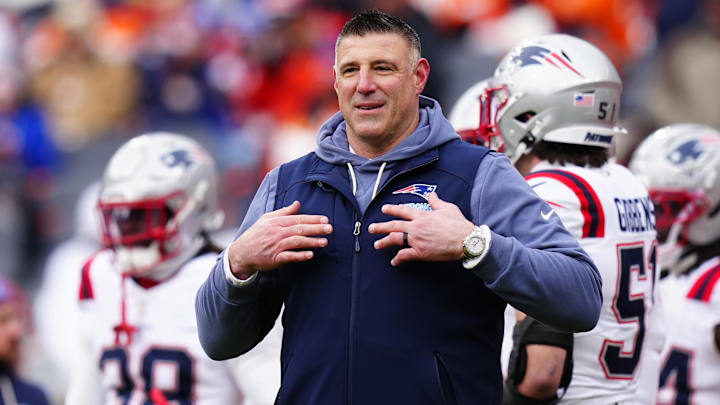
However, the therapist and former college basketball standout, along with her wife, Erika Valek, a fellow therapist and basketball star who played at Purdue, are an important part of a serendipitous story; characters in an unfolding of events that, when set into motion decades ago, arrived unknowingly at the doorstep of Patriots head coach Mike Vrabel and unleashed a force of humor, positivity, vulnerability and friendship that helped shape this team of lovable misfits.
“It’s a testament to the fact that it takes a village,” Geraghty says. “And, people being generous enough to share their expertise and things that work. A lot of people tend to hold their cards close, and this is one of those examples where people are willing to share. And that’s pretty cool.”
In the NFL, inspiration for plays can come from anywhere, be it a lacrosse game, an NBA inbounds pass or grainy footage of some pre–World War II wing T abomination. And within that context, those schemes and concepts are put on film for other coaches to liberally borrow. Like the world of art and literature, some coaches are better at hiding the sources of their theft, disguising it with different motions or personnel. Others are content to be plagiarists. Either way, it’s understood and accepted.
Apparently, the same can be said for the emotional bonding techniques that take place behind the scenes. While these can sometimes exist as a trope used to explain a less sexy amalgam of schedule strength, variance in luck-oriented outcomes and a handful of other factors that marry together at the perfect time, the Patriots insist that a few of them have paved the way for their appearance here in the Bay Area. One in particular, called the Four H’s, receives the most credit and has been the subject of countless articles and television specials. In it, Patriots players and coaches were asked to stand and deliver their personal examples of their heroes, history, heartbreak and hope. In the months that followed, they grew closer and more understanding of one another.
However, just as fascinating as the subsequent outpouring of fragility and love is how, just like the creation of an NFL play, it endured countless iterations, cast adrift like a destrung, helium-filled birthday balloon, only to land at the perfect place and time. At each turn, it was molded just a bit by circumstance. The Four H’s are now at every corner of the coaching world, from high school basketball to executive boardrooms.
But back in the early 2000s, there were only Three H’s, two of them that wouldn’t make the final cut. And after nearly a dozen phone calls, text messages and emails, we can figure out precisely how it came to define Super Bowl LX.
“I saw an article about the Patriots doing the Four H’s, and I just giggled,” Geraghty says.
It was 2004, or maybe 2005, when Geraghty was playing fall basketball for a team sponsored by Athletes in Action, a faith-based sports organization that marries athletic development with tenets of a spiritual life, culminating in a mission trip. That’s when she was first asked to share her hero, highlight and hardship. She credits the organization with being the first time she’d heard of the exercise.
Valek, whom she met through Athletes in Action basketball, made the first significant tweak to the Three H’s, noting that there should be a fourth H: hilarious. After she and Geraghty brought the Three H’s from their own AIA playing days to other workshops with women’s college basketball teams and even the Colombian women’s national team, Valek felt the icebreaker needed a mood lightener before it transitioned to the next presenter if the previous person had just expressed their hardship.
From there, Geraghty found herself on the phone one day with Cori Close, the women’s basketball coach at UCLA since 2011. Close is an avid consumer of motivational content (scrolling through her Instagram is like being shuttled through a pep-talk car wash, which I’d highly recommend if you’re ever having a bad day) and is legendary for her sprawling reach for valuable team-building content. Geraghty relayed the exercise, saying it was one of the most powerful during her time with AIA and as a basketball coach herself.
“Cori’s the type of person who reaches out and gathers information,” Geraghty says. “Her team is always top in the nation because she’s humble enough to ask for help. She gathers knowledge and is willing to share it.”

Close, as it turns out, is a frequent interview guest and collaborator with Jon Gordon, the motivational speaking star who has worked with the Rams’ Sean McVay, Dodgers’ Dave Roberts and Clemson’s Dabo Swinney, and who has spoken at countless seminars and events across the country. Chances are, if you have a child in elementary school, they have been taught one of the tenets of his popular books, The Coffee Bean or The Energy Bus.
Gordon, in an interview about his 2015 book You Win In The Locker Room First, where the Three H’s first appeared, said it helps “make the team tougher. Being tough doesn't mean that you’re not real. Being tough doesn’t mean that you don’t share what’s on your heart and who you are. Being tough doesn’t mean you don’t cry. You might cry and you can still be very tough. It just means that you, you feel.”
Close, appearing on Gordon’s podcast, said it was her go-to for the first time her team was together in person.
You Win In The Locker Room First was cowritten by former Falcons head coach Mike Smith and became a popular reference for team builders in need of effective solutions to bring their groups closer together.
Around the time it came out, another furious consumer of motivational exercises, Mike Rhoades, then the head men’s basketball coach at Virginia Commonwealth University, picked up a copy and modified the H’s again to fit the vibe of his own locker room and what he was going through in his life. He finished with hope, which, he says, helped him reconcile with his own thoughts on losing his father, a beloved Pennsylvania state senator named James J. Rhoades, back in 2008 to a drunk driving accident.
“I think when we would do that exercise, it gave me warmth about, I’m not the only one that’s gone through this, others have gone through this,” Rhoades, now the head coach at Penn State, told me. “It’s not about going into a hole. It’s the responding and making those you want to honor proud. Without a doubt it’s helped. I've always said being a coach and being around young people makes you understand and work on yourself all the time.”
Rhoades calibrated the Four H’s to ensure that his kids—many of whom had never spoken in front of a group before—didn’t have to feel uncomfortable for too long. Now, the exercise had a pace and the proper rhythm.
“The goal is next year when we do it again, he speaks for two and a half minutes and he’s comfortable. So a lot of kids now in today’s world, they’d rather tweet everything or text everything. So to get up and speak in front of everybody, even for probably professionals and players in New England, it’s hard for some of those guys to express how they feel in front of their peers because it shows a level of weakness.
“Well, I hope we have the teams—I’ve always tried to build a family where we have a net, right? We can catch each other and we support each other. That’s really important to me. And I think that when we do this exercise, it really provides that, that it’s a safe place. And we’ve got your back.”
During Rhoades’s time at VCU, his top assistant was a coach named Jimmy Martelli (now the associate head coach at VCU). Martelli, the son of the legendary men’s college basketball coach Phil Martelli Sr., attended high school at Saint Joseph’s Prep, a private Catholic school in Philadelphia. One of his best friends, another standout athlete at the school, was a quarterback named Kevin Stefanski.
In 2020, as Stefanski was preparing for his first head coaching job with the Browns, the world was in the midst of the COVID-19 pandemic. Coaches began to pour en masse onto Zoom meetings for advice and, perhaps, a bit of sanity. Martelli asked Stefanski to meet with the VCU staff to educate them on how he was building an NFL program. In turn, Stefanski came away with the Four H’s, which he credited as a critical icebreaker during a time of little personal contact. A year later, the Browns won their first playoff game since 1995.
The Four H’s remained a part of Stefanski's repertoire when the opportunity to land Vrabel as a consultant arose after Vrabel was fired by the Titans. Vrabel, according to coaches in Cleveland, was a force of unbridled positivity, trash talk and perfectly timed humor. He was also reckoning with the most monumental change of his own career, having been let go from an organization he’d turned into a respectable and consistent power in the AFC South.
“Whether it’s a player that gets released and then picked up by another team or it’s a coach that somebody moves on from or fires, I think you just are grateful for the opportunity that you have the next time and you try to do everything that you can not to let that happen,” Vrabel said at the podium this week at the Super Bowl, reflecting on the moment Tennessee fired him. “As far as emotions go, I think there’s plenty of emotion, whether that’s being traded to Kansas City as a player or that’s being fired as a coach. There’s a lot of emotions that you go through, and sometimes that takes a little longer to get over than others.”
And so it went that Vrabel wanted the Four H’s with him when his second chance arose, this time as head coach of the Patriots. When the team’s defensive coordinator, Terrell Williams, was undergoing treatment for prostate cancer. When the highly drafted quarterback was entering a critical second year after a four-win rookie season. When the team imported a slew of free agents to set a new vibe, culture and tone—each of them as different personally as the phases of the moon (see: the verbose and effusive Stefon Diggs and the understated and measured Robert Spillane).
When the only option was love and understanding, which needed to happen both over time and all at once.
Lucky for all of them, it just happened to arrive in the nick of time.
“It was something that was gifted to me,” Geraghty says. “My wife and I were blessed to gift it to other coaches and athletes. And it sounds like the gift that keeps on giving.”
More NFL on Sports Illustrated
 Add us as a preferred source on Google
Conor Orr is a Senior Writer for Sports Illustrated with more than 15 years of experience covering the NFL. His work has been cited in Best American Sportswriting and has won a PFWAA award. Prior to Sports Illustrated, he covered both the Giants and Jets for The Star-Ledger. Conor lives in New Jersey with his amazing wife and three children.
Follow author