%20%20--%3E%0A%3Csvg%20version%3D%221.1%22%20id%3D%22Layer_1%22%20xmlns%3D%22http%3A%2F%2Fwww.w3.org%2F2000%2Fsvg%22%20xmlns%3Axlink%3D%22http%3A%2F%2Fwww.w3.org%2F1999%2Fxlink%22%20x%3D%220px%22%20y%3D%220px%22%0A%09%20width%3D%2239px%22%20height%3D%2240px%22%20viewBox%3D%220%200%2039%2040%22%20enable-background%3D%22new%200%200%2039%2040%22%20xml%3Aspace%3D%22preserve%22%3E%0A%3Cpath%20fill%3D%22%23FFFFFF%22%20d%3D%22M38.5%2C7H28.2v26h10.3V7z%22%2F%3E%0A%3Cpath%20fill-rule%3D%22evenodd%22%20clip-rule%3D%22evenodd%22%20fill%3D%22%23FFFFFF%22%20d%3D%22M26.1%2C25.5c0%2C5.8-4.1%2C7.5-12.9%2C7.5C3.9%2C33%2C0%2C31.2%2C0%2C25.2v-1.1h11.6%0A%09v2.4c0%2C0.7%2C0.1%2C1.4%2C1.2%2C1.4c1%2C0%2C1.2-0.4%2C1.2-1.3v-0.9c0-1.6-0.9-1.6-3.5-2.2C2.2%2C21.7%2C0%2C19.7%2C0%2C15.3v-0.9C0%2C9.3%2C5.5%2C7%2C12.9%2C7%0A%09c10.2%2C0%2C12.8%2C2.6%2C12.8%2C7.4v1.8h-11v-2.9c0-0.6-0.4-1.1-1.2-1.1c-0.6%2C0-1.2%2C0.4-1.2%2C1.1v0.9c0%2C1.5%2C0.9%2C2%2C3.3%2C2.5%0A%09c8%2C1.6%2C10.5%2C3.3%2C10.5%2C7.5V25.5z%22%2F%3E%0A%3C%2Fsvg%3E%0A)
God bless Erik Karlsson: The Senators think their defenseman is Heaven-sent

The first law of the NHL playoffs: Do not discuss your injuries. This dictum is for self-preservation, limiting but not eliminating the possibility of adding injury to injury. (Only martial law takes more liberties than hockey players.) Teams once hid behind the flimsy veil of the diagonal rule, which posited that if a banged-up player grudgingly acknowledged he might have a bum right ankle, he most likely had a separated left shoulder. When video ruined that ruse, the NHL defaulted to the murky world of the “upper-body injury” and the “lower-body injury” linguistic acrobatics that have been credited to the late Pat Quinn, the Hall of Fame coach who, not surprisingly, trained as a lawyer.
Then Erik Karlsson took out a Sharpie and drew a map.
The Senators’ defenseman can do practically anything he wants on the ice, and apparently off. Flouting convention and baffling teammates, he specified last week that the lower-body problem that had bedeviled him for a month was two hairline fractures in his left heel. Until that moment the only heel being heavily scrutinized in the Stanley Cup playoffs was professional irritant Ryan Kesler, the Ducks’ center who currently is tormenting Edmonton star Connor McDavid. “I’m not much for secrets,” Karlsson said before Ottawa’s second-round series against the Rangers. No kidding. He might as well have tweeted his ATM PIN.
Illustrated Review: How Erik Karlsson opens up the ice for his Senators' teammates
Karlsson sustained the hairline fractures when he was struck by a shot in late March, obliging him to miss two games. This season, his eighth, he was second in total blocked shots and third in blocks per game. The statistics earned him widespread praise, buttressing the argument that he had completed a metamorphosis from a freelancer who might give both teams a good chance to win to a steadfast, all-around defenseman.
There is, of course, a flip side to shot blocking. Given the attrition that comes from standing in the path of 90-mph slappers, asking Karlsson to play human shield is like that eight-year-old neighbor who asked Albert Einstein for help with her multiplication tables. Doesn’t a genius have better things to do?
Ottawa’s coach demurs. “In the modern NHL, you can’t play if you don’t block shots,” says Guy Boucher, whose team relies on Karlsson’s blocks to counterattack. NHL shot blockers stereo-typically are warhorses, but Karlsson, a two-time Norris Trophy winner and a near point-per-game player over the past four seasons, is a natural because he makes sound reads and closes quickly on shooters. “There’s another reason to block shots,” Senators general manager Pierre Dorion says. “You’re expected as a team to do whatever it takes to win. And when the best player is doing it, he’s also your best leader.”
Karlsson has been in Dorion’s thoughts and, recently, in his prayers. On April 23, the morning of Game 6 of Ottawa’s first-round series against the Bruins, Dorion attended 7:30 Mass at the Shrine of St. Anthony in Boston. As always, Dorion prayed for his children, Vanessa, 15, and Antoine, 11. Then the Holy Spirit moved him to murmur, “God bless Erik Karlsson.”
And so the next day, after the Senators’ series-clinching overtime win, Dorion blurted something more startling than anything his defenseman would reveal about his left heel. “They always say God rested on the seventh day,” Dorion told a press conference. “I think on the eighth day He created Erik Karlsson.”
Erik Karlsson, touched by an angel.
As long as the angel—or a Ranger—doesn’t take a Sher-Wood to that heel during a postwhistle scrum, things might be O.K. Karlsson has already done his Hail Mary.
*****
Dorion swiveled in his office chair at the Canadian Tire Centre, grabbed an NHL rule book off a shelf and double-checked the distance -between the end boards and the net. Doing some mental math—subtract 11 feet, add the distance to the far blue line—he looked up and declared, “One-hundred-and-fourteen feet.” So that was the distance of a miracle. The height? Ten feet, maybe? Eleven? The GM shrugged. Hockey still struggles with analytics when it concerns the supernatural.
Jean-Gabriel Pageau: Ottawa’s little sparkplug with the big heart
The stretch pass is hockey’s equivalent of the bomb, a long pass customarily whistled along the ice to a forward breaking behind the defense. Some eight minutes into Game 3 against Boston, the ground route was not an option with Bruins clogging the neutral zone. So Karlsson, on his forehand to the right of his net, improvised a pass that stretched the defense—and credulity. He saucered the puck, lofting a teardrop that floated those 114 feet and alighted, splat, flat on the far blue line. Winger Mike Hoffman, barely onside, gathered it and scored with the same one-handed move that landed Peter Forsberg on a Swedish postage stamp after the 1994 Olympics.
“If we’d tried it in practice, which we never did, without defenders or anything, we’d pull it off one in 10,” Hoffman says. “Maybe.”
“I played with [Ron] Francis and against [Wayne] Gretzky and [Mario] Lemieux,” says Jeff O’Neill, a TSN analyst who played 11 NHL seasons, “and that was the greatest pass [I’ve ever seen].”
“That whole play, you’ll be watching it for years,” Senators right wing Bobby Ryan says. “I thought he was icing the puck. I was wondering what the hell was going on. Then it was—well, there we are.”
“No one will ever do that again,” Senators defenseman Fredrik Claesson says. He pauses. “And if anyone does, it’ll be him.”
When asked to rate the skill involved in Karlsson’s pass, an NHL assistant coach said, “On a scale of one to 10, I’d say almost zero. Great vision to pick out Hoffman—absolutely. But that was a lob. Players do that. Now that play he made the game before, if you want to talk skill, that was off the charts.”
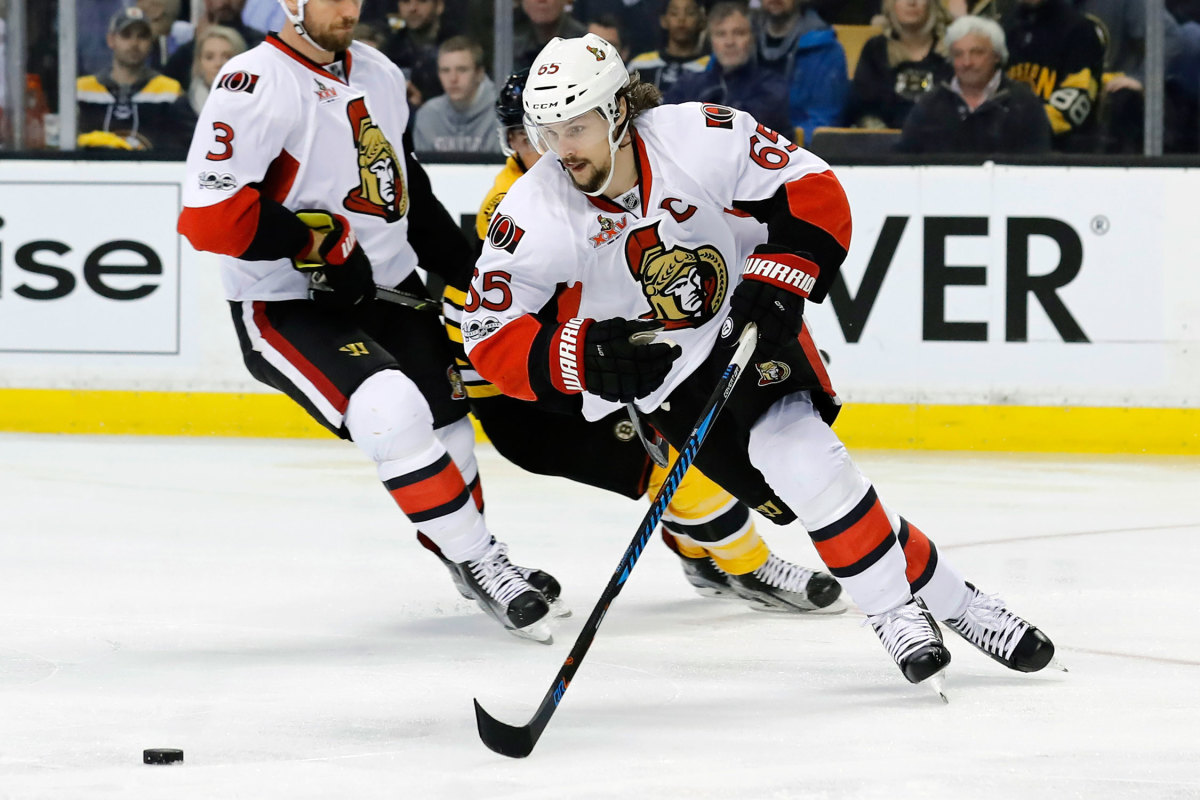
That other play—the one that was superior to the best pass anyone could remember—was more filigreed, a 24-carat combination of mobility, agility, smarts, vision and execution. With Ottawa trailing in the series and down 3–2 in the third period of Game 2, Karlsson won a brief puck battle with Bruins forward Riley Nash on the right boards. The defenseman then began angling to his left along the blue line. A righthanded shot, Karlsson stickhandled as he circled clockwise, basically taunting Nash by yanking the exposed puck out of reach of his flailing stick. He was maneuvering Nash into the area occupied by savvy Bruins forward Dominic Moore, who ran out of ideas and drifted back toward the slot. When Karlsson finally wheeled to just above the left face-off dot, he swiveled his hips and toe-dragged the puck across his body. Goalie Tuukka Rask steeled himself for a shot. Ottawa center Derick Brassard, near the right hashmarks, was about to head to the net for a rebound, but “I hesitated for an extra second because, you know, it was Erik. He was liable do something magical.” Karlsson might as well have sawed a comely assistant in half. Instead of shooting, he bisected the hypnotized Bruins with a pass to Brassard, who whipped the puck into an open net. Score tied. Ottawa wins in overtime. Series saved.
The anticlimax: In Game 4 in Boston, Karlsson, one stride in from the point, made a no-look slap pass to Ryan for a goal. The deceptive slap pass is in most NHL toolboxes, but Karlsson, who conceived the play even before receiving the puck, made that pass to Ryan’s backhand off a one-timer. Like Claesson says, the next time you see a pass like that, if ever, Mr. Eighth Day will be the triggerman.
*****
The new guy was apprehensive. This was Anders Forsberg’s first NHL draft. He had worked in player development for the Swedish hockey federation and had coached under-16 and under-17 national teams, but as Ottawa’s top European scout, he figured he needed to sell his bosses on the waif who’d arrived four years earlier at a development camp with crazy skills and no clue about defensive positioning. “Erik didn’t look like a hockey player,” says Forsberg, now the Sabres director of European scouting. “He looked like a soccer player.” Senators management was targeting Karlsson, but on the eve of the 2008 draft, Forsberg figured he should take one last stab at painting a picture for the men in the room.
“Zubov without the cigarettes,” Forsberg said, a reference to masterful Russian defenseman Sergei Zubov, who had won Stanley Cups with the Rangers and the Stars.
The Borg: SI's 2017 Beard Bracket
The Senators, the draft hosts, were picking 18th. As the first round lurched into the teens, assistant general manager Tim Murray asked Bryan Murray, the GM, “Ya gonna move up, or what?” Concerned the Ducks would take Karlsson at No. 17, Bryan zeroed in on No. 15 Nashville, which he suspected wanted goalie Chet Pickard. With the sweetener of a third-rounder, the teams swapped places. (Predators GM David Poile did select the goalie, who would never play an NHL game, but said he would have taken Karlsson if Nashville had kept the pick. “Ouch!” he wrote in an email.)
Then Bryan Murray turned his attention to Dorion. “Do you really want me to take a 5' 10-1⁄2", 157-pound Swedish defenseman?” Smile.
“I really do.”
“How long do you want to work for me?” Smile.
“A really long time.”
After the Senators announced the pick, Karlsson came to their table. And he stayed for two days. By the time the draft ended, Karlsson could have run for mayor. He shook every hand, posed for every picture. He greeted the other six Ottawa draftees—two Swedes, four Canadians—with “Hi, Erik Karlsson, first-round draft pick,” which was more about politesse than pecking order. Not that Karlsson was diffident about his gifts. There’s a story about how a team slotted in the mid-20s had wanted to interview Karlsson, but he had blown them off, saying he would be gone long before then. “I’ve heard that story,” Karlsson says, “but I don’t remember it happening.” Neither does his agent. But Dorion does. The GM says he is 99% certain the team in question was Montreal, which wound up trading the 25th pick to Calgary in a deal for Alex Tanguay.
Forsberg was right about the smokes and only a little off with the Zubov analogy. Almost a decade since that draft, Karlsson has surpassed the Russian, who in his second season led the Rangers in scoring when they ended their 54-year Cup drought. Unlike Zubov, however, Karlsson sidled into stardom. At Karlsson’s first NHL development camp, Tim Murray, authentic and acerbic, turned to Dorion and said, “So we’ve drafted a defenseman who can’t skate backwards.” Not quite a fair comment. Karlsson has the quickest first three strides of any premier defenseman—“11 out of 10,” Dorion says—but even now, skating in reverse, Dorion rates him as 9.5 out of 10. Eight months after winning his first Norris Trophy in 2012, Karlsson suffered a horrific laceration to his left Achilles when he was cut by a skate blade; the tendon was 75% severed. Karlsson had some difficulty pivoting long after he returned, remarkably, just 10 weeks later. “It’s still not the same,” he says of his Achilles. “Not like before, anyway. But your body adapts, and you adjust.”
While his offense has never flagged, Karlsson continually has had to reinvent himself in his own end. Former coach Paul MacLean was fond of saying he would be happy to play Karlsson “30 minutes a game as long as he didn’t play 16 minutes for us and 14 minutes for them.”
“I never took that personally,” Karlsson says now. “Mac just wanted to hold his best player accountable and push me to be better. That was for the team as much as me.” Karlsson still plays monster minutes—he ranked fourth in the NHL at 26:50 per game—but he is no liability. Boucher, in his first season in Ottawa, simply has made Karlsson’s minutes count more.
There were fears Boucher’s defense-first style would herald the yawn of a new era for Senators hockey. Never happened. Instead, Dorion says, “Boucher empowered [Karlsson]. Together they discovered a moment of clarity when Erik understood he could be as good or even be better.” Boucher fit his system around Karlsson’s strengths, trimming minutes by shortening his shifts, including on the power play, while increasing his penalty-kill responsibility. When possible Boucher also used Dion Phaneuf and Cody Ceci as the principal shutdown defense pair, which often gave Karlsson and partner Marc Methot marginally easier defensive matchups. “He always was a great offensive defenseman”—Karlsson’s .73 career playoff points-per-game average leads all active blue-liners with more than 25 games—“but he was also just a great defenseman,” Boucher says.
Although Karlsson, who led the NHL in assists in 2015–16, dropped from a point per game to 71 points this season, he thinks his game, within the Senators’ structure, has never been better. After center Jean-Gabriel Pageau scored four in a 6–5 double-overtime win over the Rangers last Saturday to give the Senators a 2–0 series lead—Karlsson set up the tying goal with 62 seconds left in regulation—there is no debate.
“It was like he almost had tried too hard,” Ryan says. “Then this year he realized he didn’t have to put up 82 points, but he had to try to get 82 wins. He was always pretty vocal as our leader, our captain, but before when he’d be talking, it usually was about how to score. Now it’s about how to play within our system.”
So shot blocks might be the building blocks for a Cup, last won in Canada’s capital by the original Senators 90 years ago. Not gimpy but not fully healed, either, Karlsson made all of his three Game 1 blocks in the final two minutes after New York pulled its goalie in a futile effort to force overtime. Karlsson had scored 150 seconds earlier on a shot from a foot below the goal line deep in the right corner, a trompe l’oeil.
Crunch Time: Playoff hockey means it's time to get physical
There were two possible explanations for the “magical goal”:
1. The puck ticked off Rangers center Derek Stepan before it glanced off the back of goalie Henrik Lundqvist’s neck and into the net.
Or…
2. As theorized by the aforementioned world-renowned genius, anything with mass—in this case a now 6-foot, 191-pound Swedish defenseman with an impish grin and a visage that makes him look like the fourth Musketeer—is capable of warping the fabric of space-time, of bending the four-dimensional cosmic grid. And, Einstein might’ve added, all while going top cheese.
We choose Option 2.
 Add us as a preferred source on Google
Along with the pages of Sports Illustrated, you'll find senior writer Michael Farber in the Hockey Hall of Fame. Farber joined the staff of Sports Illustrated in January 1994 and now stands as one of the magazine's top journalists, covering primarily ice hockey and Olympic sports. He is also a regular contributor to SI.com. In 2003 Farber was honored with the Elmer Ferguson Award from the Hockey Hall of Fame for distinguished hockey writing. "Michael Farber represents the best in our business," said the New York Post's Larry Brooks, past president of the Professional Hockey Writers' Association. "He is a witty and stylish writer, who has the ability to tell a story with charm and intelligence." Farber says his Feb. 2, 1998 piece on the use and abuse of Sudafed among NHL players was his most memorable story for SI. He also cites a feature on the personal problems of Kevin Stevens, Life of the Party. His most memorable sports moment as a journalist came in 1988 when Canadian Ben Johnson set his controversial world record by running the 100 meters in 9.79 seconds at the Summer Olympic Games, in Seoul. Before coming to Sports Illustrated, Farber spent 15 years as an award-winning sports columnist and writer for the Montreal Gazette, three years at the Bergen Record, and one year at the Sun Bulletin in Binghamton, NY. He has won many honors for his writing, including the "outstanding sports writing award" in 2007 from Sports Media Canada, and the Prix Jacques-Beauchamp (Quebec sportswriter of the year) in 1993. While at the Gazette, he won a National Newspaper award in 1982 and 1990. Sometimes Life Gets in the Way, a compendium of his best Gazette columns, was published during his time in newspapers. Farber says hockey is his favorite sport to cover. "The most down-to-earth athletes play the most demanding game," he says. Away from Sports Illustrated, Farber is a commentator for CJAD-AM in Montreal and a panelist on TSN's The Reporters (the Canadian equivalent of ESPN's The Sports Reporters in the United States, except more dignified). Farber is also one of the 18 members on the Hockey Hall of Fame selection committee. Born and raised in New Jersey, Farber is a 1973 graduate of Rutgers University where he was Phi Beta Kappa. He now resides in Montreal with his wife, Danielle Tétrault, son Jérémy and daughter Gabrielle.