%20%20--%3E%0A%3Csvg%20version%3D%221.1%22%20id%3D%22Layer_1%22%20xmlns%3D%22http%3A%2F%2Fwww.w3.org%2F2000%2Fsvg%22%20xmlns%3Axlink%3D%22http%3A%2F%2Fwww.w3.org%2F1999%2Fxlink%22%20x%3D%220px%22%20y%3D%220px%22%0A%09%20width%3D%2239px%22%20height%3D%2240px%22%20viewBox%3D%220%200%2039%2040%22%20enable-background%3D%22new%200%200%2039%2040%22%20xml%3Aspace%3D%22preserve%22%3E%0A%3Cpath%20fill%3D%22%23FFFFFF%22%20d%3D%22M38.5%2C7H28.2v26h10.3V7z%22%2F%3E%0A%3Cpath%20fill-rule%3D%22evenodd%22%20clip-rule%3D%22evenodd%22%20fill%3D%22%23FFFFFF%22%20d%3D%22M26.1%2C25.5c0%2C5.8-4.1%2C7.5-12.9%2C7.5C3.9%2C33%2C0%2C31.2%2C0%2C25.2v-1.1h11.6%0A%09v2.4c0%2C0.7%2C0.1%2C1.4%2C1.2%2C1.4c1%2C0%2C1.2-0.4%2C1.2-1.3v-0.9c0-1.6-0.9-1.6-3.5-2.2C2.2%2C21.7%2C0%2C19.7%2C0%2C15.3v-0.9C0%2C9.3%2C5.5%2C7%2C12.9%2C7%0A%09c10.2%2C0%2C12.8%2C2.6%2C12.8%2C7.4v1.8h-11v-2.9c0-0.6-0.4-1.1-1.2-1.1c-0.6%2C0-1.2%2C0.4-1.2%2C1.1v0.9c0%2C1.5%2C0.9%2C2%2C3.3%2C2.5%0A%09c8%2C1.6%2C10.5%2C3.3%2C10.5%2C7.5V25.5z%22%2F%3E%0A%3C%2Fsvg%3E%0A)
Karlsson helps Sweden top Czech Republic, 4-2, in Olympic opener
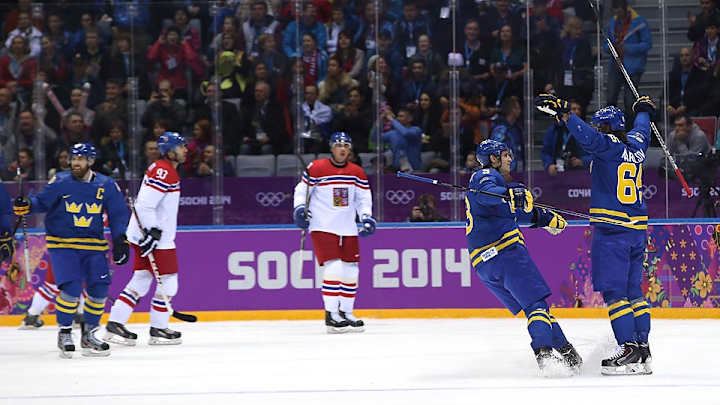
SOCHI -- Three thoughts on Sweden’s 4-2 victory over the Czech Republic in their Olympic men’s hockey opener Wednesday at Bolshoy Ice Palace.
1) The beauty of the wider international ice is Swedish defenseman Erik Karlsson has a bigger piece of paper on which to fingerpaint. He is liable go anywhere at any time, lugging the puck out of danger in the defensive zone and pinching in the offensive zone at every available opportunity. When Paul Maclean took over behind the bench in Ottawa, he wanted to make sure the daredevil D-man wasn’t playing “16 minutes for us and 12 for them.” Well, Swedish coach Par Mårts has liberated Karlsson, and the results are breathtaking. Karlsson drew a trip in his own zone and then scored on the delayed penalty with a shot from the right point that handcuffed Czech goalie Jakub Kovar for the first goal. Karlsson is playing with Oliver Ekman-Larsson, making this duo Sweden’s Glitter Twins. If they are not the best D-pair in the Olympics, they are the most thrilling. The pairing of go-go defensemen is uncommon -- often it’s one cowboy teamed with a stay-at-home guy -- but the impact was profound. Karlsson also pounded home a power-play drive from the point in the second period, Sweden’s fourth goal on 11 shots.
2) Czech coach Alois Hadamczik made some, ummm, curious decisions in building this team that is so relatively advanced in years that it takes its meals at 4:30 and asks for the two-for-one coupon. No Jiri Hudler here. No Radim Vrbata. No Roman Polak. But the oddest decision was to not dress Ondrej Pavelec and start him in goal. (Payback for not accepting an invitation two years ago to the world championships?) Pavelec, who will make his debut against Latvia, was a cipher early in the season for Winnipeg but seemed to have turned his game around after Paul Maurice was hired as coach. Kovar has been solid in the KHL -- he has a .934 save percentage and 1.91 goals against average this year for Yekatarinburg -- but he is not tested with the same quality of shots in that league. Maybe he is more at ease on the larger ice than the Jets goalie, but he certainly didn’t seem to be in the first period. He was beaten by a Karlsson drive off his glove -- Daniel Alfredsson screening -- and later gave up a short-sider to Patrik Berglund. That is known as being beaten to the AHL side, not the KHL side. A Henrik Zetterberg floater past his glove less than one minute into the second ended his night.
3) While Sweden is a co-favorite and represents a rugged way for the Czechs to dip their toe into a tough pool, it is sad to see one of the world powers wallowing in hard times. Jaromir Jagr remains a tower of power at 42 (on Saturday), using his J-Lo backside to fend off defensemen and create scoring chances. Jagr scored on a one-handed backhand in a little display of the old virtuosity; he is still better with one hand on the stick than most guys are with two. And 24-year-old Jakub Voracek is a top-shelf forward. But Czech dependence on older players such as Jagr and 42-year-old Nedved, exhumed for the tournament from the domestic league, is a reminder that the freshet of young stars has slowed to a trickle. The Czech Republic, backstopped by Dominik Hasek, won the first NHL era Olympic gold, beating Canada in a semifinal shootout and blanking Russia in the 1998 final. The country partied in Wenceslas Square in Prague, one of the greatest hockey celebrations any country has witnessed. Hold the confetti in 2014.
 Add us as a preferred source on Google
Along with the pages of Sports Illustrated, you'll find senior writer Michael Farber in the Hockey Hall of Fame. Farber joined the staff of Sports Illustrated in January 1994 and now stands as one of the magazine's top journalists, covering primarily ice hockey and Olympic sports. He is also a regular contributor to SI.com. In 2003 Farber was honored with the Elmer Ferguson Award from the Hockey Hall of Fame for distinguished hockey writing. "Michael Farber represents the best in our business," said the New York Post's Larry Brooks, past president of the Professional Hockey Writers' Association. "He is a witty and stylish writer, who has the ability to tell a story with charm and intelligence." Farber says his Feb. 2, 1998 piece on the use and abuse of Sudafed among NHL players was his most memorable story for SI. He also cites a feature on the personal problems of Kevin Stevens, Life of the Party. His most memorable sports moment as a journalist came in 1988 when Canadian Ben Johnson set his controversial world record by running the 100 meters in 9.79 seconds at the Summer Olympic Games, in Seoul. Before coming to Sports Illustrated, Farber spent 15 years as an award-winning sports columnist and writer for the Montreal Gazette, three years at the Bergen Record, and one year at the Sun Bulletin in Binghamton, NY. He has won many honors for his writing, including the "outstanding sports writing award" in 2007 from Sports Media Canada, and the Prix Jacques-Beauchamp (Quebec sportswriter of the year) in 1993. While at the Gazette, he won a National Newspaper award in 1982 and 1990. Sometimes Life Gets in the Way, a compendium of his best Gazette columns, was published during his time in newspapers. Farber says hockey is his favorite sport to cover. "The most down-to-earth athletes play the most demanding game," he says. Away from Sports Illustrated, Farber is a commentator for CJAD-AM in Montreal and a panelist on TSN's The Reporters (the Canadian equivalent of ESPN's The Sports Reporters in the United States, except more dignified). Farber is also one of the 18 members on the Hockey Hall of Fame selection committee. Born and raised in New Jersey, Farber is a 1973 graduate of Rutgers University where he was Phi Beta Kappa. He now resides in Montreal with his wife, Danielle Tétrault, son Jérémy and daughter Gabrielle.