%20%20--%3E%0A%3Csvg%20version%3D%221.1%22%20id%3D%22Layer_1%22%20xmlns%3D%22http%3A%2F%2Fwww.w3.org%2F2000%2Fsvg%22%20xmlns%3Axlink%3D%22http%3A%2F%2Fwww.w3.org%2F1999%2Fxlink%22%20x%3D%220px%22%20y%3D%220px%22%0A%09%20width%3D%2239px%22%20height%3D%2240px%22%20viewBox%3D%220%200%2039%2040%22%20enable-background%3D%22new%200%200%2039%2040%22%20xml%3Aspace%3D%22preserve%22%3E%0A%3Cpath%20fill%3D%22%23FFFFFF%22%20d%3D%22M38.5%2C7H28.2v26h10.3V7z%22%2F%3E%0A%3Cpath%20fill-rule%3D%22evenodd%22%20clip-rule%3D%22evenodd%22%20fill%3D%22%23FFFFFF%22%20d%3D%22M26.1%2C25.5c0%2C5.8-4.1%2C7.5-12.9%2C7.5C3.9%2C33%2C0%2C31.2%2C0%2C25.2v-1.1h11.6%0A%09v2.4c0%2C0.7%2C0.1%2C1.4%2C1.2%2C1.4c1%2C0%2C1.2-0.4%2C1.2-1.3v-0.9c0-1.6-0.9-1.6-3.5-2.2C2.2%2C21.7%2C0%2C19.7%2C0%2C15.3v-0.9C0%2C9.3%2C5.5%2C7%2C12.9%2C7%0A%09c10.2%2C0%2C12.8%2C2.6%2C12.8%2C7.4v1.8h-11v-2.9c0-0.6-0.4-1.1-1.2-1.1c-0.6%2C0-1.2%2C0.4-1.2%2C1.1v0.9c0%2C1.5%2C0.9%2C2%2C3.3%2C2.5%0A%09c8%2C1.6%2C10.5%2C3.3%2C10.5%2C7.5V25.5z%22%2F%3E%0A%3C%2Fsvg%3E%0A)
Memories of a miracle: A remarkable day in a village in upstate New York
SOCHI – Mostly, I remember the clock.
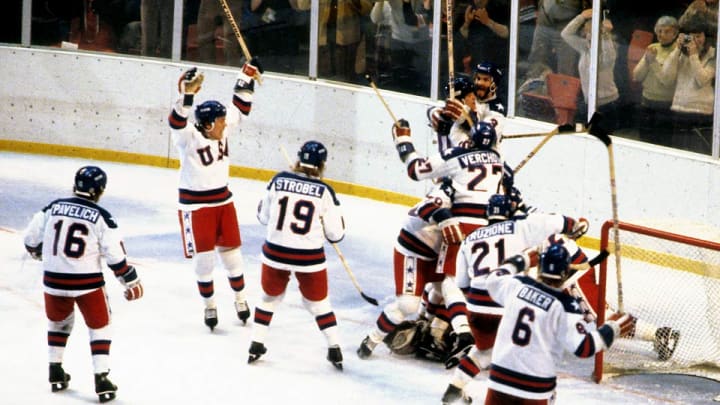
After Mike Eruzione scored with 10 minutes left in the third period to give the Americans a 4-3 lead over the Soviet Union, every 15 seconds or so, from my seat in the press tribune, I would glance at the scoreboard in amazement. Like disbelief, time had been suspended. The digits seemed stuck, like my brain now trying to reassemble the fading memories of a famous hockey game that was played 34 years ago in a village in upstate New York.
Sometimes when you have a fifth row seat to history, when you watch forever unspool in real time, the significance does not scream in your ear the way everyone assumes it should. Sometimes you grasp that the world has tilted off its axis in an infinitesimal way and will never be exactly the same -- say, Ben Johnson’s doped 9.79 at the Seoul Olympics in 1988 -- but sometimes you fix on the ragged bones of a sport and not the blood coursing through the moment. You blow it.
Then months or years or decades later, myth extends its tendrils and chokes the organic experience, the two becoming so entwined you can no longer separate the strands with absolute certainty. There are days when you conjure the image of Herb Brooks but you actually see Kurt Russell’s face, and nights when the little voice in your head sounds like Al Michaels.
The Miracle on Ice has been encoded in the American genome, a moment that is never allowed to simply be, but must be exhumed whenever the U.S. plays Russia, as it does on Saturday in a round-robin Olympic match.
My point: I’d like to tell you I can recall everything about the game between Team USA and the Soviet Union at my first Olympics, but I don’t.
For me, the miracle of Lake Placid was getting to the venues. I was staying at a motel about two-and-a-half miles down a winding road from Lake Placid High School, hub of the Olympics, as laughable as that might sound today.
I had moved from New Jersey to Canada 10 months earlier and was writing for Montreal's Gazette. Maybe two weeks before the Opening Ceremony, the Canadian ambassador to Iran, Ken Taylor, played a pivotal role in rescuing American hostages there, and there was never a better time to be a Canadian, which I wasn’t. (Nor am I today.)
There was an American love-in for their northern neighbors, so I played the Canada card. I wore a big white campaign-style Maple Leaf button that contrasted nicely with my blue duffel coat, which allowed me to scrounge rides -- The Hitchhiker’s Guide to the Olympic Galaxy.
Lake Placid was a total mess, the Apocalympics Now. Every night at precisely seven o’clock, the Lake Placid Olympic Organizing Committee would hold a press conference to explain the screw-ups du jour, bureaucratic theater of the absurd. Instead of Waiting for Godot, this was Waiting for a Bus.
One night midway through the games, an older Italian journalist, sitting a row away in the balcony of the school auditorium, took the microphone. After excusing his accented but excellent English, he said, “Sir, I understand you cannot be in two places at once. But here in Lake Placid, you have made it impossible to be in one place at once.”
As we shuffled out a few minutes later, I approached the guy to congratulate him for his cheek.
“Bah! This is the second most disorganized event I ever covered.”
“What was the first?”
“World War II.”
The thing is when you work for a Canadian newspaper, you are professionally bound to see the Olympics through a Canadian lens.
I watched the Americans tie Sweden in their opener, a hint of possibility after the debacle against the Soviets at Madison Square Garden days earlier, but I covered more Canadian games than ones that involved the U.S. I was not in daily contact with Brooks’ team, unlike E.M. Swift of SI, who would report definitively and lyrically about the gold-medal team.
CAZENEUVE: Ranking the 12 greatest moments in Olympic hockey history
I was the only credentialed reporter from The Gazette, so I had to take a stab at everything. Even with the tense geopolitical climate, the U.S. was sidebar material.
Canada’s big story was Crazy Canuck downhiller Ken Read. Read was the favorite in the event that, at the time, was to the Winter Games what the men’s 100-hundred meters were to the Summer Olympics. There was an early split time posted for all the skiers in the Lake Placid downhill, 10 or 15 seconds, and I was stunned to see the clock keep racing past those numbers. Trouble. Read’s ski binding had popped just after the start. In Canada, the story had legs.
Right, the Miracle on Ice.
The game is recalled in snippets, visions I have been obliged to reference against the record.
The first is Mark Johnson’s greasy goal. Dave Christian had fired a 100-foot no-hope slapper on Vladislav Tretiak, the fabulous Soviet goalie who had first gained attention in North America with his play in the 1972 Summit Series against Canada. I had seen enough of Tretiak to know that he almost never gave up Technicolor rebounds, but this one caromed directly to Johnson, who deked, a move that pulled Tretiak to his knees. Johnson slid the puck into the net, tying the score 2-2.
One second remained in the first period. On the perfunctory faceoff -- I don’t think the Soviet Union even had all six players on the ice -- Vladimir Myshkin stood in goal. My assumption was that an enraged Tretiak had skated to the dressing room with one tick left. It wasn’t until Myhskin came out after intermission that I realized coach Viktor Tikhonov had yanked his star. Tikhonov is 83. The decision will be on his tombstone.
In 1987, in the Canada Cup final, maybe the highest quality hockey ever played, Tikhonov made an even more grievous mistake. He had the Soviets’ third defense pair, Igor Kravchuk and a pinching Sergei Bautin, out against the line of Wayne Gretzky, Mario Lemieux and Dale Hawerchuk when Lemieux scored the winner. Of course that gaffe had no Cold War implications, and it didn't force a generation of American parents to get up at six in the morning on Saturdays to drive their kids to the rink. That was just, you know, hockey.
The winner was a screened wrister that beat Myshkin. Eruzione can dine out forever on that goal. Then the clock bled, drip by drip, until it was over.
But Lake Placid is never over, is it? I did not begin to sense its import until I filed my story and left the rink. The street was a cacophony, a bold and atonal celebration of victory, patriotism and possibility.
I squeezed into a bar where the mob periodically broke into "The Star-Spangled Banner." I needed that Greek chorus, or drunkard’s chorus, to help me fully comprehend.
There had been maybe 5,000 people in the arena and another 10,000 in the streets, but I guessed that by the time the news spread -- the game was shown on tape-delay by ABC in the U.S. -- a joyous noise would reverberate throughout a nation. I had no clue that the echoes would be heard in the next century.
When asked about Lake Placid at a Sochi press conference, Tretiak, now the head of the Russian Ice Hockey Federation, said, “Mistakes were rectified,” before noting that the Soviet Union won the gold medal in 1984. The answer elicited applause.
One man’s miracle is another man’s mistake -- and a third man’s memory.
FARBER: Team USA feasts on Slovakia with main course vs. Russia up next
 Add us as a preferred source on Google
Along with the pages of Sports Illustrated, you'll find senior writer Michael Farber in the Hockey Hall of Fame. Farber joined the staff of Sports Illustrated in January 1994 and now stands as one of the magazine's top journalists, covering primarily ice hockey and Olympic sports. He is also a regular contributor to SI.com. In 2003 Farber was honored with the Elmer Ferguson Award from the Hockey Hall of Fame for distinguished hockey writing. "Michael Farber represents the best in our business," said the New York Post's Larry Brooks, past president of the Professional Hockey Writers' Association. "He is a witty and stylish writer, who has the ability to tell a story with charm and intelligence." Farber says his Feb. 2, 1998 piece on the use and abuse of Sudafed among NHL players was his most memorable story for SI. He also cites a feature on the personal problems of Kevin Stevens, Life of the Party. His most memorable sports moment as a journalist came in 1988 when Canadian Ben Johnson set his controversial world record by running the 100 meters in 9.79 seconds at the Summer Olympic Games, in Seoul. Before coming to Sports Illustrated, Farber spent 15 years as an award-winning sports columnist and writer for the Montreal Gazette, three years at the Bergen Record, and one year at the Sun Bulletin in Binghamton, NY. He has won many honors for his writing, including the "outstanding sports writing award" in 2007 from Sports Media Canada, and the Prix Jacques-Beauchamp (Quebec sportswriter of the year) in 1993. While at the Gazette, he won a National Newspaper award in 1982 and 1990. Sometimes Life Gets in the Way, a compendium of his best Gazette columns, was published during his time in newspapers. Farber says hockey is his favorite sport to cover. "The most down-to-earth athletes play the most demanding game," he says. Away from Sports Illustrated, Farber is a commentator for CJAD-AM in Montreal and a panelist on TSN's The Reporters (the Canadian equivalent of ESPN's The Sports Reporters in the United States, except more dignified). Farber is also one of the 18 members on the Hockey Hall of Fame selection committee. Born and raised in New Jersey, Farber is a 1973 graduate of Rutgers University where he was Phi Beta Kappa. He now resides in Montreal with his wife, Danielle Tétrault, son Jérémy and daughter Gabrielle.