%20%20--%3E%0A%3Csvg%20version%3D%221.1%22%20id%3D%22Layer_1%22%20xmlns%3D%22http%3A%2F%2Fwww.w3.org%2F2000%2Fsvg%22%20xmlns%3Axlink%3D%22http%3A%2F%2Fwww.w3.org%2F1999%2Fxlink%22%20x%3D%220px%22%20y%3D%220px%22%0A%09%20width%3D%2239px%22%20height%3D%2240px%22%20viewBox%3D%220%200%2039%2040%22%20enable-background%3D%22new%200%200%2039%2040%22%20xml%3Aspace%3D%22preserve%22%3E%0A%3Cpath%20fill%3D%22%23FFFFFF%22%20d%3D%22M38.5%2C7H28.2v26h10.3V7z%22%2F%3E%0A%3Cpath%20fill-rule%3D%22evenodd%22%20clip-rule%3D%22evenodd%22%20fill%3D%22%23FFFFFF%22%20d%3D%22M26.1%2C25.5c0%2C5.8-4.1%2C7.5-12.9%2C7.5C3.9%2C33%2C0%2C31.2%2C0%2C25.2v-1.1h11.6%0A%09v2.4c0%2C0.7%2C0.1%2C1.4%2C1.2%2C1.4c1%2C0%2C1.2-0.4%2C1.2-1.3v-0.9c0-1.6-0.9-1.6-3.5-2.2C2.2%2C21.7%2C0%2C19.7%2C0%2C15.3v-0.9C0%2C9.3%2C5.5%2C7%2C12.9%2C7%0A%09c10.2%2C0%2C12.8%2C2.6%2C12.8%2C7.4v1.8h-11v-2.9c0-0.6-0.4-1.1-1.2-1.1c-0.6%2C0-1.2%2C0.4-1.2%2C1.1v0.9c0%2C1.5%2C0.9%2C2%2C3.3%2C2.5%0A%09c8%2C1.6%2C10.5%2C3.3%2C10.5%2C7.5V25.5z%22%2F%3E%0A%3C%2Fsvg%3E%0A)
Win over Norway does little to ease doubts about Team Russia
SOCHI – In the realm of chaos theory – and by chaos theory, we mean the study of nonlinear dynamics and not the study of Sochi hotels before journalists got their light bulbs and curtain rods – there is a phenomenon known as the butterfly effect. You know it: if a butterfly does or doesn’t flap its wings in one part of the world, then three weeks later there might or might not be a hurricane halfway around the globe.
Now adapt the butterfly theory to the nonlinear dynamic of Olympic hockey. Let’s time travel back to Saturday and the shot from the left point by Russian defenseman Fedor Tyutin late in the third period. Tyutin’s shot cleanly beat Team USA goalie Jonathan Quick and entered the net. The goal would have counted in the NHL, but Dorothy, we’re not in Kansas anymore. Because the net was off its moorings, the referees had no option under International Ice Hockey Federation rules but to wave it off.
Of course, if the net had not been askew and the go-ahead goal had been allowed, and the Americans had not been able to find a way to back into the game in the final five minutes … well, Russia probably wins the pool and heads directly into the quarterfinals without having to stop before passing Go or collecting 200 rubles. The Olympic tournament bracket in front of you now would basically be confetti.
All of which returns us to another part of the world, Norway, which has many lovely fjords and a handful of world-class hockey players. Team Russia was supposed to make a relatively quick detour through the Norwegians on its way to the quarterfinals, a perfunctory exercise that would soothe Russian nerves and allow coach Zinetula Bilyaletdinov one last opportunity to address the issue that has haunted Russian hockey since the dissolution of the Soviet Union more than two decades ago: five skaters and one puck.
FARBER: Russian hockey seeks return to glory
As partisans filed into Bolshoy Arena on a rainy Tuesday afternoon, they would have bet $51 billion that their hockey heroes would handily dispatch the Norwegians, who were missing their most dangerous forward, munchkin Mats Zuccarello of the New York Rangers. He was shown on the arena video board during the first period with bandages on his left hand. (Norway did have a Forsberg in the lineup, but it was Kristian and not Peter.) After 60 mostly stultifying minutes, the fans won their virtual wager.
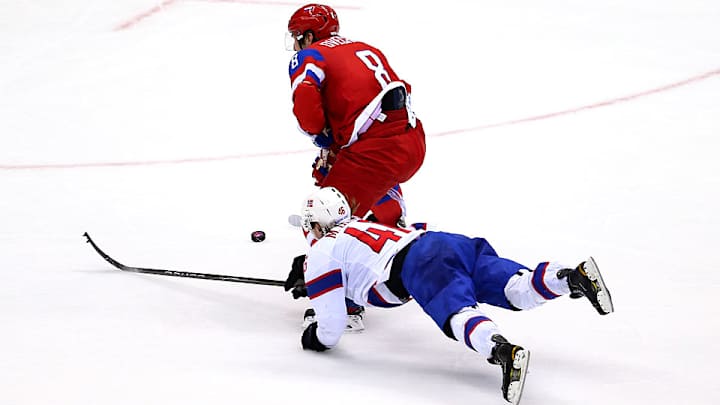
Russia 4, Norway 0.
In 2010, Canada used a side trip to a qualification game to pummel Germany and coalesce as a team on its way to a quarterfinal rout of a disorganized Team Russia – talk about chaos theory - and ultimately the gold medal. The match on Tuesday did not look or feel the same. Russia’s win was not totally persuasive. Despite what Pavel Datsyuk called “a good result,” this was not the springboard that Team Russia -- “the indisputable favorite” as Pavel Bure had labeled it before the tournament -- would have liked heading into its match against Finland in the quarterfinals on Wednesday. The Norwegians are Finland Lite, lacking NHL players and a world-class goalie like Tuukka Rask. The Finns are quick, structured and fearless even if they have been decimated by injuries at center.
For more than 24 minutes, Russia slogged to penetrate the 1-4 carapace of the Norwegians, who, in their preliminary round opener, had sufficiently sucked enough oxygen out of the match to make Canada sweat. Russia’s team play failed to produce anything of substance because, in hockey as in boxing, it is impossible to counterpunch an opponent who simply won’t lead. (Despite their high-end skill, the Russians, under Bilyaletdinov, have adopted the old Moscow Dynamo style, making them the New Jersey Devils in Cyrillic.)
Finally, Alexander Radulov decided to go all New School. The Russian bad boy – he took some harmful penalties against the U.S. on Saturday -- lugged the puck on his backhand around a collapsing defense and then from a ridiculous angle best understood by 10th grade geometry teachers, backhanded the puck along the ice. It ticked off the skate of defenseman Jonas Holos, but goalie Lars Haugen had already opened his pads and the puck slid through a five-hole that was large enough to house a family of four. The puck clicked off the inside of the far post and into the net. A nation exhaled.
“We attacked a lot of times,” Bilyaletdinov said. “If we had scored earlier, it would have been easier to pass their defense.”
Ilya Kovalchuk scored on a rebound off the post late in the second period, and there were two other goals in the final minutes -- including an empty netter. None was scored by Alex Ovechkin, who cashed in his first shot on his first shift 77 seconds into the tournament and has nothing to show since. The most visible player in the world has been a ghost. (He started the qualification round tied for 26th in goal scoring.) Bilyaletdinov dropped Alex Semin off the right wing on the Evgeni Malkin-Ovechkin line in favor of Alexander Popov, to no particularly noticeable effect.
“The most important thing is about winning,” Ovechkin said. “It’s not about personal stats. The goal scoring lead. We’re here to win the gold, not to win some scoring titles or that kind of thing.
“I’m pretty sure everybody knows it’s not easy to beat Norway,” he continued. “The goalie played well. He stopped a couple of great chances against us. We scored a couple lucky goals, and it gave us more opportunities in the offensive zone and neutral zone as well.”
Well, that’s all true. But the Russians should be prepared for more of the same against Finland, a chess match in which the Russians need to channel their inner Spassky.
 Add us as a preferred source on Google
Along with the pages of Sports Illustrated, you'll find senior writer Michael Farber in the Hockey Hall of Fame. Farber joined the staff of Sports Illustrated in January 1994 and now stands as one of the magazine's top journalists, covering primarily ice hockey and Olympic sports. He is also a regular contributor to SI.com. In 2003 Farber was honored with the Elmer Ferguson Award from the Hockey Hall of Fame for distinguished hockey writing. "Michael Farber represents the best in our business," said the New York Post's Larry Brooks, past president of the Professional Hockey Writers' Association. "He is a witty and stylish writer, who has the ability to tell a story with charm and intelligence." Farber says his Feb. 2, 1998 piece on the use and abuse of Sudafed among NHL players was his most memorable story for SI. He also cites a feature on the personal problems of Kevin Stevens, Life of the Party. His most memorable sports moment as a journalist came in 1988 when Canadian Ben Johnson set his controversial world record by running the 100 meters in 9.79 seconds at the Summer Olympic Games, in Seoul. Before coming to Sports Illustrated, Farber spent 15 years as an award-winning sports columnist and writer for the Montreal Gazette, three years at the Bergen Record, and one year at the Sun Bulletin in Binghamton, NY. He has won many honors for his writing, including the "outstanding sports writing award" in 2007 from Sports Media Canada, and the Prix Jacques-Beauchamp (Quebec sportswriter of the year) in 1993. While at the Gazette, he won a National Newspaper award in 1982 and 1990. Sometimes Life Gets in the Way, a compendium of his best Gazette columns, was published during his time in newspapers. Farber says hockey is his favorite sport to cover. "The most down-to-earth athletes play the most demanding game," he says. Away from Sports Illustrated, Farber is a commentator for CJAD-AM in Montreal and a panelist on TSN's The Reporters (the Canadian equivalent of ESPN's The Sports Reporters in the United States, except more dignified). Farber is also one of the 18 members on the Hockey Hall of Fame selection committee. Born and raised in New Jersey, Farber is a 1973 graduate of Rutgers University where he was Phi Beta Kappa. He now resides in Montreal with his wife, Danielle Tétrault, son Jérémy and daughter Gabrielle.