%20%20--%3E%0A%3Csvg%20version%3D%221.1%22%20id%3D%22Layer_1%22%20xmlns%3D%22http%3A%2F%2Fwww.w3.org%2F2000%2Fsvg%22%20xmlns%3Axlink%3D%22http%3A%2F%2Fwww.w3.org%2F1999%2Fxlink%22%20x%3D%220px%22%20y%3D%220px%22%0A%09%20width%3D%2239px%22%20height%3D%2240px%22%20viewBox%3D%220%200%2039%2040%22%20enable-background%3D%22new%200%200%2039%2040%22%20xml%3Aspace%3D%22preserve%22%3E%0A%3Cpath%20fill%3D%22%23FFFFFF%22%20d%3D%22M38.5%2C7H28.2v26h10.3V7z%22%2F%3E%0A%3Cpath%20fill-rule%3D%22evenodd%22%20clip-rule%3D%22evenodd%22%20fill%3D%22%23FFFFFF%22%20d%3D%22M26.1%2C25.5c0%2C5.8-4.1%2C7.5-12.9%2C7.5C3.9%2C33%2C0%2C31.2%2C0%2C25.2v-1.1h11.6%0A%09v2.4c0%2C0.7%2C0.1%2C1.4%2C1.2%2C1.4c1%2C0%2C1.2-0.4%2C1.2-1.3v-0.9c0-1.6-0.9-1.6-3.5-2.2C2.2%2C21.7%2C0%2C19.7%2C0%2C15.3v-0.9C0%2C9.3%2C5.5%2C7%2C12.9%2C7%0A%09c10.2%2C0%2C12.8%2C2.6%2C12.8%2C7.4v1.8h-11v-2.9c0-0.6-0.4-1.1-1.2-1.1c-0.6%2C0-1.2%2C0.4-1.2%2C1.1v0.9c0%2C1.5%2C0.9%2C2%2C3.3%2C2.5%0A%09c8%2C1.6%2C10.5%2C3.3%2C10.5%2C7.5V25.5z%22%2F%3E%0A%3C%2Fsvg%3E%0A)
Enhanced Games Explained: Inside the Steroid-Fueled Competition Drawing Olympians
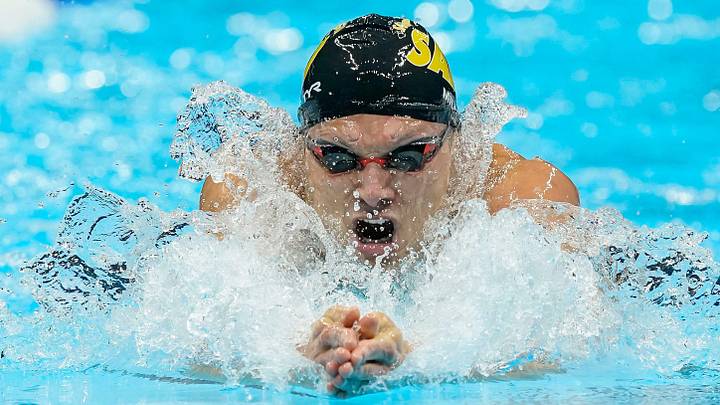
Thursday, Cody Miller is receiving his last injection of human growth hormone. That will cap a nine-week cycle taking HGH, testosterone and the metabolic steroid oxandrolone. Sunday, the 2016 Olympic medalist will swim against other performance-enhancing drug users for the biggest prize money of his life.
This is the Enhanced Games, appropriately held in Las Vegas, a place where just about anything goes. With millions of dollars potentially on the line, there are essentially no rules in the swimming, running and weightlifting competitions to be staged at Resorts World. Just go as fast as you can, lift as much as you can, grab as much cash as you can. There certainly is no post-competition drug testing to worry about.
“It’s definitely the wildest experience I’ve ever had,” Miller tells Sports Illustrated.
This athletic lab experiment bills itself as “a global movement that develops scientific insights, medical discoveries and record-breaking sports events to unite humanity and inspire scientific innovation.” Yet its website also serves as a storefront, selling the kind of products you hear advertised on sports talk radio—personalized testosterone, fat burners, peptides, etc. There also is a pitch to investors to join the publicly traded company, which hit the New York Stock Exchange on May 8, saw its price per share plummet by mid-month and has slowly been creeping back up.
Among the investors: Donald Trump Jr., PayPal and Palantir billionaire Peter Thiel and Saudi Arabian royalty. Among the Enhanced athletes with Olympic medals on their résumés: swimmers Miller, Australian James Magnussen and Ben Proud of Great Britain, and American track sprinter Fred Kerley. Stars from the world of strongman competitions are involved, including Thor Björnsson and Mitchell Hooper. There will be female competitors in all three sports as well.
It’s a mini Steroid Olympics, a burlesque version of the five-ring international events that are exalted every four years. It’s a sensationalist PR grab with some of the base appeal of reality TV. To some, it’s a cynical, subversive, corrosive advertisement for shortcutting the legitimate hard work that goes into becoming a great athlete.
But for others, this is the logical (or illogical) counter-argument to the notion that truly clean Olympic sports competition exists. If that’s a myth—if the dopers are eternally ahead of the testing, and the World Anti-Doping Association is often ineffective—why not just go rogue?
Rogue is not the correct response to a problematic system, says United States Anti-Doping Association CEO Travis Tygart. He’s referred to the Enhanced Games as “a clown show.”
“The WADA system needs reform and WADA turning a blind eye to Chinese doping undercuts the [clean sport] effort,” Tygart tells SI. “It’s sad to hear Ben Proud say that’s why he, in part, went to open competition. But this is not the answer to WADA failures and poor leadership.”

For Miller, a 34-year-old married father of two who competed collegiately at Indiana and lives in Indianapolis, it’s a chance to earn the kind of money that is unavailable in mainstream swimming. In addition to a multiyear contract he signed with Enhanced, the purses available Sunday are huge compared to high-level swim meets sponsored by governing bodies USA Swimming and World Aquatics.
“Olympic athletes are the best in the world at what they do, and they’re not being paid properly,” says Enhanced swim coach Brett Hawke, who competed in the 2000 and ’04 Olympics for Australia. “When I was finished with my career, there was no money at the end of it, no job prospects.”
Hawke swam collegiately at Auburn and was the head coach of the Tigers from 2009 to ’18. He got onboard with the Enhanced Games last year and helped former Alabama swimmer Kristian Gkolomeev “break” the world record in the 50 freestyle, with the assistance of PEDs and a banned tech suit—Enhanced Games has brought those back, along with the steroids.
“I coach athletes to go fast, and I love the human potential side of it,” Hawke says. “How fast can we actually swim? But this is the toughest challenge of my career—everybody’s got eyes on it and everybody’s got opinions on it. I think you’ll see some world records Sunday.”
There are nine swimming events, all at 50 or 100 meters, with first place worth as much as $250,000 in each race. Break a world record (not that it would be sanctioned by anyone) and there is a $1 million prize.
Miller, who won a gold medal as a member of the U.S. 400-meter medley relay and a bronze in the 100 breastroke in Rio de Janeiro a decade ago, said he never made more than $100,000 in a year as a professional. He termed the available compensation through USA Swimming and the U.S. Olympic and Paralympic Committee for national teamers “bulls---.” This is a common lament among Olympians who drive massive TV ratings, many of whom are never compensated like mainstream sports stars.
“We’ve just never been supported like this before,” Miller says. “The fact that we’re being paid really well is just part of it.”
Miller, a longtime video blogger with nearly 200,000 YouTube subscribers, has an array of video testimonials to the opulent training camp the Enhanced athletes enjoyed during the winter in Abu Dhabi. New training and recovery facilities, spacious hotel rooms, fine dining—all the trappings of the elite life enjoyed by top athletes in the higher-profile sports.
There also is a medical staff ready to supply a regimen of PEDs. And nobody’s hiding it.
Miller, who was an active pro swimmer through 2024, says he’s cut 4% off his body fat and added six pounds of muscle this year under the PED and training regimen prescribed by Enhanced Games medical staff. His aching knees feel better, and the former American record-holder in the 100 breast is anxious to see how fast he can go with a juiced-up physique.
As for the potential health risks that can come with steroid use? Miller says he was well counseled beforehand, well monitored during his cycle by knowledgeable professionals and well aware of what he was getting himself into.
“I’ll have post-cycle therapy to avoid crashing,” he says. “All hormones should go back to normal in a couple of weeks. I know dozens of people who are on these types of enhancements.
“I don’t mind risk. I like watching Formula One, where they drive 200 miles an hour with a risk of crashing. I love watching Alex Honnold climb a mountain without a rope. What we’re doing is way safer.”
Miller is not cavalier about the Enhanced Games—neither the potential side effects of doping nor the message it potentially sends to athletes intent on clean competition in mainstream sports. Nor is he dismissive of his role influencing younger swimmers. He remains an advocate for clean sport at the Olympics and other major competitions.
“Look, man, this is a different kind of sandbox,” he says. “If you’re an 18-year-old or 16-year-old swimmer, this is not for you. I’m 34 and I’m no longer in that world.”
If the Enhanced Games spark wider discussion about what athletes put in their bodies, Miller is all for it. He and Hawke both made mention of the abuse of Therapeutic Use Exemptions (TUEs) that allow many Olympic-level athletes to take an array of banned medications on doctors’ recommendation. The two men have competed against swimmers from nations that engaged in state-sponsored doping.
Then there are the demonstrably unhealthy products that are not just allowed but celebrated and aggressively marketed in popular culture. Miller is especially sensitive to the dangers of alcohol abuse, having grown up with an alcoholic father who became homeless and was found dead on the streets in Southern California months before Miller’s Olympic glory. Miller opened up to me about that tragedy, and the effect on his family, in detail 10 years ago.
“What I mostly want is to have an honest conversation with my kids, and any young swimmers, about PEDs and everything we put in our bodies,” he says. “There is a lot of hypocrisy. [American swimming star] Caeleb Dressel wins a gold medal and we cut to a commercial for McDonald’s. It’s like, what are we doing here?”
The response to becoming an Enhanced Games competitor in “the real world,” as Miller puts it, has been “100% positive.” The anonymous posters on message boards and social media are a different story.
“People who talk s--- on the internet, I just tune that out,” he says. “If you’re a real person and you don’t like what we’re doing, I respect that opinion and you don’t have to watch the Enhanced Games. That’s O.K.”
More Olympics From Sports Illustrated
 Add us as a preferred source on Google
Pat Forde is a senior writer for Sports Illustrated who covers college football and college basketball as well as the Olympics and horse racing. He cohosts the Others Receiving Votes podcast for SI and is a regular contributor to the Tony Kornheiser Show podcast. He previously worked for Yahoo Sports, ESPN and The (Louisville) Courier-Journal. Forde has won 28 Associated Press Sports Editors writing contest awards, has been published three times in the Best American Sports Writing book series, and was nominated for the 1990 Pulitzer Prize. A past president of the U.S. Basketball Writers Association and member of the Football Writers Association of America, he lives in Louisville with his wife. They have three children, all of whom were collegiate swimmers.
Follow ByPatForde