%20%20--%3E%0A%3Csvg%20version%3D%221.1%22%20id%3D%22Layer_1%22%20xmlns%3D%22http%3A%2F%2Fwww.w3.org%2F2000%2Fsvg%22%20xmlns%3Axlink%3D%22http%3A%2F%2Fwww.w3.org%2F1999%2Fxlink%22%20x%3D%220px%22%20y%3D%220px%22%0A%09%20width%3D%2239px%22%20height%3D%2240px%22%20viewBox%3D%220%200%2039%2040%22%20enable-background%3D%22new%200%200%2039%2040%22%20xml%3Aspace%3D%22preserve%22%3E%0A%3Cpath%20fill%3D%22%23FFFFFF%22%20d%3D%22M38.5%2C7H28.2v26h10.3V7z%22%2F%3E%0A%3Cpath%20fill-rule%3D%22evenodd%22%20clip-rule%3D%22evenodd%22%20fill%3D%22%23FFFFFF%22%20d%3D%22M26.1%2C25.5c0%2C5.8-4.1%2C7.5-12.9%2C7.5C3.9%2C33%2C0%2C31.2%2C0%2C25.2v-1.1h11.6%0A%09v2.4c0%2C0.7%2C0.1%2C1.4%2C1.2%2C1.4c1%2C0%2C1.2-0.4%2C1.2-1.3v-0.9c0-1.6-0.9-1.6-3.5-2.2C2.2%2C21.7%2C0%2C19.7%2C0%2C15.3v-0.9C0%2C9.3%2C5.5%2C7%2C12.9%2C7%0A%09c10.2%2C0%2C12.8%2C2.6%2C12.8%2C7.4v1.8h-11v-2.9c0-0.6-0.4-1.1-1.2-1.1c-0.6%2C0-1.2%2C0.4-1.2%2C1.1v0.9c0%2C1.5%2C0.9%2C2%2C3.3%2C2.5%0A%09c8%2C1.6%2C10.5%2C3.3%2C10.5%2C7.5V25.5z%22%2F%3E%0A%3C%2Fsvg%3E%0A)
Ilia Malinin, Team USA’s Quad God, Is Redefining the Limits of Figure Skating
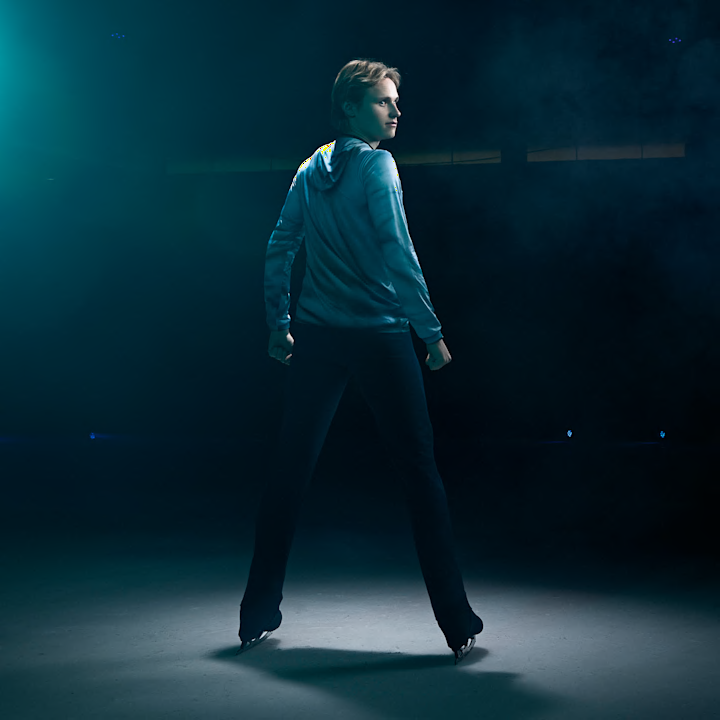
Ilia Malinin doesn’t quite understand the question. How has the pressure he feels changed as he has gone from incredible to inevitable, from wunderkind to world champion?
He ponders for a bit. “I just feel a lot more confident when I step on the ice,” he says eventually. “And I think that comes with practice and training. I’m able to go out there under pressure and really just give it my all.”
Malinin, 21, sees the added expectations as a natural result of his performance. He can’t even conceptualize the idea that they might be a burden.
He was like that long before he became figure skating’s Simone Biles, a sui generis athlete whose technical ability is so far above that of his competitors that, barring a devastating mistake or injury, he is guaranteed to win. Even as a grade-schooler, competing in his first events after picking up the sport of his Olympian parents at age 7, he struggled to understand why other kids were so anxious before they skated. Didn’t they feel the freedom on the ice that had attracted him to this pursuit?
“I work with so many skaters,” says his agent, Ari Zakarian. “High-quality Olympic champions, world champions, and I’ve been there for more than 30 years. And Ilia is exceptional. I’ve never seen anyone like him. He’s incredible. His mind is completely different. He’s not like a new generation. He’s like a future generation from space.”

Malinin has not lost a competition since November 2023, when he finished second in the Grand Prix de France. Since then his wins include three straight U.S. and world championships, including this weekend’s win at the U.S. championships to qualify for Milan Cortina.
In a sport in which the margin is often fractions of a point, Malinin opened this season by crushing the field by 20.74 points at the Challenger Series Lombardia Trophy despite wobbling a few times and ditching his quadruple Axel. A month later, he won the Grand Prix de France by more than 40.05 points, then explained he was coming to terms with “not [being] at my best shape so early on.”
Two weeks later, when he broke his own free skate world record at Skate Canada—in a performance that included the first time an athlete had cleanly landed five different quad jumps in a single program—Malinin all but shrugged. “It wasn’t perfect, and there’s always more to add to the program,” he said. “So I know that hopefully that record can be even higher.”
In early December at the Grand Prix Final in Nagoya, Japan, Malinin beat his own free skate record by almost 10 points en route to a gold-medal finish, becoming the first skater to cleanly land seven quad jumps in a single program.
From another planet. 🪐✨
— The Olympic Games (@Olympics) December 6, 2025
There aren’t enough words to capture what Ilia Malinin just did... A record-breaking performance with seven clean quads, including his iconic quad axel.#GPFigure @ISU_Figure @the_quadg0d
pic.twitter.com/UdeUxwllcV
And he did it all despite an injury that he says threatened to keep him out of the Grand Prix season altogether, although he declines to elaborate on what that was. “I don’t want to be too specific,” he says. “My legs weren’t feeling the way I want them to.” There is, of course, no defense in figure skating; his opponents can’t do anything with information about his condition. But there might be some gamesmanship. “I usually just don’t like saying what I’m dealing with most of the time,” he says. “Especially this season.”
Anyone who has followed figure skating even loosely has a sense of what Malinin is dealing with. Four years after missing the Beijing Olympic team in a controversial decision, he is the favorite for gold at the 2026 Games by kilometers. As his top competitors attempt three or four quadruple jumps per program, the self-styled Quad God regularly nails six and is aiming for seven in Milan Cortina. He debuted his quad Axel more than three years ago, at 17; he is still the only person in history to have completed it. (“I’m so honored that we were here in the building,” two-time Olympian Johnny Weir said on the broadcast the second time Malinin hit it. “It’s like seeing the moon landing.”)
When he won his second straight world title, in March, he collapsed—not in joy at the accomplishment but in frustration that he missed his fifth of seven attempted quads. (That he hit the quad Axel did not even merit mention by this point.) “It wasn’t the skate I would have liked,” he lamented afterward, gold medal dangling from his neck.
Winning is no longer enough. He expects to make history every time he takes the ice.
In some ways, it seems too simplistic: Talented kid fails to make the 2022 Olympic team, redoubles his efforts to achieve revenge and prove everyone wrong, becomes best in the world.
“Well, yeah,” he says. “I wouldn’t say out of pure revenge. I would say it was more kind of like, O.K., let me change the world of skating. After that, I did the first quad-quad combination on social media, then landed the first quad Axel, then started [breaking] all of these records. That’s where the whole Quad God origin story started.”
Two months before the selection committee left him home, he was already expecting to be excluded. He was 17 years old, only two years into his junior skating career, and because he had missed the 2021 U.S. championships with an injury and the pandemic had cancelled the junior Grand Prix season and junior world championships that year, his résumé was thin. On the eve of the ’22 U.S. championships, from which the Beijing Olympic team would be named, Malinin was seen as the future of U.S. men’s figure skating—but the distant future. When he aced his four-quad free skate and finished second, perhaps no one was more shocked than he was. “I definitely wasn’t expecting to skate this good,” he said afterward. “Even though I’ve been training for this moment, I was really surprised on how easy things came.”
The performance meant that he was eligible to be considered for the three-man U.S. Olympic team, along with six-time national champion Nathan Chen, who had won the event; Vincent Zhou, who placed third; and Jason Brown, who finished fourth. Malinin clearly exhibited the most potential, but Zhou and Brown were both former U.S. medalists and Olympic veterans. Suddenly everyone around Malinin was talking about his high-scoring ceiling, how he might have a chance to win a medal for the U.S. if the committee focused on peak performance rather than overall body of work.
“They said they can send a person just to get that experience for next time if they see the potential,” Malinin recalls. “But then, of course, they didn’t add me to the team.”

So, Malinin returned to his life as a junior at George C. Marshall High in Falls Church, Va., attending classes in the morning and practicing for four hours in the afternoon. Like everyone else, he watched from home as the U.S. took silver in the team event. (Team USA was eventually elevated to gold after a 2024 ruling on a ROC doping violation.) Malinin watched as Chen dominated to win the men’s competition, while Zhou tested positive for COVID-19 and withdrew, and Brown finished sixth. And he watched as Japanese skating legend and defending two-time men’s singles champ Yuzuru Hanyu set out on his main mission at the 2022 Games—to land the quad Axel—only to try it and tumble to the ice.
Through it all, Malinin tried not to picture himself in Beijing. Instead, he pictured himself in Milan.
As he tinkers with his free skate, there is one element Malinin always includes: a backflip. (The move was previously banned and only became legal in 2024.) He grew up preferring soccer to figure skating, even though his parents, Tatiana Malinina and Roman Skorniakov, both competed in the sport at the Olympic level for Uzbekistan. (Malinina and Skorniakov gave their son the masculine version of his mother’s surname because they feared his father’s was too difficult for Americans to pronounce; as it turns out, they struggle with MAL-uh-nin, too.) Just wait until he learns a triple jump, Malinina’s father, Russian figure skating coach Valery Malinin, told them. Then you won’t be able to tear him away. As expected, the boy found his way into the family business. But since he follows the rest of the sports world, he understands that one obstacle to his breakthrough among casual fans is that they have never tried to do what he does.
Just about everyone has shot a basketball or kicked a soccer ball or hit a baseball, so we understand how much better the pros are. But how many of the people who tune into NBC every four years for figure skating can explain the difference between a Lutz and a loop, let alone execute either one? A backflip, though: “I’m sure they understand [it],” Malinin says. “But to do it on the ice, in skates, at the end of a program, after four minutes, when you’re so tired, exhausted—that’s something that they can relate to.”
Well, maybe that’s generous. But in fairness, even most other Olympic figure skaters cannot really relate to the level of difficulty Malinin embraces as a matter of course. Despite his bloodline, the 5' 9" Malinin doesn’t look as if he were built in a lab to excel at figure skating. His long limbs help him achieve incredible height on jumps, but that also means he has more mass to pull in and control to achieve a tight rotation. Indeed, Hanyu, who came closest to the quad Axel before Malinin pulled it off, had at 5' 8" almost the opposite physique: long torso, short legs. But Malinin combines power and stamina in a way no one else in the sport can reach. Each quad jump is impressive on its own—especially the Axel, whose forward takeoff means it really amounts to four and a half revolutions in less than a second—but what really astonishes the people around him is Malinin’s ability to stack them.
“[With] that many quads, it’s hard to deliver the kind of program that looks like art,” says Malinin’s choreographer, Shae-Lynn Bourne. “The energy it takes to do those jumps is very different than someone, let’s say, that’s [doing] one quad and the rest are triples. You can really explore and push the [artistic] score, because you have the energy, but he’s really pushing himself to have both.”

As much as difficult jumps are admired in figure skating, the fact remains that the sport is all about a balance between athleticism and artistry. And unfairly, a skater who is so good at one is often bound to be shortchanged in the other. Malinin has heard the criticism that it’s impossible for him to do seven quads in one program and be a complete skater.
“I think absolutely you can,” he says. “I think we have to put everything at an even playing field—so that people are trying quads, and they’re getting rewarded for those, but the people that do quads and also skate beautifully and put their heart and soul into their performance also get a bonus from that.”
He says what he focuses on now in training is not just achieving the jumps but executing them so that they seem effortless. (That training regimen, says Zakarian, is unremarkable: Malinin warms up, and then he skates. He does not do yoga or run marathons or lift heavy. “He’s doing less [off the ice] than anybody else,” says Zakarian. “There’s no artificial intelligence or voodoo or magic tricks. He just works hard.”) The Quad God wants to do quads so smoothly that the judges barely realize he’s doing them.
That goal may not seem realistic. Most of Malinin’s don’t—until he pulls them off. His father, who along with his mother coaches him, will sometimes hear Bourne and Malinin discussing a particular plan—an especially quick piece of footwork, for example—and scoff. “No,” Skorniakov will say. “He can’t do that. It’s just not possible.”
“Yes, I can!” Malinin will bleat indignantly, and then he will. (Bourne suspects there might be a bit of reverse psychology at play.)
Malinin’s team does not employ a mental skills coach, Zakarian says, “because he’s his best psychologist.”
Now a part-time student at George Mason—which he chose to stay close to home and his nearby training rink in Reston, Va.—Malinin has expressed interest in studying civil engineering. He has combined confidence and perfectionism since childhood, refusing to come inside until he drained his layups exactly the way he wanted to. That mentality allows him to stretch the concept of what is possible on the ice.

Bourne can’t count the number of times she has arrived at the rink to find Malinin waiting for her, skates laced, beaming, ready to go.
“Even things that look life-threatening to me, that I wouldn’t even attempt, he’ll do,” says Bourne. “There’s no limit, really, with him.”
For as intense as his programs are, Malinin remains loose. While other skaters lock in at events, pretending other skaters do not exist, refusing casual conversation, he makes small talk and cheers for his opponents.
Zakarian recalls the 2023 Grand Prix Final, in Beijing, when Malinin, skating last, watched each of his competitors nail their short program. Malinin had not planned to deploy his quadruple Axel at that point, but he knew he needed it to set himself apart. He barely seemed to register the stakes. He simply executed the first quad Axel ever landed in a short program; the computerized scoring system did not initially recognize it as possible. During the free skate, he added a quad loop to become the first skater to land every kind of quadruple jump.
Malinin is most focused on the future. He is already working on quintuple jumps, which he thinks he might try to show off after the Olympics. He also wants to grow his sport: The backflip is just part of his efforts to engage American fans. In Russia or Japan, Olympic-level figure skaters are mobbed everywhere they go; in the U.S., Malinin largely escapes notice. So he tries to hype up the crowd during warmups. His short program features “The Lost Crown,” a song from the Prince of Persia video game soundtrack, and he added his own spoken-word element to his free skate music.
He wants figure skating to adopt the ways of major sports leagues. Malinin has watched countless athletes enter arenas wearing high fashion. He imagines a world in which skaters stroll into the rink decked in designer clothes.
“Part of skating is you have to be authentic, you have to be creative, you have to be interesting,” he says. “So that’s something that I think fashion works really well with.”

In the meantime, he puts together outfits himself, a combination of expensive pieces and thrift-store finds, streetwear and tailored suiting separates. Malinin also sells Quad God merchandise at events and is working on his own fashion line. He sees these efforts as different means of expressing who he is—just like skating.
“When we’re making the program, it’s a blast, because we are enjoying it, and without the kind of monitoring of, Oh, it’s the Olympics,” says Bourne. “Will we impress this judge? No, we throw that away. Are we enjoying this? Is this what you want to say? Keeping it about what it should be about: his journey. It’s not anyone else’s.”
And in the end, she thinks that’s the secret to Malinin’s ability to manage the pressure. It’s not just about his technical ability or his artistic work or even his unshakable confidence. It’s both more and less complicated than that. The downside of being so far ahead of your opponents is that you’re not really competing with anyone else. The upside is that you’re only competing with yourself.
More Olympics on Sports Illustrated
 Add us as a preferred source on Google
Stephanie Apstein was a senior writer covering baseball and Olympic sports for Sports Illustrated, where she started as an intern in 2011 and has since covered a dozen World Series and three Olympics. She has twice won top honors from the Associated Press Sports Editors, and her work has been included in the Best American Sports Writing book series. She graduated from Trinity College with a bachelor’s in French and Italian, and has a master’s in journalism from Columbia University.
Follow stephapstein