%20%20--%3E%0A%3Csvg%20version%3D%221.1%22%20id%3D%22Layer_1%22%20xmlns%3D%22http%3A%2F%2Fwww.w3.org%2F2000%2Fsvg%22%20xmlns%3Axlink%3D%22http%3A%2F%2Fwww.w3.org%2F1999%2Fxlink%22%20x%3D%220px%22%20y%3D%220px%22%0A%09%20width%3D%2239px%22%20height%3D%2240px%22%20viewBox%3D%220%200%2039%2040%22%20enable-background%3D%22new%200%200%2039%2040%22%20xml%3Aspace%3D%22preserve%22%3E%0A%3Cpath%20fill%3D%22%23FFFFFF%22%20d%3D%22M38.5%2C7H28.2v26h10.3V7z%22%2F%3E%0A%3Cpath%20fill-rule%3D%22evenodd%22%20clip-rule%3D%22evenodd%22%20fill%3D%22%23FFFFFF%22%20d%3D%22M26.1%2C25.5c0%2C5.8-4.1%2C7.5-12.9%2C7.5C3.9%2C33%2C0%2C31.2%2C0%2C25.2v-1.1h11.6%0A%09v2.4c0%2C0.7%2C0.1%2C1.4%2C1.2%2C1.4c1%2C0%2C1.2-0.4%2C1.2-1.3v-0.9c0-1.6-0.9-1.6-3.5-2.2C2.2%2C21.7%2C0%2C19.7%2C0%2C15.3v-0.9C0%2C9.3%2C5.5%2C7%2C12.9%2C7%0A%09c10.2%2C0%2C12.8%2C2.6%2C12.8%2C7.4v1.8h-11v-2.9c0-0.6-0.4-1.1-1.2-1.1c-0.6%2C0-1.2%2C0.4-1.2%2C1.1v0.9c0%2C1.5%2C0.9%2C2%2C3.3%2C2.5%0A%09c8%2C1.6%2C10.5%2C3.3%2C10.5%2C7.5V25.5z%22%2F%3E%0A%3C%2Fsvg%3E%0A)
As Jermaine Jones embraces U.S. role, critics embrace World Cup play
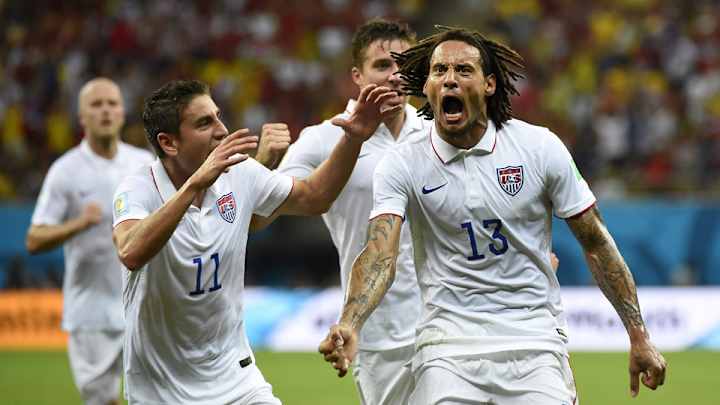
SAO PAULO – Recently regarded by so many as a yellow (or red) card in waiting or, more cynically, as the mercenary using the U.S. national team to satisfy World Cup dreams that stalled in his native country, Jermaine Jones now can feel the love.
The tattooed enforcer laughed Tuesday morning as he described the seal of approval he received from Alex Morgan, the high-scoring, telegenic Californian who’s emerged as U.S. soccer’s newest poster girl.
“She’s running around with the 13 too, and she makes ‘Jones’,” he exclaimed.
Morgan, the women’s national team star who shares a number with the German-born midfielder, posted a photo on Sunday of a red U.S. jersey with ‘JONES’ written on the white tape that obscured her own last name.It quickly became obvious why Morgan was such a fan. Jones took the field in Manaus, Brazil, a few hours later and put together yet another outstanding World Cup performance.
The highlight was the stunning second-half goal that pulled the U.S. even with Portugal. The 25-yard curler that beat Beto to the far post will make every World Cup highlight video. But Jones also played a critical role in helping the Americans establish midfield dominance and contain Cristiano Ronaldo. The FIFA World Player of the Year was quiet until the fifth minute of stoppage time, when he delivered a pinpoint cross that forced the U.S. into a 2-2 draw.
But that gut-wrenching ending failed to diminish Jones’ contribution. He covered a ton of ground, was well positioned and helped the U.S. carry the game for significant stretches. He also was efficient with the ball and effective on the dribble. Jones completed the vast majority of his passes in the attacking half.
And yes, there was a yellow card. But it was only his second in a U.S. shirt over the past year and a half. It turns out that Jones isn’t inevitably reckless. He can be smart and patient with the ball. He’ll defend and defer. In short, he’s checked all the boxes that many feared he couldn’t, and he’s been one of the two or three most consistently effective Americans at this wild World Cup.
Fans have noticed, and Jones has noticed them.
Imports of Importance: The German influence on the U.S. World Cup team
“It’s always funny, when you go on the pitch and you make your work, sometimes not the right feedback comes back. You feel a little bit like…” Jones said, searching for the right word before twisting his face in an expression of disgust and disappointment.
“The people talk. ‘You always kick the guys. You’re the bad boy.’ Sometimes it’s crazy,” he continued. “But for me, it was always the point I was saying, ‘OK, I have to work. I have to work. I will show the people.’ Now, it’s the point you play a World Cup, you play against the best player and you can show your best.”
He’s done so. Against Ghana, he played on the left rather than centrally and won a load of headers and tackles. He also had the assist on Clint Dempsey’s first-minute opener. Jones said he’s having “fun on the pitch" andhe appreciates the fact that U.S. fans now appreciate him.
“Everything is good and I hope the people support. Right now, they give me a lot back. They tweet a lot. They text me,” Jones said.
That acclaim was hard won. Although Jones earned his first U.S. cap under former coach Bob Bradley, it was his more permanent presence under Jurgen Klinsmann that rankled. Jones was uneven and unpredictable and often appeared like he was trying to do too much. The tackles were too hard, the passes too ambitious and the chemistry with Michael Bradley was uneven.
Jones was a long-time fixture at German power Schalke 04 and a UEFA Champions League regular, which Klinsmann often cited as a primary reason for the midfielder’s inclusion. But in the U.S., the week-in-, week-out rhythm of playing at the highest level was overshadowed by the frequent yellow cards and a few high-profile disciplinary issues, like the eight-week suspension in January 2012 for stomping on an opponent’s injured foot or the four-game ban the following December that followed his club-record fifth red card.
Schalke fans respected his effort, calling him kampfschwein, or “fighting pig,” because of his pugnacious approach and a jersey that never stayed clean. But in the U.S., where there was some sensitivity over Klinsmann’s recruitment and apparent reliance on foreign-born players, Jones just seemed a bit too foreign.
Klinsmann maintained his faith.
“When they have the opportunity to play in Champions League, which is the crème de la crème, the top level you can play at in a club system, you want them to take that experience, and take that attitude, and take that desire and bring it back into the national team environment,” the manager said last year. “Jermaine is a guy that never stops. He’s always ready for the next step and the next challenge. He never shies away. His inner drive is unbelievable and this is what you need when they come into our environment. They have to adjust in different ways. CONCACAF is a very different tournament for him or any European-based player. They have to switch mindsets a little bit but you need their leadership, you need their experience and then hopefully they influence the atmosphere within your team.”
And Jones repaid that faith. He's come to consider himself as much American as German. He lived in Chicago and Mississippi as a child, owns a house in Los Angeles and even named one of his five children Keanu. But there was more to do. Klinsmann wanted Jones to be a leader, not only because of his experience but because it would challenge him to hone his game and compete for the sake of the collective.
Jones embraced the more conservative midfield role he’s been asked to assume over the past few months (his contribution to the attack in Brazil has been a nice irony), proving that he can thrive amid structure. During the national team’s pre-World Cup camp at Stanford University, Jones approached U.S. Soccer’s communications staff and told them that he wished to make himself more available to the American press corps in Brazil. He’d been reluctant to do so before, in large part because he was anxious about his language skills. But Jones understood that being a spokesman, both internally and externally, is part of being a leader.
“I think it’s important too that we have some guys that have to step on and have to take the team and push the team,” he said after arriving in Sao Paulo. “For me, it’s the first World Cup and I want to try to win all these games that we play. I hate to lose. In my eyes I [am] like Timmy [Howard], Clint [Dempsey], Michael [Bradley], Jozy [Altidore] when we see that the team is maybe in a bad mood or you see that some guys feel a little bit down, you have to take them and push them onward. You have only one chance to win your games, and we need everybody, so that’s the point why we have to push everybody.”
He’s thrown himself into it like a true kampfschwein and has been a big part of the soundtrack of this World Cup. His syntax can get creative, but he always makes his point, and he’s got a sense of humor that belies his image. He’s joked about Portuguese midfielder Raul Meireles’ tattoos and called Bradley his “brother from the other mother.” He’s thrown light, good-natured jabs at Howard for sleeping through the World Cup opener and Kyle Beckerman for his reserved demeanor.
“It’s been obvious for us that he’s fully bought into it,” said midfielder Graham Zusi, who’s assisted two of the Americans’ four World Cup goals. “I think that might have been the question before, but it’s obvious to us and I think it’s obvious to everyone now that he’s fully involved. He’s got his head into this and his style of play, it’s different, but it’s something that we need as a team.”
As for the locker room chemistry between Jones and his fellow foreign-born players and the rest of the squad, Zusi called it a “process” with an ideal outcome.
“The guys have integrated very well,” the Sporting Kansas City star said. “The team has really connected and bonded and there’s no cliques. There’s no segregation by any means. It’s just a great group to be a part of.”
On Thursday afternoon in Recife, an oceanfront city on Brazil’s northeast coast, Jones will take the field in a match that seemed fated. His two homelands, the U.S. and Germany, will meet with first place in Group G at stake. Both will advance to the knockout stage with a draw (Germany would win the group), but both also could be eliminated on goal differential with a loss and an unfavorable result in the concurrent Ghana-Portugal match in Brasilia.
The stakes are high enough, but Jones’ ties to both nations adds additional emotion and depth. He played three times for Germany before switching to the U.S. and nearly made the team that won the silver medal at the 2008 European Championship.
“I always say that I’m proud of both countries,” Jones said. “I grew up in Germany and they gave me a lot. That’s where I had my first steps. I played there my first games in my first leagues. I played for Germany so, I can’t say bad stuff … But, I am still proud too when I hear the anthem from the United States. I will close my eyes and let it all go through and then will play my game.”
On Thursday, there should be no doubts that he’ll be all in. This is likely to be the 32-year-old’s only World Cup, and he’s playing as much for the U.S. as he is for himself. He reconnected with his father, a former U.S. serviceman, six years ago and now has deeper ties with the American side of his family.
A few months ago while in Turkey with his new club, Besiktas, Jones got inked with a large Stars and Stripes tattoo on his knee. The new body art is on his left leg, the one he planted firmly in the Arena da Amazônia field when he unleashed that shot against Portugal. The U.S. is a huge part of Jones’ foundation, and he’s excited to a big part of its national team’s.
Thursday’s game is about America’s World Cup future, not his German past.
“For this game against Germany we say – the whole team – we say we want to play a good game and it’s not the point to beat a friend or something. It’s the point to come to the next round. This is the important stuff,” Jones said. “We want to go there and we want to go show the people that we can battle and we can beat them, the German team.”
GALLERY: Prominent USA dual-nationals
Notable dual-nationals in U.S. soccer history
Joe Gaetjens - Port-au-Prince, Haiti
Joe Gaetijens, who scored the illustrious goal that lifted the United States to a 1-0 victory over England in the 1950 World Cup, was born in Port-au-Prince, Haiti. After returning home a hero, Gaetjens was tragically killed.
John Brooks - Berlin, Germany
Brooks, who scored the game winner in the United States’ 2014 World Cup opener against Ghana, grew up in Berlin, Germany. Although he has never lived in the United States, Brooks made the decision as a youth international to use his dual citizenship to join the USMNT.
Jermaine Jones - Frankfurt, Germany
Jones, a central midfielder known for his aggressive play, grew up in a dangerous neighborhood in Frankfurt, Germany. He debuted for the USMNT in 2010 under Bob Bradley.
Mikkel Diskerud - Oslo, Norway
Nicknamed “Mix” by his mother when he was just a young boy, Mikkel Diskerud has been a part of the USMNT since 2010. He was born in Oslo, Norway, in 1990.
Aron Johannsson - Mobile, Alabama – moved to Reykjavik, Iceland at age of 3
Aron Johannson, born in Mobile, Ala., moved to Reykjavik, Iceland, when he was 3. He has been a member of the USMNT since 2013, and has scored two goals in nine appearances.
Fabian Johnson - Munich, Germany
Fabian Johnson, who hails from Munich, Germany, made his debut for the USMNT against France in November 2011. He is a defender/midfielder on the USMNT.
Timothy Chandler - Frankfurt. Germany
Timmy Chandler, the son of a German mother and an American father, was born in Frankfurt, Germany, in 1990. He is a defender who has won 13 caps for the USMNT.
Julian Green - Tampa, Florida (born) – lived in Germany since he was 2
Julian Green, born in Tampa, Fla., to an American father and a German mother, moved to Germany at the age of 2 and has lived there ever since. At 18, Green decided to represent the United States and scored a goal in the 2014 World Cup.
Jeff Agoos - Geneva, Switzerland
Jeff Agoos, who was born in Geneva, Switzerland, won over 130 caps for the USMNT in his long career. He played in the 1998 World Cup in France, and the 2002 World Cup in South Korea.
David Regis - La Trinite, Martinique
Known for his speed as a defender, Regis was a starter for the USMNT in the 1998 World Cup. He was born in La Trinite, Martinique, and became a U.S. citizen just a few weeks before the 1998 World Cup began.
Earnie Stewart - Veghel, Netherlands
Earnie Stewart, born in Veghel, Netherlands, in 1969, was a member of the USMNT from 1990 to 2005. He is perhaps most remembered for his goal against Columbia in the 1994 World Cup, which helped the United States advance to the second round.
Fernando Clavijo - Maldonado, Uruguay
Fernando Clavijo moved from his hometown in Uruguay to the United States in 1979. He played in the 1994 World Cup and won 61 caps over his career.
Preki Radosavljevic - Belgrade, Serbia
Appearing in 28 games for the USMNT, Preki competed in the 1998 World Cup in France. He was born in Belgrade, Serbia, in 1963, and became a U.S. citizen in October 1996.
Roy Wegerle - Pretoria, South Africa
Roy Wegerle, who hails from Pretoria, South Africa, debuted for the USMNT against Iceland. He competed in both the 1994 and 1998 World Cups.
Tab Ramos - Montevideo, Uruguay
Plagued by injuries throughout his career, Ramos did not get the chance to compete for the USMNT as much as he would have liked. He is currently an assistant under head coach Jurgen Klinsmann for the USMNT at the 2014 World Cup.
Thomas Dooley - – Bechhofen, Rhineland-Palatinate, Germany
Thomas Dooley, a defender from the USMNT from 1992 to 1999, was born in Bechhofen, Rhineland-Palatinate, Germany. He recorded 81 caps and seven goals in his impressive eight-year United States career.
 Add us as a preferred source on Google
A lifelong soccer player, coach and fan, Brian Straus joined SI in 2013 after covering the sport for The Washington Post, AOL and Sporting News.