%20%20--%3E%0A%3Csvg%20version%3D%221.1%22%20id%3D%22Layer_1%22%20xmlns%3D%22http%3A%2F%2Fwww.w3.org%2F2000%2Fsvg%22%20xmlns%3Axlink%3D%22http%3A%2F%2Fwww.w3.org%2F1999%2Fxlink%22%20x%3D%220px%22%20y%3D%220px%22%0A%09%20width%3D%2239px%22%20height%3D%2240px%22%20viewBox%3D%220%200%2039%2040%22%20enable-background%3D%22new%200%200%2039%2040%22%20xml%3Aspace%3D%22preserve%22%3E%0A%3Cpath%20fill%3D%22%23FFFFFF%22%20d%3D%22M38.5%2C7H28.2v26h10.3V7z%22%2F%3E%0A%3Cpath%20fill-rule%3D%22evenodd%22%20clip-rule%3D%22evenodd%22%20fill%3D%22%23FFFFFF%22%20d%3D%22M26.1%2C25.5c0%2C5.8-4.1%2C7.5-12.9%2C7.5C3.9%2C33%2C0%2C31.2%2C0%2C25.2v-1.1h11.6%0A%09v2.4c0%2C0.7%2C0.1%2C1.4%2C1.2%2C1.4c1%2C0%2C1.2-0.4%2C1.2-1.3v-0.9c0-1.6-0.9-1.6-3.5-2.2C2.2%2C21.7%2C0%2C19.7%2C0%2C15.3v-0.9C0%2C9.3%2C5.5%2C7%2C12.9%2C7%0A%09c10.2%2C0%2C12.8%2C2.6%2C12.8%2C7.4v1.8h-11v-2.9c0-0.6-0.4-1.1-1.2-1.1c-0.6%2C0-1.2%2C0.4-1.2%2C1.1v0.9c0%2C1.5%2C0.9%2C2%2C3.3%2C2.5%0A%09c8%2C1.6%2C10.5%2C3.3%2C10.5%2C7.5V25.5z%22%2F%3E%0A%3C%2Fsvg%3E%0A)
France's Paul Pogba set for grand leap on World Cup stage
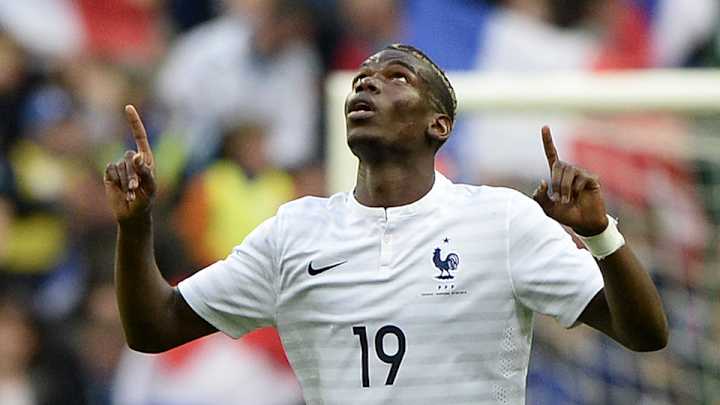

France coach Didier Deschamps has been careful with public comments in recent months, so keen is he to continue riding the wave of public euphoria following France’s unlikely 3-0 playoff win over Ukraine last year. That result, which overturned the 0-2 first leg deficit, kick-started a new feel-good factor around the side, and with the coach’s squad carefully tailored to combine the mix of talent and harmony, a repeat of any off-field problems from previous recent tournaments looks unlikely. (An example: Deschamps described his selection of the experienced Mikael Landreau as not necessarily picking the third best goalkeeper, but the best third-choice goalkeeper.)
There was one critical moment last week though, and it came after France’s confidence-boosting 4-0 win over Norway. It was a game in which Mathieu Valbuena, with three assists, starred from the right wing, and Olivier Giroud and Antoine Griezmann gave Deschamps options from the bench. One player was singled out for public admonishment, though. “He’s got to learn to stay calm and control his impulses,” said the coach. “He needs to be more rigorous tactically, for the team and for himself.”
Deschamps was talking about Paul Pogba, the 21-year-old midfielder who has less than 10 appearances for Les Bleus, but is already developing into one of its most important players. Pogba is an all-action player; he popped up in the center forward position to head home France’s opening goal against Norway and followed that up with a ‘Zidane roulette’ in the center circle, a burst through on goal and a shot that went wide.
Deschamps’ critique was gentle, but clear: keep your feet on the ground, and don’t believe the hype.
“Pogba has a combination of the qualities that Patrick Vieira had: game intelligence, strength in the tackle, and at the same time he’s capable of creating goals and scoring them,” Arsene Wenger told BeInSport. “We’re excited to watch him at this World Cup, he can be the French team’s main man for years to come.”
While the France team has experience in the form of Hugo Lloris and Karim Benzema, the reasons for optimism around the team surround the classy players who are coming through. It looks like Deschamps will pick the center back pairing of Mamadou Sakho, 24 and named vice-captain, and Raphael Varane, 21 and one of the best young defenders around. With Pogba ahead of them, and Lucas Digne, 20, pushing Patrice Evra hard for a starting fullback spot, there is a swagger to the nation that will host Euro 2016.
MORE: Franck Ribery ruled out for World Cup
For those who have watched Pogba play a decisive role for Juventus in its record-breaking Serie A success, his speedy rise to prominence in the France team has come as no surprise.
“If Pogba was Italian, he could be the new Del Piero or the new Totti,” said Alessio Tacchinardi, former Juventus midfielder and now a pundit on Sky Sports Italia. “[Juventus coach] Antonio Conte knows he has a Ferrari on his hands. He also knows that at this particular age, Pogba can still get better. Conte is clever, he uses the carrot and the stick to get results. But remember also that Pogba would not be the same player if he was at Milan or Roma, where it’s harder to make sacrifices. At Juventus, winning is the only thing, and there are role models for Pogba to look up to everywhere: Pavel Nedved in the management team, and on the pitch, Buffon, Chiellini and Pirlo.”
The same is true in the France side, and Pogba has made no secret of the fact that his hero is Deschamps, even though he was only 5 years old when the France coach lifted the World Cup in 1998. Pogba captained France Under-20s to World Cup success in 2013 and was named player of the tournament.
“I regularly talk to Didier about Paul,” the coach of that team, Pierre Mankowski, told France Football, “And I can see that he has taken the step up to the senior France team with a truly mind-blowing ease.”
The same magazine recently compared Pogba’s match statistics with the best players in other leagues of a similar age: Toni Kroos, Jack Wilshere, Thiago Alcantara, Marco Verratti and Kevin Strootman. Pogba won the most tackles. He made the most interceptions. He scored the most goals, made the most assists, had the best shooting accuracy and the most touches in the opposition penalty area.
LYTTLETON: Potential breakout players from each group
These do not mean everything, but they contextualize just how important he has become to club and country. He is modest in interviews – sample quote: “I’m just Paul, a nobody from Roissy-en-Brie. I’m not a star and don't want to be one. I just want to be the best player I can be” – and popular among his teammates. Chelsea, Paris Saint-Germain and Real Madrid want to sign him, but it will cost them.
“He is as valuable as a Salvador Dali, worth twice as much as Gareth Bale,” said his agent Mino Raiola. “In today’s market, his price would be €200 million.”
Bluster or not, the world is about to wake up to PogbaMania.
GALLERY: 25 Players to Watch at the World Cup
25 Players to Watch at the World Cup
Cristiano Ronaldo, Portugal
The reigning Ballon d’Or winner just helped Real Madrid win its 10th UEFA Champions League title as well. His supporting cast isn’t as impressive as Lionel Messi’s with Argentina or Neymar’s with Brazil, so this tournament should be a chance for Ronaldo to see just how far he can carry a team.
Lionel Messi, Argentina
Despite his obvious talent and immense contributions in conquering Europe with FC Barcelona, Messi’s biggest criticism has always been a perceived lack of similar productivity with the national team. A World Cup on his home continent, with the best Argentina team of the last few cycles around him, should be an opportunity to break that streak.
Ángel di María, Argentina
The star of Real Madrid’s Champions League final triumph, di María is a tireless midfielder who combines an explosive change of pace with excellent dribbling ability to unlock defenses. His work rate allows him to continue at the same pace all game, long after opponents have dropped off.
Luis Suárez, Uruguay
Probably the most controversial and divisive player on the planet, there is no doubting Suárez’s ability despite the headlines he accrued in the past seasons. He was voted the best player in the English Premier League by his peers this season, showing the respect he receives among those who know him best.
Arjen Robben, Netherlands
Despite the criticism of being one-footed and a diver, Robben consistently produces for club and country. He’s not strictly a goal scorer, but he seems to pop up in the right place when his team needs one, including in the 2013 Champions League final for Bayern Munich when he scored the late winner — with his left foot, of course.
Neymar, Brazil
After dominating the Brazilian league, Neymar moved to play alongside Lionel Messi and FC Barcelona this season. Injuries and a slow learning curve stunted his productivity, but his new fans did get to see his ability in flashes. The Brazilian national team might be more in his comfort zone, marking a return to the nation he carried to the 2013 Confederations Cup win.
Wayne Rooney, England
Rooney’s productivity didn’t drop with Manchester United’s league and continental fortunes. He scored 19 goals in all competitions, eclipsing his previous season, and he coupled that with seven goals for England in its World Cup qualifying campaign.
Mario Balotelli, Italy
Balotelli has taken heavy criticism for his periodically immature outbursts and a supposed lack of discipline, but a return to Serie A with AC Milan also brought with it an outburst of goals. He scored 18 in all competitions in 2013-14, as well as two in Italy’s Confederations Cup effort last summer.
Andrea Pirlo, Italy
Pirlo may appear ageless, but his game has never been predicated on physicality. While his body gets older, his mind only gets sharper, allowing him to maintain his form as one of the world’s best playmakers. Pirlo can also smack in free kicks with the best of them, making him a threat in multiple phases of play.
Didier Drogba, Ivory Coast
This World Cup will be Drogba’s last stand on the international level. Compared to his club numbers, the 36-year-old’s national team goal-scoring record has been mediocre, his own form personifying a larger listlessness among his nation at the highest levels. He has one last chance to turn the narrative around.
Karim Benzema, France
The 26-year-old Real Madrid forward helped the Spanish side to a Champions League title, scoring 24 goals in all competitions, including five on Europe’s biggest stage. With compatriot Franck Ribery ruled out for the World Cup with a back injury, the onus falls even more on Benzema to lead Les Bleus’ attack.
Keisuke Honda, Japan
Honda finally moved to a big club in January, joining AC Milan from CSKA Moscow. He has been an important player for his national team since bouncing between the Dutch first and second tiers with VVV-Venlo, working his way up gradually and patiently. Honda will be Japan’s primary playmaker in Brazil.
Paul Pogba, France
In many ways, Pogba is similar to Mario Balotelli. He had a dramatic falling out with his manager in England, leaving Manchester United for Juventus in Italy. Since then, he has become a spectacular-goal machine, regularly cutting inside from the right wing to unleash thunderous strikes past hapless goalkeepers.
Eden Hazard, Belgium
After already winning the Ligue 1 Player of the Year award twice, Hazard reminded everybody that he’s still far from his prime, winning the Young Player of the Year award in England this season. Hazard has become the subject of transfer rumors since Chelsea’s season ended, sparked by comments in the press by him and manager José Mourinho that suggest he might be losing favor.
Yaya Touré, Ivory Coast
With a weak defense behind him, Touré will be key in any success the Ivory Coast has at the World Cup. He surged forward to score 24 goals for Manchester City last season, but his physical presence and defensive ability will likely be easier to notice against the dangerous attacks of Colombia and Japan.
Michael Bradley, United States
Bradley is the United States’ version of Xavi, although extremely watered down. Rarely does a U.S. game go by where his pass-completion percentage is below 90, and his late runs from midfield add another wrinkle to the American counterattack. Above all, Bradley’s leadership ability will be vital considering the difficult road the U.S. faces to progressing beyond the group stage.
Manuel Neuer, Germany
After biding his time as a back-up for Germany and at Schalke in the lower tiers of the Bundesliga, Neuer has emerged as the best goalkeeper in the world since Euro 2012 and his move to Bayern Munich the previous summer. He is the complete package: a shot stopper, good on crosses and excellent with the ball at his feet.
Arturo Vidal, Chile
Vidal was Juventus’ leading scorer in continental competition last year, saving his best play for when the lights shined brightest. He works alongside Andrea Pirlo in that midfield, providing the engine as a box-to-box midfielder to complement the older Pirlo’s ability to pick passes. For Chile, Vidal will have to play a larger role.
Alexis Sánchez, Chile
As a frequent option off the bench for FC Barcelona, Sánchez injects pace and one-on-one ability into any game. The way he runs at defenders unsettles back lines, often creating opportunities for teammates by dribbling to the end line and cutting the ball back into onrushing attackers.
Xavi, Spain
Barcelona and Spain’s midfield maestro, few players in the world can pass the ball like Xavi. His high completion percentage shows the beauty of the simple game and how effective it can be if coupled with next-level soccer IQ. Spanish manager Vicente del Bosque will have to find the right partners for Xavi, as Andrés Iniesta and Sergio Busquets are on the club side.
Andrés Iniesta, Spain
With Cesc Fàbregas playing a larger role in central midfield for Barcelona under Tata Martino, Iniesta had to find a way to impact the game from a different spot. As a result, he became a left-winger in Barça’s 4-3-3 that thrives on overloading the middle and providing killer through passes to the forward line.
Luka Modrić, Croatia
Croatia has the ability to pull off surprise results in Brazil, not least of which would be against the host nation in the opening game. Modrić is well equipped to lead his team and control any game’s tempo from central midfield, along with partner Ivan Rakitić. Modrić is a complete player, proficient with the ball at his feet in both passing and dribbling, as well as maintaining a strong presence in front of the defense.
Robin van Persie, Netherlands
Under Dutch manager Louis van Gaal, van Persie has found the best international form of his life. He scored 11 goals for the Netherlands in qualifying for Brazil 2014, only failing to score in three competitive appearances since Euro 2012. Van Gaal will join van Persie at Manchester United after the World Cup, giving him more of a reason to want to impress his boss.
Edin Džeko, Bosnia-Herzegovina
Džeko finished the season for English champion Manchester City in great form, scoring five goals in his last four appearances. Most of the times Džeko scores, he seems to add another one later in the game, showing his never-satisfied mentality. The big target striker was his country’s leading scorer in qualifying as well, scoring 10 goals in 10 games.
Mesut Özil, Germany
After moving to Arsenal last summer, Özil’s playmaking ability shined with his new club. He can both pass the ball and finish with late midfield runs, playing deeper in the central-midfield block for both his club and Germany. It feels like Özil has been around forever, largely due to making his first-team debut with Schalke at age 17, eight years ago.

A journalist, broadcaster and consultant, Ben Lyttleton also wrote the book on PKs with his “Twelve Yards: The Art and Psychology of the Penalty Kick.”