%20%20--%3E%0A%3Csvg%20version%3D%221.1%22%20id%3D%22Layer_1%22%20xmlns%3D%22http%3A%2F%2Fwww.w3.org%2F2000%2Fsvg%22%20xmlns%3Axlink%3D%22http%3A%2F%2Fwww.w3.org%2F1999%2Fxlink%22%20x%3D%220px%22%20y%3D%220px%22%0A%09%20width%3D%2239px%22%20height%3D%2240px%22%20viewBox%3D%220%200%2039%2040%22%20enable-background%3D%22new%200%200%2039%2040%22%20xml%3Aspace%3D%22preserve%22%3E%0A%3Cpath%20fill%3D%22%23FFFFFF%22%20d%3D%22M38.5%2C7H28.2v26h10.3V7z%22%2F%3E%0A%3Cpath%20fill-rule%3D%22evenodd%22%20clip-rule%3D%22evenodd%22%20fill%3D%22%23FFFFFF%22%20d%3D%22M26.1%2C25.5c0%2C5.8-4.1%2C7.5-12.9%2C7.5C3.9%2C33%2C0%2C31.2%2C0%2C25.2v-1.1h11.6%0A%09v2.4c0%2C0.7%2C0.1%2C1.4%2C1.2%2C1.4c1%2C0%2C1.2-0.4%2C1.2-1.3v-0.9c0-1.6-0.9-1.6-3.5-2.2C2.2%2C21.7%2C0%2C19.7%2C0%2C15.3v-0.9C0%2C9.3%2C5.5%2C7%2C12.9%2C7%0A%09c10.2%2C0%2C12.8%2C2.6%2C12.8%2C7.4v1.8h-11v-2.9c0-0.6-0.4-1.1-1.2-1.1c-0.6%2C0-1.2%2C0.4-1.2%2C1.1v0.9c0%2C1.5%2C0.9%2C2%2C3.3%2C2.5%0A%09c8%2C1.6%2C10.5%2C3.3%2C10.5%2C7.5V25.5z%22%2F%3E%0A%3C%2Fsvg%3E%0A)
Michael Phelps Honored With SI’s 2025 Muhammad Ali Legacy Award

In the fall of 2015 I went to Arizona to report a story on Michael Phelps for Sports Illustrated. It was in one way a dutiful piece: Phelps was already the greatest swimmer in history and already the most decorated Olympic athlete (22 medals, 18 gold—absurd numbers that he had normalized), and here he was already deep in preparation for his fifth and, almost assuredly final, Games.
But the piece was in another way something more. A year earlier Phelps had been arrested in his hometown of Baltimore, driving erratically at 84 mph in a 45-mph zone. He tested as legally impaired and was charged with DUI, excessive speed and crossing double lane lines. It was his third transgression in a decade of fame (a DWI in 2004 at age 19; and in 2009 he was photographed using a bong and suspended for three months by USA Swimming), but the most troubling, not because of the dangerous speed and heavy drinking, but because he was 29 years old. Youth was no longer a credible excuse. Phelps had announced shortly after the incident that he was entering a residential treatment facility, but shared no specifics as to what led him there or what would be addressed. He returned to swimming in the spring of 2015 and performed near his usual levels. Phelps answered some questions after races, but revealed little.
In this way, the story I was sent to report contained mysteries, but I had no expectation that Phelps would explain them. Phelps swam a solid morning workout in rising desert heat at the Arizona State pool. He looked good, even more Olympian than usual at age 30, and with his back and shoulders dotted with cupping circles. He was visibly tight and fit. We walked up the street to a café where he liked to eat breakfast; it was crowded, so we sat at a narrow counter facing a window that looked out onto the sidewalk. Phelps ordered breakfast tacos and a pineapple pancake; I got an omelet. It was noisy and I was worried that the chaotic setting and the side-by-side seating were not conducive to intimate or even productive talk. Wrong, as it turned out.
For a while we talked easily about Arizona weather; about Katie Ledecky; about his beloved Baltimore Ravens and his friend, Ray Lewis; eventually about swimming and his growing readiness for the 2016 Olympics in Rio. Then the tenor of the interview changed. In dozens of interviews and appearances since that day, as Phelps has become a fierce and unflinching mental health advocate, Phelps has said that I asked him one question that unlocked him, although he can’t remember it, specifically.
Phelps was discussing the whole of his year since the incident and said, in summary, “Once I got back to Baltimore, once I had left therapy, I had this different outlook on everything.”

According to my transcript of the interview (the recording is long gone), I then said, “What was different?”
Phelps said, “There were a lot of obstacles I overcame, and one of them was my relationship with my father.”
And there it was. We talked for another hour, not about swimming (at least not as an athletic endeavor), for two hours the next day, several times on the phone and over text in the following couple of weeks. Phelps explained the mysteries. He talked about how he “lived in a bubble for a long time.” About the abandonment he felt when his parents split up and his father was mostly gone. About how dismissively he had treated friends and family. About how he contemplated suicide. About how his time in treatment set him on the road to understanding himself as a human being, not just a fast-swimming, gold-medal-winning television character. About all the things that he now fearlessly and publicly identifies as his own battle with anxiety and depression. He freed friends and family members to talk openly with me. “Michael told me I can go ahead and tell the real story,” said Brian Shea, a longtime Baltimore friend.
I wrote a piece that was published in the Nov. 16, 2015, issue of SI with a haunting, shadowy cover image of Phelps, taken by Simon Bruty. Phelps wears a V-neck T-shirt; a thick, unkempt goatee hangs from his chin, his eyes asking for understanding. It is a portrait of vulnerability, a giant stripped naked in the public square.
It was the beginning of Phelps’s second life, of his mission. “After that story, I didn’t hide from the mirror anymore,” says Phelps now, a decade later. “I felt, I don’t know, lighter.” In August 2016, Phelps carried the American flag at the Rio Olympics opening ceremony, the first and only one he attended while competing (because swimming events always commence the next day), and then won five more gold medals and one silver. His totals rose to 23 golds and 28 in all, and good luck to future Olympians chasing those. Then Phelps surged into another world altogether.

In the nine years since those final Games—almost a quarter of his 40 years of life—Phelps has used his name, his legacy and his lived experience to carry mental health awareness and treatment advocacy to the public, fighting stigma and offering empathy to audiences ranging from the thousands he spoke to at a conference in India just before Thanksgiving to the one at a time who approach him in places like grocery stores and ask him for help, and to his work with the online therapy platform Talkspace. “Michael Phelps is an ideal example of how to make a difference,” says Tom Insel, who served as director of the National Institute of Mental Health from 2002 to ’15. “He was one of the first celebrities to speak up.” Others have followed, whether influenced by Phelps or enabled by a more welcoming environment that Phelps helped create, including gymnast Simone Biles, tennis player Naomi Osaka and NBA veteran Kevin Love.
“We grow up in a society that does not speak totally stigma-free,” says psychiatrist Christine Yu Moutier, chief medical officer of the American Foundation for Suicide Prevention. “But that culture is changing, and Michael Phelps has been a part of that change. We are social creatures. We are unconsciously watching and mimicking those around us. Using your own lived experience story in the mental health and suicide prevention space in the way that Michael has is an enormous force for good. He has been part of a movement of fantastic change.”
For his work in the mental health space, for his tireless—and fearless—sharing of a difficult personal journey, Michael Phelps is the 2025 recipient of SI’s Muhammad Ali Legacy Award, named for Ali, notably in 2015, to honor a current or former athlete who embodies the ideals of sportsmanship, leadership and philanthropy as vehicles for changing the world. Phelps joins Eunice Kennedy Shriver (2008), Colin Kaepernick (2017), LeBron James (2020) and others as winners of the Ali award, along with the two most recent honorees, Allyson Felix in 2022 and Dikembe Mutombo, posthumously, in 2024. Phelps will receive the award as part of SI’s 2025 Sportsperson of the Year celebration, in Las Vegas on Jan. 6.
Phelps appears on screen for a video interview in early December. There is a giant—well, there’s no other way to describe it—bone, to Phelps’s right in the frame. It’s impossible not to ask about it. “It’s a woolly mammoth femur,” he says. “My wife [Nicole] and I stumbled upon it at a shop in Colorado and decided we needed it for the office.” He smiles as if it seems silly, but O.K. It’s the smile from that cover photo a decade earlier—a man unarmed. He’s only been home a few days from a trip to Australia, where he made three appearances, and India, where he made one.
“It was crazy in Australia, what, 25 years since Sydney [his first Olympics, at barely age 15]?” he says. “Brought back memories. There were some swimming questions, of course, but a lot of parents asking questions relating to mental health and kids and how to help them when they’re struggling.” Phelps and Nicole have four boys under the age of 10, from Boomer, 9, who was sitting on family laps in the Rio Olympic pool seats, watching his dad win those medals; to Nico, not yet 2; with Beckett, 7, and Maverick, 6, in the middle. Like everything in Phelps’s advocacy universe, his boys are part of his learning and sharing. “The emotions are crazy and loud,” he says. “Nicole and I have been able to implement the lion’s breath [a yoga technique], where they just take a deep breath and then they get to roar and scream as loud as they possibly can. It’s a lot. But it lowers the shoulders.”
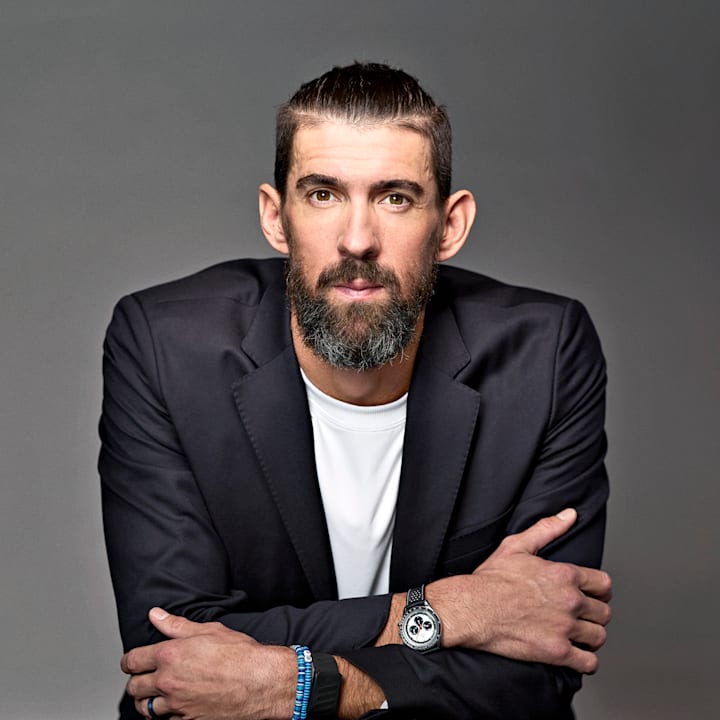
Phelps pulls off the blue wool cap that’s covering his head to make a point. The brown goatee from 2015 is now a salt-and-pepper beard. His Olympic buzz cut is shoulder length, usually pulled into a ponytail or bun. It’s a look. A statement. “I’m comfortable looking in the mirror and seeing gray in my beard and a man bun.” Pause. How did he get here? How did the room get so big? “I never thought that story from 2015 would catapult me into this world,” Phelps says. “I never thought it would put me in a position to maybe save a life. But I’ve looked at suicide, thought about it. I know people are going through that. I want to be an example of that vulnerability, and for what asking for help is about. I want people to know it’s O.K. to not be O.K.”

From out of the frame, Nicole hands him a note, citing a 2023 Centers for Disease Control report that determined suicide was the second-most-common cause of death among people aged 10 to 34, significantly more so among males. “Holy hell,” says Phelps. “Second-most common. That’s my biggest goal. Lower that rate.”
His journey has landed him in powerful places. He gave a talk at Microsoft in Redmond, Wash., in 2019, detailing his own life and his own pain. During the Q&A that followed Phelps’s talk, one of the attendees stood and bared himself, in front of hundreds of coworkers. “When I got off the stage, I was literally crying,” says Phelps. “I walked up to him and hugged him and we talked.” Phelps waits. “You know sometimes I feel like I’m on top of a mountain, screaming, and nobody is listening, and then something like that happens, and I’m like, Holy s---, yes, this is actually helping.”
On another occasion, at an event sponsored by Fidelity, in Scottsdale, an audience member told Phelps that they had considered suicide but that hearing Phelps’s story pulled them back. They said, “You saved my life.” Nicole says, “That’s heavy. But Michael takes it in stride and hugs them and tells them how worthy they are.”
“I can’t tell you how many interactions I’ve had just walking around places like a grocery store,” Phelps says. “Just out in public and people come up to me, vulnerable, and say, ‘I’ve had so many ups and downs and you’ve helped me. Thank you.’ That’s so powerful.”
Phelps’s close friend, Fox NFL personality Jay Glazer, says, “Michael wants to be of service. He wants to be in the trenches. This is not just some celeb saying ‘Oh, I’m doing something to help people out.’ No. He’s in it. He’s saying, ‘I’m going to use my pain to help others.’ That’s got to be the greatest accomplishment a man can achieve. I’m so proud of him.”

Bob Bowman was Phelps’s longtime swimming coach; they were inseparable across those five Olympics. Bowman is now the head coach at Texas and the go-to coach for some of the best swimmers in the world, including Leon Marchand of France and Summer McIntosh of Canada. He and Phelps are frequently in touch; they will talk about the workouts that Bowman writes nowadays and on occasion Bowman will send him a screenshot of some epic training session that Phelps did in his prime and Phelps will respond excitedly: I remember doing that! Just as likely, Bowman will bust him about a missed turn. “It’s all still in there,” says Bowman. They are close in a way that evades description, and so Bowman marvels at where Phelps has taken his life.
“It was surprising in the beginning,” says Bowman. “But now? I can see how gratifying it is to him. Especially since swimming is over. He gets going on this, and he seems to really care. I think it’s so important to him because he realizes how it relates to his own life. And I think the more he does it, the better he feels about it, and the more he wants to do.”
Something else: There are ripples to Phelps’s work. Bowman says he never broached the subject of mental health when Phelps was competing, because, he says, “I was just not equipped to deal with it.” But now, as a college and professional coach, “He’s empowered us to start dealing with it.”
Allison Schmitt trained with Phelps, and was among his closest friends, through most of their parallel careers; she won 10 Olympic medals, including four golds. She went public with her own mental health struggles in the spring of 2015, shortly after the death by suicide of her 17-year-old cousin. As Phelps rose and fell, she lived it with him. “Michael really thrives off helping others,” says Schmitt. “I think what he realized, at some point, was ... he went through all these years, hurting, and just putting his head down and never being heard. But now he understands, and he hears people that are screaming but don’t necessarily know how to say the words I need help.”
And this: “I have seen so much growth in him.”
There is a catch that raises the degree of difficulty in all of this. Phelps is doing his work for the world while also doing work on himself. He calls it his roller coaster. “That’s who I am,” he says. “I go through my ups and downs.”
Thanksgiving was rough. The house was full for the week, with the boys, with Bowman and Schmitt, with Nicole’s parents. “Holidays for me are always a struggle,” says Michael. “Holidays were never super rah-rah, exciting for me growing up. So as far as the roller coaster goes, these last two or three weeks, it’s just been, Holy crap. More like an express elevator going straight down.”

Moutier says, “One thing that can get tricky is when celebrities out their own lived experience, mental health journey or suicide journey, the response can be overwhelming. ... [They] are not mental health professionals and they’re not necessarily equipped in their own schedules and time. That can become a huge responsibility.
“I hope and trust that he’s got really wise and supportive people in his life, partners and others, therapists, who can help him navigate, because there may be times when it’s just too much.”
He does. Not just family, friends and therapists. Phelps is part of a text, phone and email group that includes, among others, Glazer, Rams coach Sean McVay, Commanders coach Dan Quinn and movie megastar Dwayne “The Rock” Johnson. “If any of us are spiraling, or if any of us are having a moment, we just hop into the group and honestly, we just hold ourselves accountable, to talk about it,” says Phelps. “To be vulnerable. One of us is always there to pick up the call. Just communicate. Don’t isolate. And I can isolate with the best of them.”
It all unfolds together. Phelps helps himself as he helps others by talking about it, a balance that lends power to his message. His difficult relationship with his father was central to his struggle, and in some ways, still is. His parents, Fred and Debbie, split up when Michael, the youngest of three, was 9. In my 2015 interview with Fred Phelps, he remembered some good times with Michael, whereas Michael remembered mostly not having his dad in the house. It was messy and painful. They reconciled in ’15, but it was never all the way right. Fred died in 2022. I asked Michael, “You guys were good at the end, right?”
His answer: “Uh, yeah, in my eyes, sure.”

But: “I talk about my relationship with my dad all the time,” says Phelps. “It’s out in the open. It’s not something to be ashamed of. It’s not something to be embarrassed about. It’s a chapter in your life that you’ve gone through and that made you who you are.”
He is a father now. With those four boys. On the weekend after Thanksgiving, he found himself still on the downside of the roller coaster. “I just wasn’t doing well, mentally,” says Phelps. He was in the kitchen. “And the big guy, Boomer, he walks up to me and gives me a hug, and just snuggles right in there like a little bear.”
Michael Phelps, Olympic hero, pulls off the skull cap again and shakes his head. “Those little dudes have saved me.”
So that he may save others.
 Add us as a preferred source on Google