%20%20--%3E%0A%3Csvg%20version%3D%221.1%22%20id%3D%22Layer_1%22%20xmlns%3D%22http%3A%2F%2Fwww.w3.org%2F2000%2Fsvg%22%20xmlns%3Axlink%3D%22http%3A%2F%2Fwww.w3.org%2F1999%2Fxlink%22%20x%3D%220px%22%20y%3D%220px%22%0A%09%20width%3D%2239px%22%20height%3D%2240px%22%20viewBox%3D%220%200%2039%2040%22%20enable-background%3D%22new%200%200%2039%2040%22%20xml%3Aspace%3D%22preserve%22%3E%0A%3Cpath%20fill%3D%22%23FFFFFF%22%20d%3D%22M38.5%2C7H28.2v26h10.3V7z%22%2F%3E%0A%3Cpath%20fill-rule%3D%22evenodd%22%20clip-rule%3D%22evenodd%22%20fill%3D%22%23FFFFFF%22%20d%3D%22M26.1%2C25.5c0%2C5.8-4.1%2C7.5-12.9%2C7.5C3.9%2C33%2C0%2C31.2%2C0%2C25.2v-1.1h11.6%0A%09v2.4c0%2C0.7%2C0.1%2C1.4%2C1.2%2C1.4c1%2C0%2C1.2-0.4%2C1.2-1.3v-0.9c0-1.6-0.9-1.6-3.5-2.2C2.2%2C21.7%2C0%2C19.7%2C0%2C15.3v-0.9C0%2C9.3%2C5.5%2C7%2C12.9%2C7%0A%09c10.2%2C0%2C12.8%2C2.6%2C12.8%2C7.4v1.8h-11v-2.9c0-0.6-0.4-1.1-1.2-1.1c-0.6%2C0-1.2%2C0.4-1.2%2C1.1v0.9c0%2C1.5%2C0.9%2C2%2C3.3%2C2.5%0A%09c8%2C1.6%2C10.5%2C3.3%2C10.5%2C7.5V25.5z%22%2F%3E%0A%3C%2Fsvg%3E%0A)
Why Aryna Sabalenka, Coco Gauff and More Are Threatening to Boycott Grand Slams
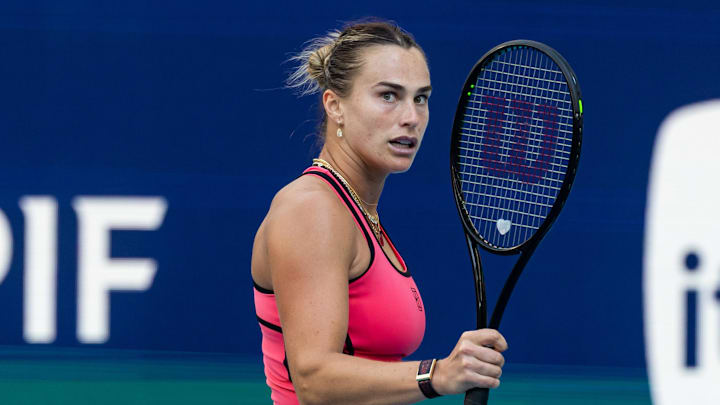
On Monday, tennis stars like World No. 1s Jannik Sinner and Aryna Sabalenka released a joint statement criticizing the prize money pool at the upcoming French Open, a move that amounts to a new installment in an ongoing battle between players and the four Grand Slam tournaments.
Then, on Tuesday, many of those same players discussed the prospect of a Grand Slam protest if their qualms aren't eased.
"I think at some point we will boycott it, yeah,” Sabalenka said during her pre-tournament press conference at the Italian Open. “I feel like that’s going to be the only way to fight for our rights."
But why exactly are the players so upset? What is at the root of this dispute, and how long has it been going on? We'll dive into it all below.
What did the Monday statement say?
The players' statement on Monday was in response to Roland Garros tournament organizers, who announced in April that the prize money at this year's French Open had increased about 10%, with an overall purse of 61.7 million euros, or $72.1 million.
Despite this, the "players' share of Roland Garros tournament revenue has declined from 15.5% in 2024 to 14.9% projected in 2026," and the underlying payout figures "tell a very different story," the statement read.
“According to tournament officials, Roland Garros generated 395 million euros ($462,481,800) in revenue in 2025, a 14% year-on-year increase, yet prize money rose by just 5.4%, reducing players' share of revenue to 14.3%.”
“With estimated revenues of over 400 million euros ($468,426,000) for this year's tournament, prize money as a percentage of revenue will likely still be less than 15%, far short of the 22% that players have requested to bring the Grand Slams into line with the ATP and WTA Combined 1000 events.”
Players also said they had not received a response from any Grand Slam leaders regarding previously levied proposals for improved representation and health and welfare.
“While other major international sports are modernizing governance, aligning stakeholders, and building long-term value, the Grand Slams remain resistant to change," the statement went on. "The absence of player consultation and the continued lack of investment in player welfare reflect a system that does not adequately represent the interests of those who are central to the sport's success.”
So, tennis's biggest stars are upset about their piece of the revenue pie?
Exactly. Although tournament revenues have increased, players are upset that their share of the revenue has not increased at the same rate.
“Definitely when you see the number and you see the amount the players [are] receiving … I feel like the show is on us,” Sabalenka said Tuesday. “I feel like without us there wouldn’t be a tournament and there wouldn’t be that entertainment. I feel like definitely we deserve to be paid more percentage.”
How long has this been going on?
This is not a new issue, nor is it the first time that top players have released a letter criticizing those in charge of the four major Grand Slams—in March of last year, in fact, twenty leading players submitted a missive requesting an in-person meeting between their representatives and the four reps from each of the Slams, during which stars hoped to discuss prize money, as well as athlete input in things like competition proposals and player health and welfare.
That letter was signed by the following WTA players: Sabalenka, Gauff, Iga Świątek, Jessica Pegula, Madison Keys, Jasmine Paolini, Emma Navarro, Zheng Qinwen, Paula Badosa and Mirra Andreeva.
And the following ATP players: Sinner, Novak Djokovic, Alexander Zverev, Carlos Alcaraz, Taylor Fritz, Casper Ruud, Daniil Medvedev, Andrey Rublev, Stefanos Tsitsipas and Alex de Minaur.
According to the communications firm that released Monday's missive, the signatories on the 2026 letter are the same as those from March 2025, minus Djokovic, who has not signed the new statement, per ESPN.
Still, you would assume Djokovic is in line with the mission here, based on past comments and his previous involvement in the PTPA.
“I’m just going to state a fact,” Djokovic said in January of 2025. “The pie split between the governing bodies in major sports, all major American sports, like NFL, NBA, baseball, NHL, is 50%. Maybe more, maybe less, but around 50%. Ours is way lower that that.”
What are the Grand Slams saying?
Slams have lots of explanations for what they pay players, all of which boil down to the fact that there are lots of mouths to feed. For instance, money from these prestigious events helps fund smaller tournaments in the different host countries—that's not necessarily the case in other leagues. Facilities, meanwhile, which must be large and advanced enough to host large multi-week events, require constant upgrades. Tournament leadership also points to the funds dedicated to player travel, housing, meals, etc., as a major expense for each of the four majors.
Still, though, players feel that they deserve more, considering there would be no Grand Slams without them.
So what happens now?
Players seem comfortable with the idea of a walkout, if that's what it takes.
“If everyone were to move as one and collaborate, yeah, I can 100% see that,” Coco Gauff, the defending French Open champion, said of a boycott. She also pointed to the new WNBA collective bargaining agreement, which made landmark strides in the world of revenue sharing, as a good example to follow.
“If the majority say we are boycotting, we are not playing, then of course I'm up for it,” added Elena Rybakina. “It's not only on the Grand Slams, and it's not only about raising the prize money. A lot of people are not aware that there is taxes which are big. You even make more prize money, but you giving it all to the taxes.”
And although she believes that at least the female players are united in their frustrations, Świątek mused that, in her estimation, a boycott might be more of a last resort.
“Hopefully before Roland Garros there's going to be opportunity to have these type of meetings, and we'll see how they go,” she said Tuesday. “But boycotting the tournament, it's a bit extreme kind of situation.”
Play at the French Open is slated to begin on May 24.
More from Sports Illustrated
 Add us as a preferred source on Google
Brigid Kennedy is a writer for the Features and Franchises team at Sports Illustrated. Before joining SI in November 2024, she covered political news, sporting news and culture at TheWeek.com before moving to Livingetc, an interior design magazine. She is a graduate of Syracuse University, dual majoring in television, radio and film (from the Newhouse School of Public Communications) and marketing managment (from the Whitman School of Management). Offline, she enjoys going to the movies, reading and watching the Steelers.