%20%20--%3E%0A%3Csvg%20version%3D%221.1%22%20id%3D%22Layer_1%22%20xmlns%3D%22http%3A%2F%2Fwww.w3.org%2F2000%2Fsvg%22%20xmlns%3Axlink%3D%22http%3A%2F%2Fwww.w3.org%2F1999%2Fxlink%22%20x%3D%220px%22%20y%3D%220px%22%0A%09%20width%3D%2239px%22%20height%3D%2240px%22%20viewBox%3D%220%200%2039%2040%22%20enable-background%3D%22new%200%200%2039%2040%22%20xml%3Aspace%3D%22preserve%22%3E%0A%3Cpath%20fill%3D%22%23FFFFFF%22%20d%3D%22M38.5%2C7H28.2v26h10.3V7z%22%2F%3E%0A%3Cpath%20fill-rule%3D%22evenodd%22%20clip-rule%3D%22evenodd%22%20fill%3D%22%23FFFFFF%22%20d%3D%22M26.1%2C25.5c0%2C5.8-4.1%2C7.5-12.9%2C7.5C3.9%2C33%2C0%2C31.2%2C0%2C25.2v-1.1h11.6%0A%09v2.4c0%2C0.7%2C0.1%2C1.4%2C1.2%2C1.4c1%2C0%2C1.2-0.4%2C1.2-1.3v-0.9c0-1.6-0.9-1.6-3.5-2.2C2.2%2C21.7%2C0%2C19.7%2C0%2C15.3v-0.9C0%2C9.3%2C5.5%2C7%2C12.9%2C7%0A%09c10.2%2C0%2C12.8%2C2.6%2C12.8%2C7.4v1.8h-11v-2.9c0-0.6-0.4-1.1-1.2-1.1c-0.6%2C0-1.2%2C0.4-1.2%2C1.1v0.9c0%2C1.5%2C0.9%2C2%2C3.3%2C2.5%0A%09c8%2C1.6%2C10.5%2C3.3%2C10.5%2C7.5V25.5z%22%2F%3E%0A%3C%2Fsvg%3E%0A)
He Had A Big Butt, No Lie: George Washington’s Athleticism Helped Build Our Sports-Mad Nation
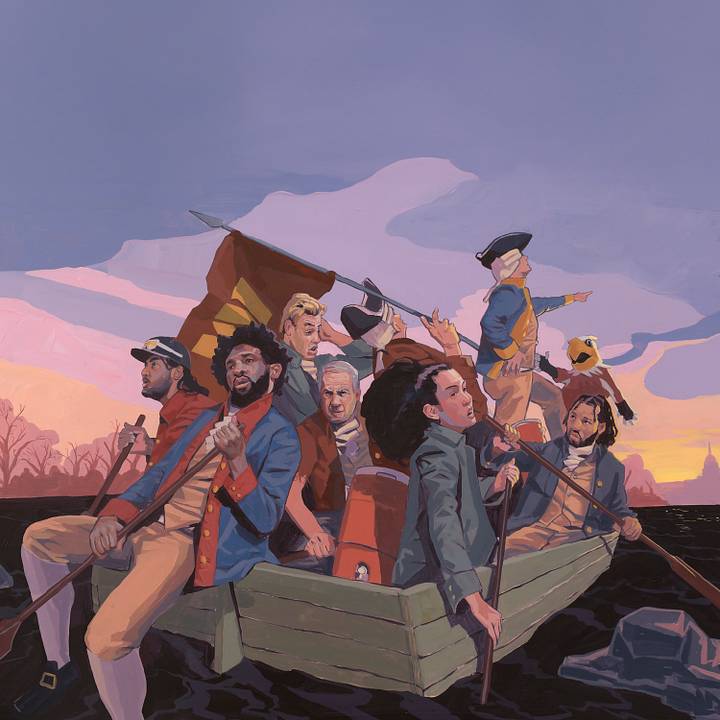
George Washington had a big dumper.
“His heroic figure was only somewhat disfigured by a huge rump,” in the words of the novelist Gore Vidal, who saw in the Founding Father an athlete who even sat like an All-Star catcher, easing himself onto a clubhouse recliner. “Slowly, carefully, painfully,” Vidal wrote in his 1973 historical novel Burr, “Washington arranged himself in a throne-like chair, favouring one huge buttock.”
Like Mariners catcher Cal “Big Dumper” Raleigh, Washington was blessed with an “oddly shaped body [that] made him the bane of his tailors,” as his Pulitzer Prize–winning biographer Ron Chernow put it. To avoid a pain in the rear, Washington became one to the men who supplied him with trousers. “These breeches must be roomy in the seat,” he wrote to one tailor.
That rear end was the seat of his power. To understand what athletic competition was like 250 years ago, in 1776, you might start by examining George Washington’s backside, as many historians have done. Like the best catchers and power pitchers, the commander-in-chief of the Continental Army leveraged his lower body to fire the muzzle-loading cannon of his right arm.

Charles Willson Peale, the artist and Revolutionary War veteran, knew Washington’s physique better than most. His 1779 oil portrait of the general sold at auction for $21.3 million in 2006. It was Peale who recalled a day at Washington’s estate in 1773 when the great man excelled at a sport combining javelin and shot put.
“One afternoon several young gentlemen, visitors at Mount Vernon, and myself were engaged in pitching the bar, one of the athletic sports common in those days, when suddenly [Washington] appeared among us,” Peale recounted. “He requested to be shown the pegs that marked the bounds of our efforts; then, smiling, and without putting off his coat, held out his hand for the missile. No sooner ... did the heavy iron bar feel the grasp of his mighty hand than it lost the power of gravitation, and whizzed through the air, striking the ground far, very far, beyond our utmost limits. We were indeed amazed, as we stood around, all stripped to the buff, with shirt sleeves rolled up, and having thought ourselves very clever fellows.”
New record set, Washington took his leave, but not before gently needling his vanquished competitors. “When you beat my pitch, young gentlemen,” he said, “I’ll try again.”
Washington was 6' 2" and loathe to talk trash to his fellow men, who were half a foot shorter than he on average. Among Washington’s earliest known handwriting samples was a widely circulated list, “Rules of Civility and Decent Behavior,” that he hand-copied as a teenager. These included the timeless precept: “Bedew no man’s face with your Spittle by approaching too near him when you Speak.”
His own athletic prowess spoke for itself. If Washington’s feats would be embellished and mythologized by others in the ensuing decades, that would only give him more in common with modern athletes who defy “the power of gravitation.” Washington didn’t really throw a silver dollar across the Potomac, not least because the river is a mile wide at Mount Vernon and silver dollars weren’t minted until 1794, when he was 62 years old. But he did throw a piece of slate across the Rappahannock River in Virginia, according to his stepgrandson, George Washington Parke Custis.
That story was so often met with skepticism that in 1936, nine years after retiring from a career that saw him win 417 games for the Washington Senators, 48-year-old Walter Johnson was roped into replicating the Rappahannock throw with a silver dollar near Washington’s boyhood home in Fredericksburg, Va. The distance was measured as 372 feet. Johnson trained at home in Germantown, Md., by throwing a silver dollar against his barn door. Before the big day, the Big Train sent an ominous message through the press: “Arm getting stronger, barn door weaker.”
On Feb. 22, the 204th anniversary of Washington’s birth, Johnson cleared the river on the last two of his three attempts. In doing so, he bridged not just the Rappahannock but also two eras of American history, both of which valued a big arm.

Before the American revolution, the colonies were largely beholden to English sports. Golf had literally been exported to the new continent. In 1743, a Charleston businessman named David Deas received a shipment of 96 clubs and 432 balls from Scotland. That same year, in England, Jack Broughton—who popularized the use of “mufflers,” or gloves—established a few boundaries in the savage sport of boxing, such as making it illegal to “seize” an opponent by “the breeches.”
But no athletic skill was more prized, or of greater use, than “horsemanship.” On foot, Washington cut a strange figure. Gore Vidal, still cooking: “For a large, rather ungainly man (he had the hips, buttocks and bosom of a woman), Washington could move with brutal swiftness.” But astride one of his warhorses—a half-Arabian named Blueskin; a chestnut gelding called Nelson—he was an equestrian statue come to life.
“He possessed strong but narrow shoulders and wide, flaring hips with muscular thighs that made him a superb horseman,” notes Chernow. Thomas Jefferson, in an 1814 letter, called Washington “the best horseman of his age, and the most graceful figure that could be seen on horseback.”
This is high praise from Jefferson, who didn’t believe that sports built good character or even good health. “Games played with the ball and others of that nature, are too violent for the body and stamp no character on the mind,” Jefferson wrote in 1785, the same year that a racehorse named Magnolia was described in a Virginia newspaper as “thought by all who have seen him to be perfect.” That Arabian stallion was owned by Washington, who liked to gamble on the ponies.
He also hunted foxes. Sweet Lips, Washington’s beloved foxhound, was a kind of emotional support dog, accompanying Washington to the first Continental Congress in Philadelphia in 1774. There, delegates drafted the 14 Articles of Association, the eighth of which resolved that colonists bracing for war with England should forsake their many recreational pastimes: “We will ... discountenance and discourage every species of extravagance and dissipation, especially all horse-racing, and all kinds of games, cock-fighting, exhibitions of shews [sic], plays, and other expensive diversions and entertainments.”
Washington so enjoyed horse racing that he called himself a “consistent and persistent loser” at the Maryland Jockey Club races in 1762, though he won money back at the card table. Washington’s card game of choice was whist. It was not lost on him that in whist, the king could be beaten by an ace.
As the Revolutionary War began, it became clear that banning sports and gambling was not just a bad idea but a futile one. Like the future country’s future obsession—American football—the war occasioned hours of downtime. Many of the soldiers filled those hours with the idle competitions of young men. On Aug. 22, 1777, Abigail Adams, the future First Lady, wrote to her husband, John, a Massachusetts delegate to the Continental Congress: “This continent has paid thousands to officers and men who have been loitering about playing foot-ball and nine-pins, and doing their own private business whilst they ought to have been defending our forts and we are now suffering for the neglect.”
Foot-ball and nine-pins weren’t the only athletic diversions for soldiers. Swimming offered the dual benefit of exercise and hygiene. Even so, Washington in his General Orders of Aug. 22, 1775, had to put an end to soldiers parading about in the altogether. “The General does not mean to discourage the practice of bathing, whilst the weather is warm enough to continue it,” Washington decreed, “but he expressly forbids, any persons doing it, at or near the Bridge in Cambridge, where it has been observed and complained of, that many Men, lost to all sense of decency and common modesty, are running about naked upon the Bridge, whilst Passengers, and even Ladies of the first fashion in the neighbourhood, are passing over it, as if they meant to glory in their shame.”
Even more debauched were the foot-ball and nine-pins that Abigail Adams abhorred. Foot-ball in the 1770s was violent, gambled on, played for prize money and contested over vast spaces. Goals could be any physical landmarks, spread as much as three miles apart, and matches between villages or teams might last for four hours. The ball, or pig’s bladder, could be kicked, thrown, carried or conveyed across these acreages by just about any means.
Writing for the British Newspaper Archive, Rose Stavely-Wadham turned up a November 1771 account in the Derby Mercury between two villages in Yorkshire, England, with the winning team getting 40 guineas: “After they had played for a full two Hours, in which Time there were a great many smart falls and ill Bruises given on both Sides, the Gentlemen of Sharlston got the first Goal. On beginning a second Time, two of the Gentlemen of opposite Parties met together at the Ball with such violence, that one of them had his Leg broke, and the other his Shoulder dislocated.” When a throng bum-rushed the competitors, the match was abruptly abandoned. “There was some damage sustained by the rudeness of the Mob,” noted the Mercury correspondent. “A fine Boy, about Eight Years of Age, was thrown down among them, and unfortunately trod to Death.”
The English brought foot-ball (or football) across the Atlantic. In a diary entry of Nov. 8, 1775, a 20-year-old Connecticut teacher and militia member wrote of a typical day during the Revolutionary War: “Cleaned my gun—pl[aye]d some football.” Has a more American sentence fragment ever been written? Less than a year later, that young man, Nathan Hale, would be hanged as a spy by the British army after saying: “I only regret that I have but one life to lose for my country.”
It’s not strictly true to say that the Revolutionary War was fought over how best to convey a ball toward a goal: using only one’s feet and head or by carrying and throwing the ball? Should that ball be perfectly round or an oblate spheroid? And what is the optimal part of the pig to be repurposed for recreational use: pig’s bladder or pigskin? Football or American football?

America would have no kings but DraftKings. Then as now, people enjoyed gambling on anything that moved. On Oct. 3, 1775, six months after the Shot Heard ’Round the World was fired at Concord, George Washington issued an order: “Any Officer, non Commission’d Officer, or Soldier, who shall hereafter be detected playing at Toss-up, pitch & hustle, or any other Games of chance, in, or near the Camp or Villages bordering on the encampments, shall without delay be confined and punished for disobedience of orders … The General does not mean by the above Order, to discourage sports of exercise and recreation, he only means to discountenance and punish Gaming.”
“Toss-up” was gambling on the outcome of a coin flip. The Super Bowl coin flip remains the most popular prop bet in the most bet-upon game in American sports. “Pitch & hustle” was a variation on pitching pennies, the game Michael Jordan was still playing for money in the bowels of the United Center in Chicago more than 200 years later.
No sport was more popular in the burgeoning nation than bowling. Lawn bowling was for the upper classes. The bowling green in lower Manhattan, which exists to this day as Bowling Green, featured a statue of King George III that was knocked from its plinth on July 9, 1776, and possibly melted down for ammunition used by Continental army soldiers.
Nine-pins was for the masses, and like every other sport served as a locus of gambling and drinking. Rip Van Winkle is the story of a henpecked husband living in New York State before the Revolutionary War. He helps carry a keg to a spot in the Catskills where men are playing nine-pins. What follows is a masculine idyll out of The Honeymooners. Beer, bowling and a break from the missus: Rip gets hammered and falls asleep for 20 years.
When he wakes, Rip notices the flag fluttering in front of the Union Hotel bears “a singular assemblage of stars and stripes—all this was strange and incomprehensible.” The portrait of King George III on the hotel sign “was singularly metamorphosed. The red coat was changed for one of blue and buff, a sword was held in the hand instead of a sceptre, the head was decorated with a cocked hat, and underneath was painted in large characters, GENERAL WASHINGTON. ”
Washington Irving was born in 1783 and named for the general who would step down as commander-in-chief of the Continental Army at the end of that year and “retire” to Mount Vernon. In Rip Van Winkle, Irving created a man joyously reborn into a new nation of infinite possibility. Rip was suddenly a free man, liberated less from an oppressive monarchy than from his own wife, who had died during his slumber: “He had got his neck out of the yoke of matrimony,” writes Irving, “and could go in and out whenever he pleased, without dreading the tyranny of Dame Van Winkle.”
The final lines of Rip Van Winkle are a testament to the retrograde consolations of boozing, snoozing and bros-being-bros on Bowling Night: “Even to this day they never hear a thunder-storm of a summer afternoon about the Kaatskill, but they say Hendrick Hudson and his crew are at their game of nine-pins; and it is a common wish of all henpecked husbands in the neighbourhood, when life hangs heavy on their hands, that they might have a quieting draught out of Rip Van Winkle’s flagon.”

Nine-pin bowling was such a dissolute pastime—province of drinkers, gamblers and other deadbeats—that the Connecticut state legislature would pass a law banning nine-pin alleys outright in 1841. Resourceful tavern owners skirted the law by adding a 10th pin which, as legend has it, gave rise to the modern game of bowling. Charles Dickens, on a visit to New York in 1842, described “a painted lamp [that] directs you to the Bowling Saloon, or Ten-Pin alley; Ten-Pins being a game of mingled chance and skill, invented when the legislature passed an act forbidding Nine-Pins.”
Still, Washington Irving’s most enduring contribution to American life lay not in nine-pins, or Rip Van Winkle, or the legendary New York City music venue Irving Plaza on Irving Place. Rather, it’s in another of his characters, Diedrich Knickerbocker, a fictional Dutchman who wrote a history of New York. Because of him, “Knickerbocker” became a nickname for any Manhattanite, and for the kind of pants favored by golfers, and for a New York baseball club founded in 1845 by Alexander Cartwright. In 1946, when a former New York sportswriter named Ned Irish founded a professional basketball team in the city, he and his staff naturally called them the New York Knickerbockers, or Knicks.
New York is also where George Washington, summoned out of retirement, was inaugurated as the new nation’s first president in 1789. The capital city on the Potomac would be established a year later and named for America’s first chief executive. But what to call that executive? Not president, surely. John Adams thought the term was not worthy of the high office. After all, he argued, “there are presidents of fire companies and cricket clubs.”
Sports were never far from the minds of the Founding Fathers. The Laws of Cricket were drafted in England in 1744. Ten years later, Benjamin Franklin brought a copy of them from London to the new continent, where sports would forever after flourish and athletes would be revered. And yet, “no public figure would ever reach the same historic heights” of iconography as Washington, in the words of biographer Joseph Ellis, who notes that long before our modern superstars did it, the first president adopted the affectation of the elite athlete: “He began to refer to himself in the third person.”
As Washington grew old and got rheumatism, his letters, Ellis notes, took on “the poignant tone of a once-great athlete past his prime.” He reminisced about glory days with old teammates, writing to his fellow revolutionary the Marquis de Lafayette: “I called to mind the days of my youth, and found they had long since fled to return no more; that I was now descending the hill, I had 52 years been climbing.”
Washington died on Dec. 14, 1799, after which the revolutionary war officer Henry “Light-Horse Harry” Lee famously eulogized him as “First in war, first in peace, and first in the hearts of his countrymen.” A century later, sportswriter Charley Dryden would just as famously repurpose the phrase, calling the baseball Senators, in the city named for Washington: “First in war, first in peace, and last in the American League.”
In sports, as in life, Washington’s name and image still echo everywhere: in the Washington Commanders, in the bridge that conveys cars to Yankee Stadium, and in the mascot races at Washington Nationals games, where mascot George Washington and mascot Thomas Jefferson compete against each other in the middle of the fourth inning 81 dates a year. How wonderful that Jefferson, who disdained “games played with the ball,” lives on as an effigy with an oversized head that wobbles as he sprints for a beer-buzzed mob at the ballpark.
For that mob, and all sports fans, the Revolutionary War still resounds. It’s in the tricorn hat of the New England football mascot Pat Patriot. It’s in the endless crawl of team names on the ticker: Revolution, Liberty, 76ers. Yankee was a pejorative term for colonists, who reclaimed the name and wore it with pride.
Listen closely and you’ll hear their voices still, echoing ever so faintly, anytime the Yankees take on the Royals, or the 76ers face down the Kings.
 Add us as a preferred source on Google
Special Contributor, Sports Illustrated Steve Rushin was born in Elmhurst, Ill. on September 22, 1966 and raised in Bloomington, Minn. After graduating from Bloomington Kennedy High School in 1984 and Marquette University in 1988, Rushin joined the staff of Sports Illustrated. He is a Special Contributor to the magazine, for which he writes columns and features. In 25 years at SI, he has filed stories from Greenland, India, Indonesia, Antarctica, the Arctic Circle and other farflung locales, as well as the usual locales to which sportswriters are routinely posted. His first novel, The Pint Man, was published by Doubleday in 2010. The Los Angeles Times called the book "Engaging, clever and often wipe-your-eyes funny." His next book, a work of nonfiction, The 34-Ton Bat, will be published by Little, Brown in 2013. Rushin gave the commencement address at Marquette in 2007 and was awarded an honorary Doctor of Letters for "his unique gift of documenting the human condition through his writing." In 2006 he was named the National Sportswriter of the Year by the National Sportswriters and Sportscasters Association. A collection of his sports and travel writing—The Caddie Was a Reindeer—was published by Grove Atlantic in 2005 and was a semifinalist for the Thurber Prize for American Humor. The Denver Post suggested, "If you don't end up dropping The Caddie Was a Reindeerduring fits of uncontrollable merriment, it is likely you need immediate medical attention." A four-time finalist for the National Magazine Award, Rushin has had his work anthologized in The Best American Sports Writing, The Best American Travel Writing and The Best American Magazine Writing collections. His essays have appeared in Time magazine andThe New York Times. He also writes a weekly column for SI.com. His first book, Road Swing, published in 1998, was named one of the "Best Books of the Year" by Publishers Weekly and one of the "Top 100 Sports Books of All Time" by SI. He and his wife, Rebecca Lobo, have four children and live in Connecticut.