%20%20--%3E%0A%3Csvg%20version%3D%221.1%22%20id%3D%22Layer_1%22%20xmlns%3D%22http%3A%2F%2Fwww.w3.org%2F2000%2Fsvg%22%20xmlns%3Axlink%3D%22http%3A%2F%2Fwww.w3.org%2F1999%2Fxlink%22%20x%3D%220px%22%20y%3D%220px%22%0A%09%20width%3D%2239px%22%20height%3D%2240px%22%20viewBox%3D%220%200%2039%2040%22%20enable-background%3D%22new%200%200%2039%2040%22%20xml%3Aspace%3D%22preserve%22%3E%0A%3Cpath%20fill%3D%22%23FFFFFF%22%20d%3D%22M38.5%2C7H28.2v26h10.3V7z%22%2F%3E%0A%3Cpath%20fill-rule%3D%22evenodd%22%20clip-rule%3D%22evenodd%22%20fill%3D%22%23FFFFFF%22%20d%3D%22M26.1%2C25.5c0%2C5.8-4.1%2C7.5-12.9%2C7.5C3.9%2C33%2C0%2C31.2%2C0%2C25.2v-1.1h11.6%0A%09v2.4c0%2C0.7%2C0.1%2C1.4%2C1.2%2C1.4c1%2C0%2C1.2-0.4%2C1.2-1.3v-0.9c0-1.6-0.9-1.6-3.5-2.2C2.2%2C21.7%2C0%2C19.7%2C0%2C15.3v-0.9C0%2C9.3%2C5.5%2C7%2C12.9%2C7%0A%09c10.2%2C0%2C12.8%2C2.6%2C12.8%2C7.4v1.8h-11v-2.9c0-0.6-0.4-1.1-1.2-1.1c-0.6%2C0-1.2%2C0.4-1.2%2C1.1v0.9c0%2C1.5%2C0.9%2C2%2C3.3%2C2.5%0A%09c8%2C1.6%2C10.5%2C3.3%2C10.5%2C7.5V25.5z%22%2F%3E%0A%3C%2Fsvg%3E%0A)
Best International Draftees
Best International Draftees
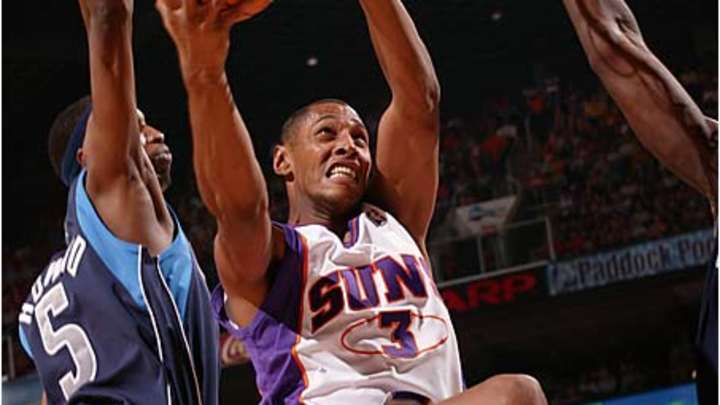
Boris Diaw, France
He was an enigma before the Hawks took a chance on him. Teams appreciated Diaw's skills but didn't know how well his unselfish play would translate to the NBA stage. He looked like a bust in his first two seasons, but a trade to Phoenix in 2005 gave him new life. Allowed to play three positions with the Suns, Diaw averaged 13.3 points, 6.9 rebounds, 6.2 assists and a block in 35.5 minutes per game, winning the league's Most Improved Player award.
Vladimir Radmanovic, Serbia
Touted as the next Dirk Nowitzki, Radmanovic hasn't enjoyed as much success as his German counterpart but has carved out a solid career as a good scorer off the bench. Averaging more than 30 minutes only once in his five-year career, Vladi has contributed 10.1 points and 4.6 rebounds a game. A 25-year-old free agent, he will be the subject of a mini bidding war this summer.
Nenad Krstic, Serbia
Nets GM Rod Thorn was willing to wait nearly two years for Krstic to hone his skills overseas before welcoming him to the fold. The Vlade Divac protégé didn't make his debut until the 2004-05 season but contributed from the outset, starting 57 games as a rookie and averaging 11.8 points and 6.0 rebounds (in 28.6 minutes) over the past two seasons.
Gheorghe Muresan, Romania
A giant with skills, the tallest player in NBA history was far from a novelty. The 7-foot-7 Muresan was Washington's anchor in the middle in the mid-1990s, winning the Most Improved Player trophy in '96. He teamed with Chris Webber, Juwan Howard and Rod Strickland in '96-97 to help Washington secure its first playoff appearance in nearly a decade. Ankle injuries kept Muresan from playing the following season, and back injuries limited him to only 31 more contests before he retired in 2000.
Mehmet Okur, Turkey
NBA fans finally got to see in 2005-06 what the 27-year-old Okur could do with extended minutes and plentiful shot opportunities. In his fourth season, and second with the Utah Jazz, "Memo" averaged 18 points and nine rebounds in just under 36 minutes a game. He won a ring with the Detroit Pistons in 2004.
Dino Radja, Croatia
He waited until 1993 to come over to the Celtics, then started 47 games in place of the recently retired Kevin McHale. A skilled offensive player who could score both inside and out, Radja even aped some of McHale's moves in the low block, though the bulk of his impact came on the offensive end.
Hedo Turkoglu, Turkey
He didn't waste any time after the Kings drafted him, becoming a rotation player in coach Rick Adelman's system for his first three seasons. More adept at shooting from the outside and off the dribble than dashing into the lane, Turkoglu has rounded into a solid player and one of the league's best sixth men. Now with his third team, the 27-year-old Magic forward established career highs in points (14.9 per game) and shooting percentage (45 percent) in his sixth season.
Sarunas Marciulionis, Lithuania
He played only 363 games in eight seasons, but his athletic, hard-nosed style helped to quash the stereotype of the passive European role player. Easily the greatest 127th pick in NBA history, Sarunas averaged 12.8 points in 22 minutes a game with the Warriors, SuperSonics, Kings and Nuggets.
Tony Parker, France
Parker's introduction to the American basketball audience was an inauspicious one, as Charles Barkley told the TNT viewers watching on draft night that he didn't "know anything about [Parker], but if he was drafted in the first round, he's probably good." The 19-year-old Parker made a better impression once his rookie year began; he started 72 games and hasn't let up his aggressive, slashing style of play. He enjoyed a career-year in 2005-06, averaging 19 points and six assists while shooting an astounding 55 percent from the floor.
Manu Ginobili, Argentina
An afterthought on draft night, he was the second-to-last pick in the second (and final) round and waited until 2002 to come Stateside. Once on board with the Spurs, however, Ginobili's perpetual motion and ability to disrupt defenses won the hearts of Spurs fans and the respect of the league. As a sixth man he was a champion in his rookie year, and contributed heavily to San Antonio's 2005 title run. Not yet 29, Manu has averaged 12.9 points and a combined seven rebounds/assists in only 27 minutes per game over his four-year career.
Andrei Kirilenko, Russia
Drafted when he was 18, Kirilenko made his NBA debut two years later with the Jazz and quickly established himself as one of the game's most versatile players. Able to play both forward positions, Kirilenko can swipe, block, rebound and jump with the best of them, and he's made a successful career out of filling up the box score. AK-47's breakout season came in 2003-04, when he lead Utah in points, rebounds, blocks, steals, three-pointers and minutes -- and the 25-year-old is still a few years away from his prime.
Drazen Petrovic, Croatia
Drafted as a 21-year-old, he passed on joining the Trail Blazers after they drafted him in the third round. With Jim Paxson and Clyde Drexler already ensconced at the wing positions, the Trail Blazers couldn't have minded as Drazen decided to hone his skills with the highly regarded Real Madrid outfit. Coming over for the 1989-90 campaign, Petrovic averaged 7.6 points in just 12.6 minutes for a Trail Blazers team that would lose that year's Finals. Moving on to the Nets after requesting a trade, Petrovic averaged over 20 points per game in 1991-92 and 1992-93 before passing away in a 1993 car accident.
Pau Gasol, Spain
With Dirk Nowitzki having just led his Mavericks to their first playoff appearance in 11 seasons back in 2001, NBA teams were all too eager to jump on the next European hot shot in that summer's draft. Taken third overall by the Hawks and immediately sent to the Grizzlies for Shareef Abdur-Rahim and Lorenzen Wright, Gasol has not disappointed. He has averaged 18.5 points and 8.4 rebounds in 35.3 minutes during his five-year career, taking the Grizzlies to the playoffs for three straight seasons.
Yao Ming, China
Few other players have had to overcome as much as Yao has in his four-year NBA career. Faced with cultural and language conflicts, he has ascended to the top of the NBA's pivot ranks in astonishing fashion. Projected to play as anything between the next Shawn Bradley and the next Bill Walton, Yao has settled in comfortably as one of the league's most dominant centers, averaging 17.5 points and 8.8 rebounds in just 31 minutes a game over his four-year career.
Zydrunas Ilgauskas, Lithuania
His career began with a bang as the 22-year-old rookie averaged 14 points and nine rebounds in just 29 minutes a game for a Cavaliers team that won 47 games and made the playoffs. From there Big Z played only 29 games over the next three seasons due to a series of foot ailments before cautiously returning for 21 minutes a night over 62 games in 2001-02. Fully healthy, Ilgauskas has missed only 10 games in the four seasons since, averaging 16.2 points, eight rebounds and 2.1 blocks in 31 minutes a game. He has stuck around long enough to see the Cavs through their first playoff appearance since his rookie year.
Toni Kukoc, Croatia
He was the object of Chicago GM Jerry Krause's affection for years before coming over for the 1993-94 season. Thrown into the fire on a Bulls team still reeling from the unexpected retirement of Michael Jordan, Kukoc overcame language difficulties and a position change (from guard to forward) to contribute mightily to a 54-win Chicago squad. Though he was a reluctant bench performer, Kukoc won the Sixth Man Award in 1996 and was a key member of three championship teams in Chicago from 1996 to '98. Kukoc has averaged 11.6 points, 4.2 rebounds and 3.7 assists in 26.3 minutes a game over the course of his 13-year career.
Peja Stojakovic, Serbia
Drafted at age 19 by the Kings while playing for PAOK Thessaloniki, Stojakovic made his NBA debut in 1999 as a sixth man for a rebuilt Sacramento squad and quickly made a mark as a sharp-shooter off the bench. Assuming a starting role in 2000-01, he rounded into a potent scorer; his 2003-04 performance saw him shoot 51 percent on two-point shots, 43 percent on three-pointers and 93 percent from the line while averaging 24.2 points a game.
Arvydas Sabonis, Lithuania
Originally drafted by the Hawks in 1985, Sabonis' selection was nullified due to his being under 21 at the time of the draft. Portland took a flier on one of the most decorated players in international basketball history in 1986 but didn't get to outfit him with a uniform until the 1995-96 season. By the time he retired in 2003, the 38-year-old Sabonis had cobbled together averages of 12 points, 7.3 rebounds, 2.1 assists and 1.1 blocks, in 24 minutes per game.
Vlade Divac, Serbia
Vlade Divac, SerbiaLos Angeles Lakers, 1989, first round, 26th overall A late-first-round curio who grew into one of the better centers of his generation, Divac found the perfect setting for his skills and considerable charisma in Los Angeles. He grew from a backup to Mychal Thompson, to the starter on the 1991 Western Conference champions, to the team's franchise player in its lean, post-Magic Johnson years. Sent to Charlotte in '96 (for the draft rights to Kobe Bryant), Divac continued his stellar play in two playoff-bound campaigns for the Hornets and became the free agent prize of the Sacramento Kings in early '99. Divac's interior brilliance and locker-room guidance created the turning point for a Kings team that had made the playoffs only twice in its franchise history. Divac lead the team to six straight playoff appearances before one last go with the Lakers in 2004-05, and retirement last summer.
Dirk Nowitzki, Germany
The cream of the crop: Nowitzki is the only overseas import to lead his team to the NBA Finals as a go-to guy, and is living proof that a skinny, jump-shooting, no-defense European player can develop enough to carry a team toward its ultimate goal. The most intriguing name in the 1998 draft, Nowitzki rose within a few months from relative obscurity as an 18-year-old pro in Germany to Mavs coach Don Nelson's personal pick for 1998-99 Rookie of the Year. Nowitzki fell short of that award but has continually improved in the years since, with two consecutive All-NBA First Team appearances and a dominant run through the 2006 playoffs.
 Add us as a preferred source on Google