%20%20--%3E%0A%3Csvg%20version%3D%221.1%22%20id%3D%22Layer_1%22%20xmlns%3D%22http%3A%2F%2Fwww.w3.org%2F2000%2Fsvg%22%20xmlns%3Axlink%3D%22http%3A%2F%2Fwww.w3.org%2F1999%2Fxlink%22%20x%3D%220px%22%20y%3D%220px%22%0A%09%20width%3D%2239px%22%20height%3D%2240px%22%20viewBox%3D%220%200%2039%2040%22%20enable-background%3D%22new%200%200%2039%2040%22%20xml%3Aspace%3D%22preserve%22%3E%0A%3Cpath%20fill%3D%22%23FFFFFF%22%20d%3D%22M38.5%2C7H28.2v26h10.3V7z%22%2F%3E%0A%3Cpath%20fill-rule%3D%22evenodd%22%20clip-rule%3D%22evenodd%22%20fill%3D%22%23FFFFFF%22%20d%3D%22M26.1%2C25.5c0%2C5.8-4.1%2C7.5-12.9%2C7.5C3.9%2C33%2C0%2C31.2%2C0%2C25.2v-1.1h11.6%0A%09v2.4c0%2C0.7%2C0.1%2C1.4%2C1.2%2C1.4c1%2C0%2C1.2-0.4%2C1.2-1.3v-0.9c0-1.6-0.9-1.6-3.5-2.2C2.2%2C21.7%2C0%2C19.7%2C0%2C15.3v-0.9C0%2C9.3%2C5.5%2C7%2C12.9%2C7%0A%09c10.2%2C0%2C12.8%2C2.6%2C12.8%2C7.4v1.8h-11v-2.9c0-0.6-0.4-1.1-1.2-1.1c-0.6%2C0-1.2%2C0.4-1.2%2C1.1v0.9c0%2C1.5%2C0.9%2C2%2C3.3%2C2.5%0A%09c8%2C1.6%2C10.5%2C3.3%2C10.5%2C7.5V25.5z%22%2F%3E%0A%3C%2Fsvg%3E%0A)
Tying a Bow on It: Brittany Bowe Is Embracing Joy in Her Olympic Farewell
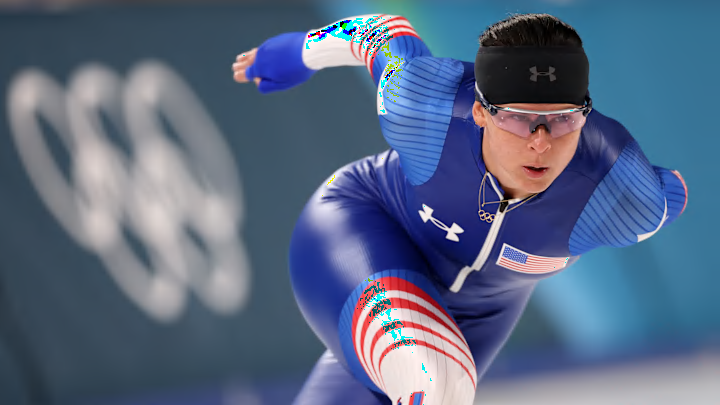
MILAN — In her last chance at her favorite individual race, Brittany Bowe missed out on a bronze medal by six tenths of a second. She needed even less time to get over it.
Well, this is speedskating. There is a reason the clock goes down to hundredths of a second. Four years ago, Bowe earned bronze in this same event—the 1,000 meters—at the COVID-19-lockdown Olympics in Beijing. She finished one tenth of a second ahead of the fourth-place finisher. She spent even less time enjoying it.
“Being on the other side, winning my first individual medal, and not having that energy in the stands—not having my mom, my dad, my sister, everyone that’s been a part of my journey from Day One—winning that medal actually felt quite empty,” Bowe said. “And being out here, finishing on the other side, I actually can say I felt more joy in that moment. Because why I do this is so much bigger than just myself.”
Bowe is 37. She plans to retire after these Olympics. She will do so with at least two Olympic medals—she also has a bronze from the team pursuit in 2018, and she still has the team pursuit, 500 and 1,500 to go in Milan. Medals are always the goal but rarely the point.
“Every 1,000-meter [race] that I’ve skated has really made me into the woman I am today,” she said Monday.
That may sound overly dramatic. It is not. Bowe grew up in Ocala, Fla., which she described recently as “a very small town, a very conservative town.” It is not that small (the population is around 70,000) and one could argue it is not that conservative: Ocala itself leaned Democratic in 2024, but Marion County is heavily Republican. Yet Ocala surely—and understandably—felt very small and very conservative to a young, gay Brittany Bowe.
“I always knew I was different,” she said recently. Her thought at the time: “Maybe it’s just better to not go there, because I don’t want to disappoint anyone.”
She went to Florida Atlantic, played basketball and “for the first time, my eyes were open: It’s O.K. for everyone to be themselves.”

After college, she started speedskating, after competing in inline skating as a kid. In 2016, she suffered a head injury that kept her out of competition for almost a year. She had panic and anxiety attacks for the first time in her life, which led to another revelation: She had always assumed, without even knowing why, that the tough stay silent.
“I don’t know what you’re taught, or [if] you just think that you can’t show weakness,” she said. “You have to be mentally tough all the time.”
She learned otherwise, recovered and won those two bronze medals. She is a six-time world champion. Athletes who are that successful, and remain healthy, can compete for much longer than the rest. That’s a gift. It also means there is more to process when it’s time to say goodbye.
“Over the course of this entire season, it’s been emotional,” Bowe said Monday. “You know, everything I’ve done has been the last time I will do this.”

Her last season brought her one more gift: “There hasn’t been anything that's brought me the amount of joy that the team pursuit has brought me this year.”
Speedskating is generally a solitary endeavor. In competition, there are only two skaters on the ice at a time. Winning is a thrill, but “no one’s feeling the same emotions that you’re feeling,” Bowe said. In the team pursuit, she has found the camaraderie she once felt on the basketball court.
Bowe arrived here as a decorated Olympian—with a supportive family wearing ‘Bowe-lieve’ shirts in the stands and her partner, American hockey star Hilary Knight, going for another medal herself. Her time in Monday’s 1,000-meter race was 1:14.55. But it took her 37 years to complete.
More Winter Olympics on Sports Illustrated
 Add us as a preferred source on Google
Michael Rosenberg is a senior writer for Sports Illustrated, covering any and all sports. He writes columns, profiles and investigative stories and has covered almost every major sporting event. He joined SI in 2012 after working at the Detroit Free Press for 13 years, eight of them as a columnist. Rosenberg is the author of "War As They Knew It: Woody Hayes, Bo Schembechler and America in a Time of Unrest." Several of his stories also have been published in collections of the year's best sportswriting. He is married with three children.