%20%20--%3E%0A%3Csvg%20version%3D%221.1%22%20id%3D%22Layer_1%22%20xmlns%3D%22http%3A%2F%2Fwww.w3.org%2F2000%2Fsvg%22%20xmlns%3Axlink%3D%22http%3A%2F%2Fwww.w3.org%2F1999%2Fxlink%22%20x%3D%220px%22%20y%3D%220px%22%0A%09%20width%3D%2239px%22%20height%3D%2240px%22%20viewBox%3D%220%200%2039%2040%22%20enable-background%3D%22new%200%200%2039%2040%22%20xml%3Aspace%3D%22preserve%22%3E%0A%3Cpath%20fill%3D%22%23FFFFFF%22%20d%3D%22M38.5%2C7H28.2v26h10.3V7z%22%2F%3E%0A%3Cpath%20fill-rule%3D%22evenodd%22%20clip-rule%3D%22evenodd%22%20fill%3D%22%23FFFFFF%22%20d%3D%22M26.1%2C25.5c0%2C5.8-4.1%2C7.5-12.9%2C7.5C3.9%2C33%2C0%2C31.2%2C0%2C25.2v-1.1h11.6%0A%09v2.4c0%2C0.7%2C0.1%2C1.4%2C1.2%2C1.4c1%2C0%2C1.2-0.4%2C1.2-1.3v-0.9c0-1.6-0.9-1.6-3.5-2.2C2.2%2C21.7%2C0%2C19.7%2C0%2C15.3v-0.9C0%2C9.3%2C5.5%2C7%2C12.9%2C7%0A%09c10.2%2C0%2C12.8%2C2.6%2C12.8%2C7.4v1.8h-11v-2.9c0-0.6-0.4-1.1-1.2-1.1c-0.6%2C0-1.2%2C0.4-1.2%2C1.1v0.9c0%2C1.5%2C0.9%2C2%2C3.3%2C2.5%0A%09c8%2C1.6%2C10.5%2C3.3%2C10.5%2C7.5V25.5z%22%2F%3E%0A%3C%2Fsvg%3E%0A)
Don't Call Them ‘Cool Runnings’—This Jamaican Bobsled Team Is Looking for More
Cratered by potholes, the road to the Jamaican parish of Trelawny narrows into a ribbon, cutting through sugar cane fields and extending into an area that has produced some of the country’s greatest athletes. Here, mere miles apart, are the hometowns of eight-time Olympic gold medalist sprinter Usain Bolt and his former relay teammate Tyquendo Tracey.
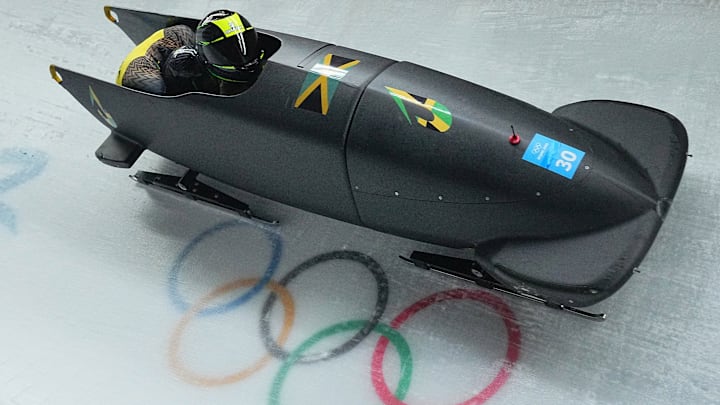
Now 32, Tracey’s legs have taken a break from powering Jamaica’s famed relay squads and have molded into pistons pushing an Olympic bobsled in Cortina. With each stride, they’re firing the Caribbean island’s sleds across the world’s sliding tracks and into the Olympics, an international sporting theatre usually defined by the country’s summer stars and headlined by Bolt’s legacy.
“It was a really good vibe, training together to get ready for the competition and everything. ... He’s a real character, and it was always fun to be around and learn from him,” says Tracey, who once ran a blistering 9.96-second 100 metre race in 2018. “[Bolt] showed that in sports and whatever career you’re in, it is important, but you should have fun with it, and that’s what I’m doing.”

Inspired by Cool Runnings, but Beyond the Gimmick
Tracey is one of seven Jamaican bobsledders heading to Cortina for the 2026 Winter Games. The nation will field three sleds for the second time in its Olympic history, racing in the two-man with Tracey and pilot Shane Pitter, in the four-man with a mix of Pitter, Tracey, Andrae Dacres, Junior Harris, Nimroy Turgott and English-born Joel Fearon, and in the women’s monobob with Welsh-born Mica Moore.
After debuting at the 1988 Games in Calgary, in a story that inspired the Disney classic film, Cool Runnings, Jamaica has gone on to compete eight times in Olympic bobsled, with nearly every athlete coming to the sport through athletics.
Jamaica Bobsled Team 🇯🇲 has secured their spot in the 2026 Winter Olympic Games in Milano Cortina
— Team Jamaica (@TeamJA876) January 20, 2026
Monobob: Mica Moore
2-Man: Shane Pitter & Crew (Nimroy Turgott, Joel Fearon, Junior Harris)
4-Man: Shane Pitter & Crew (Andrae Dacres, Junior Harris, Tyquendo Tracey, Joel Fearon) pic.twitter.com/4e0w8cmpXD
For many on the team, the movie’s 1993 release predates their youth. Yet, despite its largely fabricated nature, the film has remained iconic and serves its purpose as inspiration.
“A lot of people recognize us, and the first thing they think about is the movie,” Tracey says. “To me, the legacy of that team is to be remembered as just a group of men who came from a place where there’s nothing for a sport, but, because of determination and hard work, they could do what everybody else is doing.”
Jamaican bobsled has come a long way since its Hollywood beginnings in 1988—the 2026 team is a genuine standout in the sliding world. They have even proven to be a beacon for other warmer nations, including Brazil and Trinidad and Tobago, which will both slide in Cortina.
At the start of their hopeful Olympic season of 2025–26, the men’s four-man and two-man teams had planned to carry a lucky egg on their journey, an homage to a running gag from Cool Runnings character Sanka Coffie.
That idea didn’t last long. Not because the team didn’t see the inspiration, but because they are legitimate contenders.
“We said we’re gonna take it along the season,” says captain Nimroy Turgott, who is heading to his second Olympics. “But, when you reflect on the movie, it was just something for a joke, and this season, we said, ‘let’s throw the egg,’ so we ditched that because we’re no joke, and we’re, we’re serious about competing at the highest level.”
Jamaica, Winter Olympic Medalists?
With no egg tucked away in their sled, the Jamaican men see an immense opportunity at the refurbished Cortina Sliding Center, a track that has hosted only a handful of events and was not operational until November 2025, after falling into disrepair in the years following the 1956 Winter Olympics.
That factor levels out the competition, potentially opening the door for an underdog, especially considering the groundbreaking season Jamaica’s men have enjoyed.
In November, they found their way to the podium for the first time. Racing on the North American Cup, the second tier to the top-end World Cup circuit, Pitter drove the team to a gold medal on the Vancouver 2010 Olympic track in Whistler, Canada.
When Pitter looked up at the clock hanging over the finish, he couldn’t believe it. Each of those in the sled waited for the clock to calibrate—there was just no way a Jamaican sled have won a race on a track widely considered the world’s most challenging.
“The feeling was unbelievable,” says Turgott, a member of the team since 2017. “I had been through all the rough patches, and to see our hard work finally paying off, it’s a moment that I’ll never forget.”
Since then, the four-man and two-man sleds have captured eight wins and 11 podium finishes on the North American Cup, proving their legitimacy ahead of these Olympics rather than being known for a lucky-egg gimmick.
With their successful season and confidence in Pitter’s driving, there’s hope of a surprise performance in Italy—and potentially Jamaica’s first Winter Olympics medal ever. The nation’s previous all-time best of 14th place came at Lillehammer 1994 by the four-man squad of Dudley Stokes, Winston Watts, Chris Stokes and Wayne Thomas (the Stokes brothers were part of the original 1988 team).
“At the Olympics, you have a chance to do something amazing,” Turgott says. “For the French Alps 2030 Olympics, we want to qualify two sleds in each category and challenge for medals. Initially, the aim to get a medal was for Salt Lake City 2034, but the progress that Shane has made as a pilot makes that reality even closer.”

Inspiring a Nation
For Jamaica’s bobsledders, the stakes in Italy extend well beyond the ice. While sliding for results headlines their goal, these Games carry added weight and pride. In November, Hurricane Melissa left widespread destruction across many parishes, including Trelawny, displacing thousands and cutting power to more than 500,000 people.
For Tracey, it all leads back to Trelawny, his home, and a place that holds immense meaning to the country’s sporting history.
“With Hurricane Melissa, a lot of people feel defeated, in a sense, especially when you lose everything that you've worked for in life,” he said. “Now they can watch us from a country that has no ice, getting to the point of the Olympics and doing well in a sport that they have no type of facility to train for … it gives them hope, and that is just what we are for a lot of people—hope.”
And in Cortina, that hope will be measured in seconds inside a rattling sled, as the Jamaican bobsledders look to bring some energy back to the nation’s ever-beating sporting heart.
More Olympics on Sports Illustrated
 Add us as a preferred source on Google
Ben Steiner is an American-Canadian journalist who brings in-depth experience, having covered the North American national teams, MLS, CPL, NWSL, NSL and Liga MX for prominent outlets, including MLSsoccer.com, CBC Sports, and OneSoccer.
Follow BenSteiner00