%20%20--%3E%0A%3Csvg%20version%3D%221.1%22%20id%3D%22Layer_1%22%20xmlns%3D%22http%3A%2F%2Fwww.w3.org%2F2000%2Fsvg%22%20xmlns%3Axlink%3D%22http%3A%2F%2Fwww.w3.org%2F1999%2Fxlink%22%20x%3D%220px%22%20y%3D%220px%22%0A%09%20width%3D%2239px%22%20height%3D%2240px%22%20viewBox%3D%220%200%2039%2040%22%20enable-background%3D%22new%200%200%2039%2040%22%20xml%3Aspace%3D%22preserve%22%3E%0A%3Cpath%20fill%3D%22%23FFFFFF%22%20d%3D%22M38.5%2C7H28.2v26h10.3V7z%22%2F%3E%0A%3Cpath%20fill-rule%3D%22evenodd%22%20clip-rule%3D%22evenodd%22%20fill%3D%22%23FFFFFF%22%20d%3D%22M26.1%2C25.5c0%2C5.8-4.1%2C7.5-12.9%2C7.5C3.9%2C33%2C0%2C31.2%2C0%2C25.2v-1.1h11.6%0A%09v2.4c0%2C0.7%2C0.1%2C1.4%2C1.2%2C1.4c1%2C0%2C1.2-0.4%2C1.2-1.3v-0.9c0-1.6-0.9-1.6-3.5-2.2C2.2%2C21.7%2C0%2C19.7%2C0%2C15.3v-0.9C0%2C9.3%2C5.5%2C7%2C12.9%2C7%0A%09c10.2%2C0%2C12.8%2C2.6%2C12.8%2C7.4v1.8h-11v-2.9c0-0.6-0.4-1.1-1.2-1.1c-0.6%2C0-1.2%2C0.4-1.2%2C1.1v0.9c0%2C1.5%2C0.9%2C2%2C3.3%2C2.5%0A%09c8%2C1.6%2C10.5%2C3.3%2C10.5%2C7.5V25.5z%22%2F%3E%0A%3C%2Fsvg%3E%0A)
How Scoring Works in Olympic Snowboard Halfpipe As Chloe Kim Chases Gold
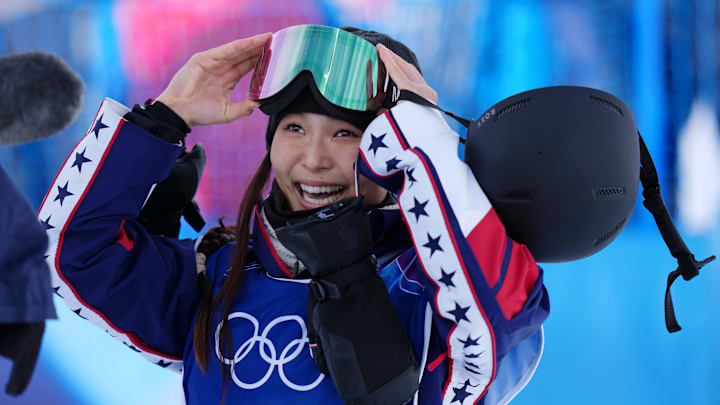
On Thursday, Team USA snowboarder Chloe Kim is looking to do something no American has ever done—win her third consecutive gold medal in snowboarding. And after a fabulous qualifying run that saw her comfortably snag first place among the field of 12 riders, it really does feel like her podium place to lose. But of course, anything could happen ... and it's not like Kim isn't also nursing a shoulder injury that kept her sidelined from competition until just before the Games.
So, ahead of one of the day's most anticipated events, let's take a look at how the event is scored, as well as some of the difficult tricks you can keep an eye out for come 1:30 p.m. ET on NBC.
How is halfpipe scored?
The snowboarding halfpipe is exactly what it sounds like. Much like the skateboarding apparatus of the same name, the course here resembles a literal pipe, sliced in half horizontally. Starting at the top of one side of the wall, boarders begin by "dropping" into the snowy course and flying up and down both sides, gathering speed as they move downhill and snagging big air/hitting tricks when they go up.
The qualifying round—wherein competitors completed two runs, and the top 12 were selected to move on to the finals—was held on Wednesday. In Thursday's medal event, each of the 12 boarders will have three runs to go for gold.
As for the scoring process itself, six judges rate each run between 0 and 100. Those ratings are then averaged once the highest and lowest scores are dropped. The panelists are looking at five different criteria:
- Amplitude: how much height the athlete gets
- Difficulty: the technical difficulty of the tricks
- Variety: the diversity in the tricks
- Execution: stability, fluidity and control
- Progression: the introduction of new tricks or linking tricks together in a novel way
Per NBC Olympics, there is no real consensus on how to deduct from an athlete's score, or on how to determine the score exactly. Rather, the scores are really just a way to position skiers appropriately on the leaderboard. Still, though, here are a few ways athletes can earn deductions:
- Missing or letting go of the board early during a trick (Riders must grab their snowboard every trick).
- Flailing arms during a trick.
- Hand drags or butt checks during landings.
- Over-rotating a trick to the extent that a rider's direction changes.
Which tricks are most difficult?
Tricks with more inverts and/or rotations are generally considered more difficult. For instance, a triple cork 1440, which has three inverts and four rotations, is considered the hardest trick in the men's event right now, per NBC Olympics. The double cork 1080, with two inversions and three rotations, is its equal on the women's side.
As for Kim, the 25-year-old could attempt a jump known as a 1260, which is three and a half rotations (or 1260 degrees), in Thursday's event. Per USA Today, a woman has never landed the 1260 in Olympic competition, though Kim has landed it elsewhere before. Whether or not she tries it in Milan might depend on whether she is comfortably leading the pack after her first or second runs.
Full results from the qualifying round in women’s halfpipe
Bold font indicates the top 12 finishers from the quarterfinals who are moving on to Thursday’s final.
- Chloe Kim, Team USA—90.25
- Sara Shimizu, Japan—87.50
- Maddie Mastro, Team USA—86.00
- Rise Kudo, Japan—84.75
- Xuetong Cai, China—83.00
- Gaon Choi, South Korea—82.25
- Queralt Castellet Ibanez, Spain—81.00
- Elizabeth Hosking, Canada—80.25
- Sena Tomita, Japan—77.50
- Bea Kim, Team USA—76.75
- Mitsuki Ono, Japan—76.00
- Shaotong Wu, China—75.25
- Leilani Ettel, Germany—67.50
- Jiayu Liu, China—62.75
- Madeline Schaffrick, Team USA—61.75
- Isabelle Loetscher, Switzerland—48.50
- Felicity Geremia, Canada—44.00
- Kona Ettel, Germany—43.25
- Lu Yang, China—42.50
- Amelie Haskell, Australia—41.75
- Anne Hedrich, Germany—36.25
- Nayoon Lee, South Korea—35.00
- Brooke Dhondt, Canada—24.00
- Emily Arthur, Australia—7.25
More Winter Olympics on Sports Illustrated
 Add us as a preferred source on Google
Brigid Kennedy is a writer for the Features and Franchises team at Sports Illustrated. Before joining SI in November 2024, she covered political news, sporting news and culture at TheWeek.com before moving to Livingetc, an interior design magazine. She is a graduate of Syracuse University, dual majoring in television, radio and film (from the Newhouse School of Public Communications) and marketing managment (from the Whitman School of Management). Offline, she enjoys going to the movies, reading and watching the Steelers.