%20%20--%3E%0A%3Csvg%20version%3D%221.1%22%20id%3D%22Layer_1%22%20xmlns%3D%22http%3A%2F%2Fwww.w3.org%2F2000%2Fsvg%22%20xmlns%3Axlink%3D%22http%3A%2F%2Fwww.w3.org%2F1999%2Fxlink%22%20x%3D%220px%22%20y%3D%220px%22%0A%09%20width%3D%2239px%22%20height%3D%2240px%22%20viewBox%3D%220%200%2039%2040%22%20enable-background%3D%22new%200%200%2039%2040%22%20xml%3Aspace%3D%22preserve%22%3E%0A%3Cpath%20fill%3D%22%23FFFFFF%22%20d%3D%22M38.5%2C7H28.2v26h10.3V7z%22%2F%3E%0A%3Cpath%20fill-rule%3D%22evenodd%22%20clip-rule%3D%22evenodd%22%20fill%3D%22%23FFFFFF%22%20d%3D%22M26.1%2C25.5c0%2C5.8-4.1%2C7.5-12.9%2C7.5C3.9%2C33%2C0%2C31.2%2C0%2C25.2v-1.1h11.6%0A%09v2.4c0%2C0.7%2C0.1%2C1.4%2C1.2%2C1.4c1%2C0%2C1.2-0.4%2C1.2-1.3v-0.9c0-1.6-0.9-1.6-3.5-2.2C2.2%2C21.7%2C0%2C19.7%2C0%2C15.3v-0.9C0%2C9.3%2C5.5%2C7%2C12.9%2C7%0A%09c10.2%2C0%2C12.8%2C2.6%2C12.8%2C7.4v1.8h-11v-2.9c0-0.6-0.4-1.1-1.2-1.1c-0.6%2C0-1.2%2C0.4-1.2%2C1.1v0.9c0%2C1.5%2C0.9%2C2%2C3.3%2C2.5%0A%09c8%2C1.6%2C10.5%2C3.3%2C10.5%2C7.5V25.5z%22%2F%3E%0A%3C%2Fsvg%3E%0A)
Jordan Stolz was sick in bed one day in West Bend, Wis. He was maybe 11 years old. He had the family iPad with him, and his parents hadn’t heard from him for a couple of hours. Dirk and Jane Stolz limited their kids’ screen time, so Dirk went to check in on his son.
Young Jordan was watching YouTube videos of the best men’s speedskater on the planet, Pavel Kulizhnikov, who broke the world record in the 500-meter sprint twice in November 2015. He wasn’t just watching; he was studying.
“I’m just trying to figure out how to get the world record,” Jordan told his dad.
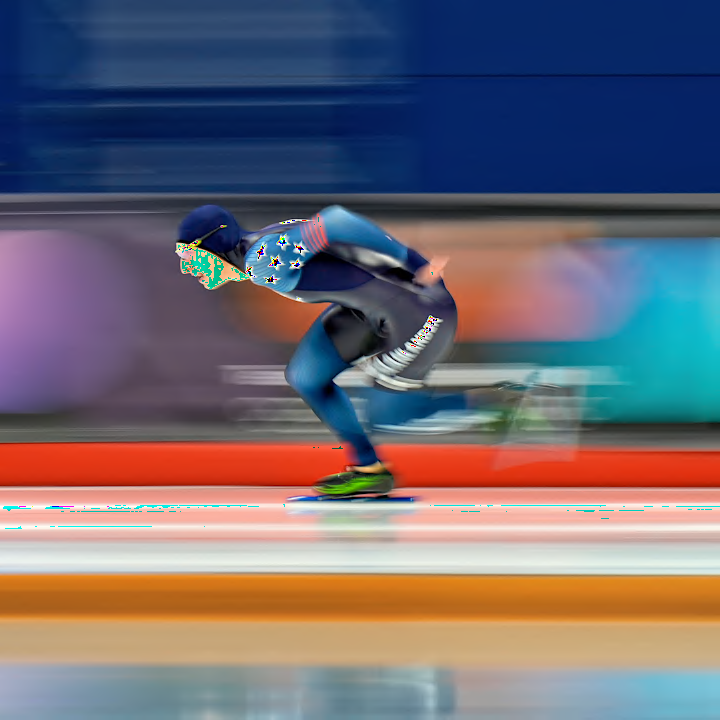
He figured it out. Today, Stolz owns the fastest time in the 1,000 meters, and is favored to win gold medals at three distances at the Milan Cortina Olympics: the 500-, the 1,000- and the 1,500-meter races. He’s also entered in the mass start race—a more chaotic, crapshoot event—giving him a shot at four golds.
At age 21, Stolz is positioned to be the classic Olympic shooting star, a sudden household name and face for millions of Americans who forget that speedskating exists between Winter Games. If things go well, he will be the next Eric Heiden, the next Bonnie Blair, the next Apolo Anton Ohno, the next Shani Davis (who coached Stolz for a while) to the viewing public. NBC has its hype machine idling, waiting to engage it when Stolz starts competition Wednesday in the 1,000-meter.

What the U.S. will see is a young man who is focused, determined, immersed in his craft, all about the work, quietly self-confident. The same qualities that made Katie Ledecky a legend in water can be found in a budding star on frozen water. He is neither loud nor showy, but there is a fierce competitive spirit that has percolated within from a very young age.
“Even as a kid,” Dirk says, “he was fixated on how to get faster.”
Dirk Stolz saw Ohno, winner of eight Olympic medals, in Milan on Sunday. The father of the next great one told the last great one, “You planted the seeds. Jane and I watered them.”
Ohno was the short-track face of American speedskating from 2002 to ’10, when Jordan and his sister, Hannah, were doing what kids in Wisconsin do—lacing up skates and finding the nearest frozen pond. Conveniently, it was in their backyard.
Dirk was a police officer and his wife, Jane, a dental hygienist, but at their core they were outdoors enthusiasts. They built a three-acre body of water on their property with visions of their kids fishing in it and catching frogs. When they saw Ohno excelling in the Olympics, the pond became something else: a place that would shape much of their lives.
When it froze over, Dirk fashioned a 300-yard straightaway for sprints, then eventually created a short-track oval. The parents raced the kids, and the kids never wanted to come inside. Like the Indiana family that installs lights over the driveway basketball goal, Dirk illuminated the pond to extend the fun past sundown.
“They’d be out there until midnight,” he says.

Hannah and Jordan were home-schooled, which allowed more time to devote to skating and the outdoors. Both were accomplished on ice, but Hannah eventually gave up the sport for another family pursuit: taxidermy. (She is now an elite bird taxidermist, winning national championships and competing at the world level.) Once locked in, Jordan’s attraction to speedskating never wavered. He was driven to be good at it.
That drive carried over to fishing and hunting, producing one particularly memorable family story. Dirk and Jane took their annual two-week fishing trip to Alaska, and when Hannah was 12 and Jordan, 10, they were deemed old enough to come along. This was not exactly a passive, laid-back outing—the family was fishing in ocean water for halibut, which can be massive and fight fiercely when hooked.
One day, after already boating a load of fish and dropping it off at their cabin in Petersburg, they went back out to a spot Dirk liked when the water was calm. Soon enough, a school of halibut came by and a frenzy began. With two 70-pounders already boated by his sister and mom, Jordan hooked a true monster.
The fight lasted 45 minutes, dragging the brute up from the depths. When Jordan got it to the boat, the fish took off again, screaming off line, literally lifting the child off his feet. Dirk grabbed his son’s life jacket from behind to keep him from going overboard, and Jordan yelled to keep his hands off.
“He wanted to do it all by himself,” Dirk recalls. “He had sweat droplets on his forehead.”
Jordan finally outlasted the fish, hauling it alongside the aluminum johnboat. Dirk got it into the boat, and the resulting photo is something—the halibut was longer than its captor, and weighed nearly twice as much. The fish was 142 pounds and Jordan was 73.
In his teens, Jordan grew into a speedskating prodigy, graduating from the short-track in the backyard to the big oval. He prefers the more orderly long-track form of the sport to the randomness of short-track, where bumping and jostling might determine who wins instead of speed, power, endurance and technique.

“You train in the offseason, get as strong as you can and then try and put those times onto the ice, skating with good technique, and there’s no way to cheat or get ahead of someone,” Jordan said. “It’s very honest.”
(This aligns with Dirk’s enjoyment of most Olympic sports over what he considers more “politicized” sports like baseball. The time on the scoreboard determines everything.)
Jordan’s formative years as a skater were at Pettit National Ice Center in nearby Milwaukee—the mecca of the sport in the U.S. Built upon the site of an outdoor ice rink that was the training ground of several legends, the Pettit was the next iteration. Blair and Dan Jansen, on his way to becoming another Olympic gold medalist from Wisconsin, were the first skaters there when it opened in 1992.
“I think almost every single U.S. Olympic gold medalist speedskater has trained at the Pettit for a long period of time,” Jordan said.
He’s ready to add his name to the illustrious lore. He made the 2022 Beijing Olympics at the precocious age of 17, finishing 13th in the 500-meter and 14th in the 1,000-meter. The other notable development from those Winter Games—Jordan got his first cell phone, years behind his peers but right on time in the Stolz family, where the TV was rarely on and technological distractions were minimized.
Now Stolz is poised to take the next step. Everything has been pointing in that direction for four years.
His dominance was underscored by an 18-race World Cup winning streak from February 2024 to February 2025 across three distances. He’s now an international star, skating professionally in the Netherlands—the world’s primary hotbed of the sport—and recognizable on the streets there.
On the way to the top, Stolz became obsessed with his equipment. Previous body suits were too loose, so he suggested and received tighter ones. But he’s particularly into his skate blades. Last year he made an unannounced visit to the Viking Blades factory in the Netherlands to check on their work.
“I checked 77 pairs of them with a gauge,” Stolz said. “And then you just test maybe four out of those 77 and try and find the best feeling ones, because each one feels different even though they’re manufactured the same. Then you can change the radius, the bend—all the blades are usually bent to help me get around the turn a bit more. And I like my bend a certain way, so I kind of had to figure that out myself.”
“I know how to do all my own equipment because I like to have it a certain way,” Stolz continued. “Usually if you have some other guy do it, it’s not going to feel right, so you may as well just do it yourself.”
When Jordan Stolz needs to get away from the ice, and the weather permits, he jumps on his bike and hits the Wisconsin backroads. He’ll go up to four hours at a time, logging 70 or 80 miles, perfect cross-training for a speedskater.
They’re built like elite cyclists—all the power in the lower body, and a scarcity of mass up top. (As a result, Stolz’s quadriceps are massive.) Aerobic conditioning is everything, with an embrace-the-pain mentality to match it.
What’s going through his mind on those long rides?

“Usually nothing,” Stolz said. “You kind of zone out, try and focus on the cars, make sure the cars don’t hit you. Once it starts getting really bad, like three hours into a ride, you just try and focus on what you’re trying to accomplish within the coming days or coming weeks, and what the absolute goal is.”
It’s now go-time for the absolute goal. Dirk says he’s talked to Jordan nightly since everyone arrived in Italy, and all signs are positive. Jordan has been “pushing some pretty good split times” in workouts on the Olympic ice, Dirk says. That follows experimenting back in Wisconsin to improve his 1,500-meter time.
The vibe is understated confidence. Because this is not a family that overstates.
“We don’t get nervous,” Dirk says. “Whatever happens, happens. We know he’s not thinking about anyone else, just himself. He’s so focused on trying to find perfection.”
More Winter Olympics on Sports Illustrated
 Add us as a preferred source on Google
Pat Forde is a senior writer for Sports Illustrated who covers college football and college basketball as well as the Olympics and horse racing. He cohosts the Others Receiving Votes podcast for SI and is a regular contributor to the Tony Kornheiser Show podcast. He previously worked for Yahoo Sports, ESPN and The (Louisville) Courier-Journal. Forde has won 28 Associated Press Sports Editors writing contest awards, has been published three times in the Best American Sports Writing book series, and was nominated for the 1990 Pulitzer Prize. A past president of the U.S. Basketball Writers Association and member of the Football Writers Association of America, he lives in Louisville with his wife. They have three children, all of whom were collegiate swimmers.
Follow ByPatForde