%20%20--%3E%0A%3Csvg%20version%3D%221.1%22%20id%3D%22Layer_1%22%20xmlns%3D%22http%3A%2F%2Fwww.w3.org%2F2000%2Fsvg%22%20xmlns%3Axlink%3D%22http%3A%2F%2Fwww.w3.org%2F1999%2Fxlink%22%20x%3D%220px%22%20y%3D%220px%22%0A%09%20width%3D%2239px%22%20height%3D%2240px%22%20viewBox%3D%220%200%2039%2040%22%20enable-background%3D%22new%200%200%2039%2040%22%20xml%3Aspace%3D%22preserve%22%3E%0A%3Cpath%20fill%3D%22%23FFFFFF%22%20d%3D%22M38.5%2C7H28.2v26h10.3V7z%22%2F%3E%0A%3Cpath%20fill-rule%3D%22evenodd%22%20clip-rule%3D%22evenodd%22%20fill%3D%22%23FFFFFF%22%20d%3D%22M26.1%2C25.5c0%2C5.8-4.1%2C7.5-12.9%2C7.5C3.9%2C33%2C0%2C31.2%2C0%2C25.2v-1.1h11.6%0A%09v2.4c0%2C0.7%2C0.1%2C1.4%2C1.2%2C1.4c1%2C0%2C1.2-0.4%2C1.2-1.3v-0.9c0-1.6-0.9-1.6-3.5-2.2C2.2%2C21.7%2C0%2C19.7%2C0%2C15.3v-0.9C0%2C9.3%2C5.5%2C7%2C12.9%2C7%0A%09c10.2%2C0%2C12.8%2C2.6%2C12.8%2C7.4v1.8h-11v-2.9c0-0.6-0.4-1.1-1.2-1.1c-0.6%2C0-1.2%2C0.4-1.2%2C1.1v0.9c0%2C1.5%2C0.9%2C2%2C3.3%2C2.5%0A%09c8%2C1.6%2C10.5%2C3.3%2C10.5%2C7.5V25.5z%22%2F%3E%0A%3C%2Fsvg%3E%0A)
Meet the Winter Olympics’ Newest Adventure-Packed Sport: Ski Mountaineering
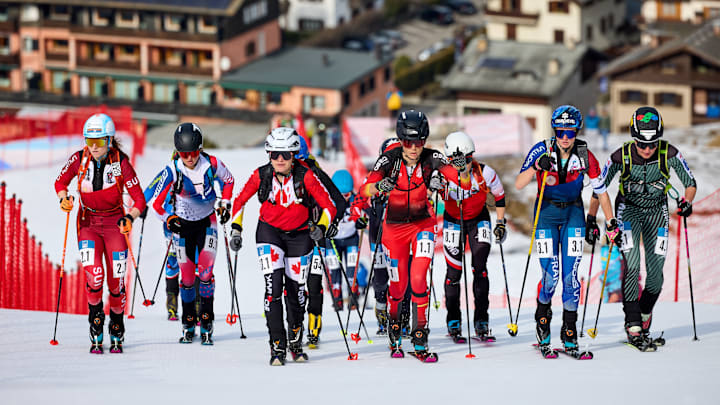
What goes up must come down, and that, as much as anything, best sums up the newest addition to the Winter Olympics program. Ski mountaineering sounds like a combination of cross-country skiing and cattle herding, and while that would be awesome, the sport is actually as basic as anything this side of the downhill: First you climb a mountain, then you ski down it.
“Skiing without chairlifts,” says Team USA’s Cam Smith. “Skiing existed for centuries before we had chairlifts. This is how people got around. This is a sport with a lot of history, practicality and participation.”
Smith says that back home in Crested Butte, Colo., “most people around town sort of know what I’m up to.” The rest of the country has questions. Smith is happy to provide answers.
The classic skimo race, which is called the individual, involves a long climb and descent and lasts at least 90 minutes with a minimum elevation gain of 4,500 feet. It is an incredible test of will and skill, of endurance and speed, of … hey! We see you falling asleep over there! This is why the International Olympic Committee will not stage the individual at the Milan Cortina Games.
Instead, there will be men’s and women’s sprints, which last around three minutes, held at the Stelvio Ski Centre in Bormio. There will also be a mixed relay, in which one man and one woman alternate going up and down the mountain; they each do two laps and the race should last around 30 minutes. This is a bit like holding a hockey tournament consisting entirely of shootouts, but as the IOC likes to say, Citius, Altius, Televise Us. Skimo will take what it can get.
Skimo, a Sport Perfect for the American TV Audience
If you think ski mountaineering is too much of an oddball sport to include in the Olympics, we would like to introduce you to something we like to call “the Olympics.” They have always been an ongoing experiment.
The 1900 Olympics leaned hard into fun with horses, though perhaps not fun for horses: Polo was a sport, and horses competed in the high jump and long jump (but sadly, not pole vault). The first few Summer Games featured Basque pelota (similar to racquetball), jeu de paume (a form of indoor tennis) and croquet; clearly, the IOC’s motto at the time was “Let’s sound as French as possible.” In 1904, the IOC grabbed a fencing sabre and sliced two letters off croquet; it was replaced by a similar game called roque.
Every Summer Olympics from 1904 to ’20 included tug-of-war, and one of the great mysteries of the universe is why the IOC has not brought that back.
When the Winter Games debuted in 1924 in the French Alps, the slate was, weirdly, not weird at all: Athletes competed in speedskating, cross-country skiing, bobsled, hockey, curling, ski jumping, figure skating, Nordic combined and military patrol, which was basically the biathlon. All nine sports will be contested at these Games, though after the 1924 Olympics, the curlers all went out for a beer and did not return for a medal until ’98.
If you were forced to winnow the Summer Olympics down to one sport, track would be an easy choice, and in the winter, it would probably be Alpine skiing. But Alpine was not an Olympic sport until 1936. Athletes at the first three Winter Games could win medals by jumping off a mountain, but not by skiing down it.
The IOC’s love for sliding events is overpowering, but we’re afraid that even those periodically disappear. Before the 1960 Olympics in Squaw Valley, Calif., organizers decided that there were not enough countries interested in bobsledding, so they did not build a track. The IOC made up for this the next time around by bringing back bobsled and welcoming luge.
Skeleton, the only sport named after competitors’ worst-case scenario, was introduced in 1928. It vanished until ’48. Then it vanished again. For the 2002 Olympics, IOC leaders embraced flying headfirst down a track again, and added what might be their favorite event: bribery.
IOC leaders’ second-favorite event: adding more events.
The first Winter Olympics hosted in northern Italy, in Cortina d’Ampezzo in 1956, featured 24 events across eight sports. The next one staged in the country, in Turin in 2006, featured 84 events across 15 sports. This year, there will be 116 events across 16 sports. Two entities in particular have benefited from the expanded program: NBC, which needs 17 days of entertainment; and the U.S., where NBC is based.
The U.S. has produced many of the biggest stars in the newest sports, from short-track speedskating (Apolo Anton Ohno) to snowboarding (Chloe Kim, Shaun White). At the 2022 Olympics in Beijing, the U.S. won 25 medals. Twelve of those came in nontraditional sports (snowboarding, freestyle skiing); two more in the debut of monobob; and the last one in the figure skating team event, which was awarded in Paris in 2024 after the Court of Arbitration for Sport finally finished investigating the Russians for doping.
Say what you want about skimo, but it is definitely not an excuse to spoon-feed medals to Americans. North America received one skimo quota spot in the Olympics; Smith and Anna Gibson will represent the U.S. after winning gold in the mixed relay World Cup in December. Europeans dominate the sport, in part because many European militaries have ski mountaineering teams. The U.S., on the other hand, has the Army-Navy football game. To each their own.
Team USA’s Cam Smith, a Skimo Star in the Making
Smith grew up in Rockford, Ill., and learned to ski in Galena, in the northwest corner of the state, at an upside-down ski resort: “You park at the top and then ski down the bluffs to the Mississippi River,” he says. “There’s lots of netting down there so that you don’t slide into the mile-wide river.”
Smith didn’t get into skimo until he moved to Colorado in 2014. He has since emerged as the sport’s premier American male competitor, for reasons he is still trying to understand himself.
“You want to say, like, ‘Oh, well, I just put more work into it,’ ” Smith says. “But even if that’s true, there’s lots of people that are very, very close to that level of commitment. But for whatever reason, I’ve had more competitive success than anyone else competing right now [among U.S. men]. There must be something that I have that other people don’t.”
There is no skimo archetype. Bodies that are perfectly built for climbing up a mountain are not necessarily ideal for skiing down one. The sport does require exceptional stamina. During one training stretch in France, Smith climbed a 12,000-foot mountain, then skied down it every day for seven straight days.

Unlike in Alpine events, athletes compete simultaneously in skimo, and the transition from up to down is crucial, especially in the shorter events that will be held in these Games: “They will go from the ascent, to ripping their [climbing] skins off, putting them away and starting the descent in less than 10 seconds,” says U.S. Skimo head of sport Sarah Cookler. With so many competitors rushing and vying for position, transitions can get dicey; Smith preps his brain for precise movements under pressure by learning a new juggling trick in the week leading up to a race.
Every new Olympic endeavor draws skepticism, some of it well-founded. The IOC has tried to introduce ballroom dancing and, at the Paris Games in 2024, breaking. But you never know what might stick or where.
Beach volleyball and short-track speedskating started as curiosities and are now Olympic staples, while baseball and softball have been shelved. For the first half of the 20th century, Americans had moderate success in figure skating. Since then, the U.S. has won more medals in the sport than any other country.
The mixed relay is not usually skimo’s biggest event. But it could be what keeps skimo in the Olympics.
“I think it’s going to be great for television,” Smith says. “You’re going to see teams with stronger women and [other] teams with stronger men, kind of moving back and forth. It’s going to be really dynamic racing with lots of passing, lots of drama.”
If skimo fails to entertain—and really, even if skimo succeeds in entertaining—the IOC will find more sports to add. It always has and always does. On that note, we pass along this vow from U.S. bobsledder Elana Meyers Taylor: “As soon as I pass the finish line, I’m getting me a cannoli.” We’re not saying that the mixed bobsled-and-cannoli-grabbing relay should be an Olympic event … but if it were, we would watch.
More Winter Olympics on Sports Illustrated
 Add us as a preferred source on Google
Michael Rosenberg was a senior writer for Sports Illustrated, covering any and all sports. He writes columns, profiles and feature stories and has covered almost every major sporting event. He joined SI in 2012 after working at the Detroit Free Press for 13 years, eight of them as a columnist. Rosenberg is the author of “War As They Knew It: Woody Hayes, Bo Schembechler and America in a Time of Unrest.” Several of his stories also have been published in collections of the year’s best sportswriting. He is married with three children.
Follow rosenberg_mike