%20%20--%3E%0A%3Csvg%20version%3D%221.1%22%20id%3D%22Layer_1%22%20xmlns%3D%22http%3A%2F%2Fwww.w3.org%2F2000%2Fsvg%22%20xmlns%3Axlink%3D%22http%3A%2F%2Fwww.w3.org%2F1999%2Fxlink%22%20x%3D%220px%22%20y%3D%220px%22%0A%09%20width%3D%2239px%22%20height%3D%2240px%22%20viewBox%3D%220%200%2039%2040%22%20enable-background%3D%22new%200%200%2039%2040%22%20xml%3Aspace%3D%22preserve%22%3E%0A%3Cpath%20fill%3D%22%23FFFFFF%22%20d%3D%22M38.5%2C7H28.2v26h10.3V7z%22%2F%3E%0A%3Cpath%20fill-rule%3D%22evenodd%22%20clip-rule%3D%22evenodd%22%20fill%3D%22%23FFFFFF%22%20d%3D%22M26.1%2C25.5c0%2C5.8-4.1%2C7.5-12.9%2C7.5C3.9%2C33%2C0%2C31.2%2C0%2C25.2v-1.1h11.6%0A%09v2.4c0%2C0.7%2C0.1%2C1.4%2C1.2%2C1.4c1%2C0%2C1.2-0.4%2C1.2-1.3v-0.9c0-1.6-0.9-1.6-3.5-2.2C2.2%2C21.7%2C0%2C19.7%2C0%2C15.3v-0.9C0%2C9.3%2C5.5%2C7%2C12.9%2C7%0A%09c10.2%2C0%2C12.8%2C2.6%2C12.8%2C7.4v1.8h-11v-2.9c0-0.6-0.4-1.1-1.2-1.1c-0.6%2C0-1.2%2C0.4-1.2%2C1.1v0.9c0%2C1.5%2C0.9%2C2%2C3.3%2C2.5%0A%09c8%2C1.6%2C10.5%2C3.3%2C10.5%2C7.5V25.5z%22%2F%3E%0A%3C%2Fsvg%3E%0A)
In a New York Times opinion piece in August, Canadian writer Stephen Marche wrote: “Canada is living through an era of acute, sustained, profound and abiding rage. The source is President Trump; the object is the United States.” The month before, he launched an eight-part podcast series on Canada’s freshly fraught relationship with what had been its forever friendly neighbor, the United States. The name of the podcast series: Gloves Off.
Hockey term. Of course.
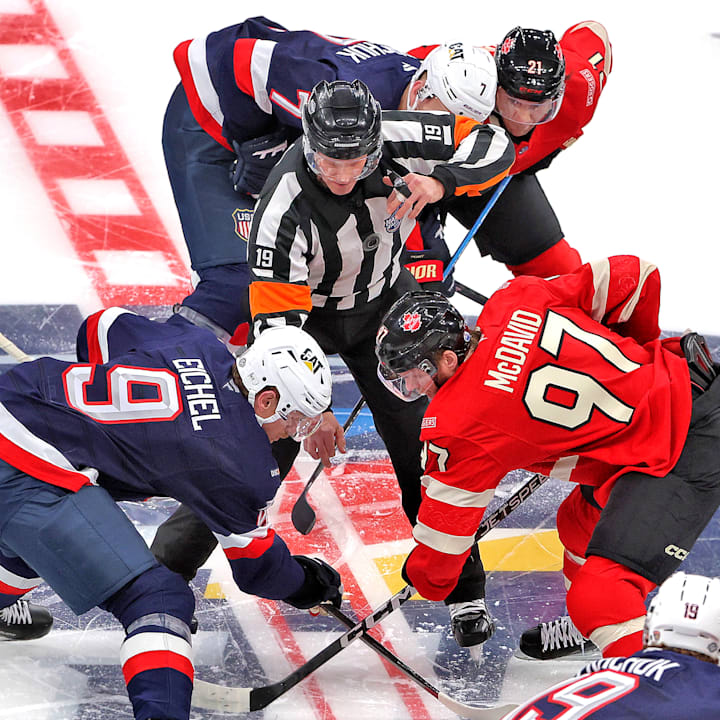
Once arm in arm, the two countries now are squaring off politically, economically—and on the ice. The modern version of their hockey rivalry was spiced up last February when a U.S.-Canada game in the 4 Nations Face-Off, a new international tournament featuring NHL standouts, turned into fight night. The home crowd in Montreal booed “The Star-Spangled Banner,” setting a pugnacious tone, and thereafter the gloves were, indeed, off.

Brothers Matthew and Brady Tkachuk of the U.S. were the fire starters. Matthew, a winger for the Panthers, skated up to Canadian and Lightning forward Brandon Hagel before the opening face-off and asked him to fight. Hagel obliged as soon as the game started. After the first bout ended—let’s call it a draw—Brady, a winger for the Senators, fought Panthers forward Sam Bennett. Six seconds after the restart, American J.T. Miller, a Rangers forward, topped it off by brawling with Blues defenseman Colton Parayko.
The three fights took place in the first nine seconds of play—an eruption of violence rarely seen in international hockey, with a roaring crowd in the Bell Centre ratcheting up the intensity. The U.S. backed up its feistiness by winning that game, 3–1, but lost a more peaceful 4 Nations final five days later to the Canadians in Boston.
The next international hockey tournament is the big one, the 2026 Winter Games in Milan Cortina. NHL players will compete in the Olympics for the first time in 12 years. (Fighting is strictly prohibited in Olympic hockey and results in ejection.) Away from the rink, a tense political climate still simmers. Elbows up.
“4 Nations was a great little appetizer,” Matthew Tkachuk says. “The main course is up next. I think it’s going to be even more intense.”
The brothers insist that the Tkachuks vs. Canucks fisticuffs were not a reflection of the political zeitgeist. Just a hockey decision that was made shortly before taking the ice.

“I’m sorry, I don’t talk politics,” Matthew says. “I just play hockey. … We were just thinking, How are we going to go into this away rink, the most hostile environment a lot of us have ever been in, and kind of flip the script?”
This riveting hockey showdown played out shortly after Donald Trump won re-election, announced a 25% tariff on all Canadian goods in February and began airing an out-of-nowhere interest in annexing Canada to “become our 51st state.” The aggrieved country responded in kind, applying a reciprocal tariff on American imports.
This rise in tensions has been significant enough north of the world’s longest undefended border that it has affected the leadership of the country. Prime minister Mark Carney’s election win last April was owed largely to a tough, sovereignty-focused stance against potential American encroachment. Pew Research from July indicates that Canadians see the U.S. as both the country’s greatest ally and its greatest threat.
“It’s been a very drastic year,” Marche says. “On some level, Canadians and Americans are always going to be bound together. It’s like we’re family members, and one person in the family has gone insane. They’re showing up at your house at night with a knife asking for money. There’s anger toward the U.S., but also a sense of distrust.”
Will Olympic hockey heal the distrust? Or further inflame it?
On the morning of Aug. 3, hundreds of cyclists gathered at City Pier in Port Angeles, Wash. The ruggedly beautiful Olympic Peninsula is “where the mountains meet the sea,” as Port Angeles likes to say. The cyclists embarked on the annual “Ride the Hurricane,” a steep, 40-mile climb up and down Hurricane Ridge in Olympic National Park. Afterward, they gathered on the pier to eat chili, drink beer and rehash the ride.
The context around the event hinted at a missing element. Canadian maple leaf flags flapped next to the Stars and Stripes on several buildings. A sign on the way into downtown read, “We Welcome Our Canadian Friends!” The message was clear: No hard feelings here, please come visit.
The Strait of Juan de Fuca separates the two countries, with the U.S.-based M.V. Coho ferry carrying cars and pedestrians on a 90-minute trip between Victoria and Port Angeles. There is not as much southbound traffic as there once was.

“We’re definitely seeing a reduction of visits from Canada,” says Port Angeles mayor Kate Dexter, who cites a roughly 15% decline in business from Canadians.
Lynnette Braillard, who coordinates public relations for Visit Port Angeles, says traffic to that tourism-based website plummeted “almost 100%” when Trump retook office in January. But she says there have been signs of a warming trend in recent months. The three-day Port Angeles Dungeness Crab Festival in October saw an uptick in Canadian participation from earlier in 2025, for example. But things are still not what they were before the 2024 presidential election.
“The Canadians are basically saying, ‘It’s not you guys, it’s your president. And we’re not going to support this or stand for this,’ ” Braillard says.
On July 2, in between Canada Day and Independence Day, the mayors of International Falls, Minn., and Fort Frances, Ontario, got together on the northern side of the border that runs between the two towns. A barbecue was held at the Fort Frances Civic Centre, with citizens from both communities attending. City, state, province and national flags were raised. A “Proclamation of Friendship” was read.
“With all the political stuff going on, we wanted to formally recognize, in writing, our friendship,” Fort Frances mayor Andrew Hallikas says. “We wanted to make sure there was no dispute. Our communities are so intertwined.”
Fort Frances residents get gas and groceries and eat meals on the U.S. side. International Falls residents visit the Walmart in Fort Frances—and the snowmobile dealership. The two high schools play against each other in several sports, with the rivalry sharpest when the International Falls Broncos face the Fort Frances Muskies in hockey.
“We depend on each other greatly,” says International Falls mayor Drake Dill. “But there’s certainly been some changes.”
The standard assumption in the U.S. is that Canadians are too laid-back to annoy. The standard assumption in Canada is that Americans are nuts, but trustworthy. Both are up for revision.
“The U.S. has always been Canada’s favorite TV show,” says Toronto Star columnist Bruce Arthur. “We consume American culture to a degree most other countries don’t. The current situation has been a shock to our system. There’s genuine worry about the people in power. It’s incredibly serious.”
Matthew and Brady Tkachuk aren’t just the sons of a hockey great. Keith Tkachuk ranks among the U.S.’s foremost Olympians, having competed in four Winter Games between 1992 and 2006. He was on a silver-medal-winning squad in Salt Lake City in 2002, but primarily was part of U.S. teams that were a cut below Canada and others internationally.

The boys were young when Keith was playing in the Games, but they saw enough to catch the spirit. They imagined themselves scoring the gold-medal-winning goal playing with mini sticks in the family home. “He’s got incredible stories from playing on U.S. soil in Salt Lake City,” Matthew says of his dad. “I’ve had two dreams in my professional life—win a Stanley Cup and win an Olympic gold medal. I’ve got the first.”
The NHL pulled the plug on Olympic participation in 2018 and ’22, stalling the younger Tkachuks’ vision. With Matthew now 28 and Brady 26, they’re in the prime of their careers as part of a vastly improved U.S. program. Pushing Canada’s loaded team into overtime in the 4 Nations final, five days after the Brawl in Montreal, set the stage for Italy.
“It’s been a dream come true to be able to represent [my] country,” Brady says. “It’s an honor. 4 Nations was probably my favorite hockey memory. It was just the best-on-best, first time in eight years, and to be one shot away from being the best country—it’s something that’s given [us] a ton of motivation.”
In Milan, there will be ample competition from other nations, but North America will be undoubtedly fixated on a 4 Nations rematch, with Olympic medals and bragging rights on the line.
“Being American and playing for our country, we’ll do absolutely whatever it takes,” Matthew says. “I think the country is going to be really proud of how we represent them.”
For Canada, reclaiming Olympic men’s hockey gold for the first time since 2014 is nonnegotiable. It’s the nation’s sport, and there is no acceptable excuse for not winning.
“The 4 Nations is a made-up event,” Arthur says. “But it mattered a lot that we won. We booed your anthem, as pure an expression of our feelings for the U.S. as it can get.”

Marche says he believes Connor McDavid will be commemorated on a postage stamp for scoring the overtime winner in the 4 Nations final, which eerily echoed Sidney Crosby’s golden goal for Canada against the U.S. in the 2010 Olympics.
The tension of last winter might not be replicable this time around, especially in Italy. An Olympic venue applies indirect heat, not the blast furnaces of crowds in Montreal and Boston. But Olympic gold medals are forever—no country has won more than Canada’s nine in men’s hockey—and this one might mean more than any of the others.
“We’re truly living in a f----ed-up world if the result of a hockey game has historical importance,” says Marche. “But the stakes for this are jacked up, right to the brim.”
More Winter Olympics on Sports Illustrated
 Add us as a preferred source on Google
Pat Forde is a senior writer for Sports Illustrated who covers college football and college basketball as well as the Olympics and horse racing. He cohosts the Others Receiving Votes podcast for SI and is a regular contributor to the Tony Kornheiser Show podcast. He previously worked for Yahoo Sports, ESPN and The (Louisville) Courier-Journal. Forde has won 28 Associated Press Sports Editors writing contest awards, has been published three times in the Best American Sports Writing book series, and was nominated for the 1990 Pulitzer Prize. A past president of the U.S. Basketball Writers Association and member of the Football Writers Association of America, he lives in Louisville with his wife. They have three children, all of whom were collegiate swimmers.
Follow ByPatForde