%20%20--%3E%0A%3Csvg%20version%3D%221.1%22%20id%3D%22Layer_1%22%20xmlns%3D%22http%3A%2F%2Fwww.w3.org%2F2000%2Fsvg%22%20xmlns%3Axlink%3D%22http%3A%2F%2Fwww.w3.org%2F1999%2Fxlink%22%20x%3D%220px%22%20y%3D%220px%22%0A%09%20width%3D%2239px%22%20height%3D%2240px%22%20viewBox%3D%220%200%2039%2040%22%20enable-background%3D%22new%200%200%2039%2040%22%20xml%3Aspace%3D%22preserve%22%3E%0A%3Cpath%20fill%3D%22%23FFFFFF%22%20d%3D%22M38.5%2C7H28.2v26h10.3V7z%22%2F%3E%0A%3Cpath%20fill-rule%3D%22evenodd%22%20clip-rule%3D%22evenodd%22%20fill%3D%22%23FFFFFF%22%20d%3D%22M26.1%2C25.5c0%2C5.8-4.1%2C7.5-12.9%2C7.5C3.9%2C33%2C0%2C31.2%2C0%2C25.2v-1.1h11.6%0A%09v2.4c0%2C0.7%2C0.1%2C1.4%2C1.2%2C1.4c1%2C0%2C1.2-0.4%2C1.2-1.3v-0.9c0-1.6-0.9-1.6-3.5-2.2C2.2%2C21.7%2C0%2C19.7%2C0%2C15.3v-0.9C0%2C9.3%2C5.5%2C7%2C12.9%2C7%0A%09c10.2%2C0%2C12.8%2C2.6%2C12.8%2C7.4v1.8h-11v-2.9c0-0.6-0.4-1.1-1.2-1.1c-0.6%2C0-1.2%2C0.4-1.2%2C1.1v0.9c0%2C1.5%2C0.9%2C2%2C3.3%2C2.5%0A%09c8%2C1.6%2C10.5%2C3.3%2C10.5%2C7.5V25.5z%22%2F%3E%0A%3C%2Fsvg%3E%0A)
What Is a Biathlon? The Winter Olympic Sport That Combines Skiing and Shooting
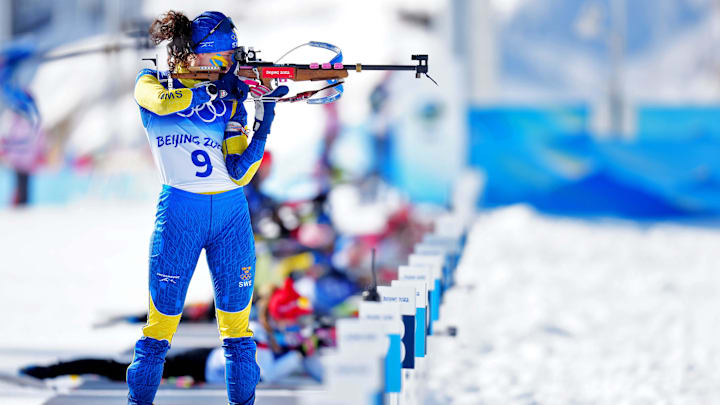
What happens when you combine the physical demands of cross country skiing with the precision of rifle shooting? A biathlon. Taking its roots from Scandinavian skiing traditions and militaristic training, the biathlon went on to transform into a sport and has continued to grow since its inclusion as an official men’s event in the 1960 Winter Olympics and an official women’s event in the 1992 Games.
We’ll further dive into the sport’s history, as well as its equipment, rules and scoring to examine what makes this one of the most popular winter sports in Europe.
The Basics: What exactly is a Biathlon?
A biathlon is a winter discipline that combines cross country skiing in the freestyle or classical technique on a track with target shooting while utilizing a rifle. The biathlon has militaristic roots, as the Norwegian and Swedish militaries first developed the combined skills of skiing and marksmanship with a rifle, which were put to use by ski units in the Second Northern War. The sport, looked to for its recreational and training benefits, first became a competition in 1767.
Today, the biathlon sees competitors navigate a looped cross-country course, stopping at firing ranges to shoot at targets while either laying down or standing. The sport’s ultimate challenge, the ability to exert oneself physically while also maintaining the necessary focus needed to consistently hit a target, gives it a survival type feel.
How the Biathlon works
Competitors ski a set distance, then stop multiple times to shoot at five targets. In each format, missing the target results in a penalty, either an added distance on the course or a time penalty.
Given that competitions are a race against the clock and other competitors, missed shots can prove costly when in pursuit of victory.
Biathlon Events at the Winter Olympics
Individual
Skiers start at 30-second or minute intervals and race against the clock through a lengthy course. Competitors carry 20 rounds of ammunition and stop for four firing sessions in the following order: prone, standing, prone, standing.
Sprint
Like individual competitions, the sprint format sees athletes start at different intervals and race against the clock through a shorter course. Unlike in the individual format, competitors are only allowed to carry 10 rounds of ammunition and stop for two firing sessions, prone followed by standing.
Pursuit
A race through a course—lengthier than sprint but shorter than individual—in which competitors start at different intervals based on the results of a previous race.
Relay
A team, typically a group of four competitors, race-to-the-finish on a course—shorter distance than the sprint—in which all athletes start at the same time. Athletes alternate between ski and shooting segments, and each subsequent member begins when they are tagged in by another team member in the relay hand-over zone. Competitors receive three spare rounds for each time they shoot.
Mass start
A race-to-the-finish in which competitors traverse a course—longer than sprint but shorter than individual—and start at the same time.
Mixed relay
The same as the relay format, but the teams typically consist of two men and two women per team.
The Milan Cortina Olympics will feature the following Biathlon events:
Milan Cortina Biathlon Events |
|---|
Men's 20km Individual |
Women's 15km Individual |
Men's 10km Sprint |
Women's 7.5km Sprint |
Men's 12.5km Pursuit |
Women's 10km Pursuit |
Men's 15km Mass Start |
Women's 12.5km Mass Start |
Men's 4 x 7.5km Relay |
Women's 4 x 6km Relay |
Mixed Relay 4 x 6km |
Scoring and Penalties
Athletes who miss the target during shooting rounds are assessed a penalty, which is either a one-minute time addition—used in individual events—or a 150-meter penalty loop, typically assessed in sprint, pursuit, relay and mass start formats. The athlete is required to ski the penalty loop for each missed target immediately after the shooting round.
The targets are each located 50 meters (164 feet) away and vary in size depending on the shooting position. Targets in the standing position are 11.5 cm (4.5 inches) in diameter while targets in the prone position are 4.5 cm (1.5 inches) in diameter. There are five targets per shooting lane and each target is equipped with automatic fall-down mechanisms to register hits. Athletes must adhere to rules—specific to each different shooting round—regarding body and ski placement.
Equipment and Shooting Rules
Athletes utilize .22 caliber, bolt-action rifles equipped with fore and rear sights and weighing approximately 3.5 kg (7 pounds). Rifles must be carried on the competitors’ back with the barrel pointing up. Athletes carry ammunition and manually load rounds into the rifle at the shooting range.
Skis are similar to cross country racing skis, designed for efficiency and the ability to glide across the terrain. Freestyle skis are typically 187 cm (6.1 feet) long and no more than 5 cm ((two inches) wide. Athletes also are equipped with a skating pole, 158 cm (5.2 feet) in height, used for propulsion through the terrain.
The Biathlon competitions in the Milan Cortina Olympics begin on Feb. 8 with a mixed relay event.
More Winter Olympics on Sports Illustrated
 Add us as a preferred source on Google
Tim Capurso is a staff writer for Sports Illustrated, primarily covering MLB, college football and college basketball. Before joining SI in November 2023, Capurso worked at RotoBaller and ClutchPoints and is a graduate of Assumption University. When he's not working, he can be found at the gym, reading a book or enjoying a good hike. A resident of New York, Capurso openly wonders if the Giants will ever be a winning football team again.
Follow TimCapurso