%20%20--%3E%0A%3Csvg%20version%3D%221.1%22%20id%3D%22Layer_1%22%20xmlns%3D%22http%3A%2F%2Fwww.w3.org%2F2000%2Fsvg%22%20xmlns%3Axlink%3D%22http%3A%2F%2Fwww.w3.org%2F1999%2Fxlink%22%20x%3D%220px%22%20y%3D%220px%22%0A%09%20width%3D%2239px%22%20height%3D%2240px%22%20viewBox%3D%220%200%2039%2040%22%20enable-background%3D%22new%200%200%2039%2040%22%20xml%3Aspace%3D%22preserve%22%3E%0A%3Cpath%20fill%3D%22%23FFFFFF%22%20d%3D%22M38.5%2C7H28.2v26h10.3V7z%22%2F%3E%0A%3Cpath%20fill-rule%3D%22evenodd%22%20clip-rule%3D%22evenodd%22%20fill%3D%22%23FFFFFF%22%20d%3D%22M26.1%2C25.5c0%2C5.8-4.1%2C7.5-12.9%2C7.5C3.9%2C33%2C0%2C31.2%2C0%2C25.2v-1.1h11.6%0A%09v2.4c0%2C0.7%2C0.1%2C1.4%2C1.2%2C1.4c1%2C0%2C1.2-0.4%2C1.2-1.3v-0.9c0-1.6-0.9-1.6-3.5-2.2C2.2%2C21.7%2C0%2C19.7%2C0%2C15.3v-0.9C0%2C9.3%2C5.5%2C7%2C12.9%2C7%0A%09c10.2%2C0%2C12.8%2C2.6%2C12.8%2C7.4v1.8h-11v-2.9c0-0.6-0.4-1.1-1.2-1.1c-0.6%2C0-1.2%2C0.4-1.2%2C1.1v0.9c0%2C1.5%2C0.9%2C2%2C3.3%2C2.5%0A%09c8%2C1.6%2C10.5%2C3.3%2C10.5%2C7.5V25.5z%22%2F%3E%0A%3C%2Fsvg%3E%0A)
The War Napheesa Collier Launched Against Cathy Engelbert Was a Long Time Coming
In this story:
Smart organizations keep their most important employees happy, and well-run sports leagues recognize the value of bright, talented, charismatic stars, but enough about that. Let’s talk about the WNBA.
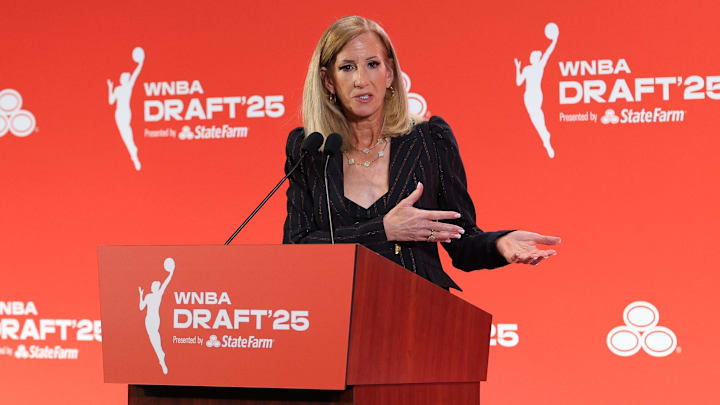
Lynx star Napheesa Collier just slingshotted WNBA commissioner Cathy Engelbert to another planet. Players and coaches are backing her up. As far as I can tell, the only person who has publicly stood up for Engelbert is Engelbert. The WNBA—a feel-good, rapid-growth story for the last two years—seems like it is suddenly imploding.
There is nothing sudden about it.
This has been building for a long time. It’s not about one conversation, one ref, one star, one incident or even the upcoming labor negotiation. It’s bigger than all of that.
Hundreds of millions of dollars are flowing into the league. High-end practice facilities built just for WNBA teams, once unheard of, are now becoming industry standard. But there is a perpetual feeling that instead of the league office leading the way, players and coaches are dragging it behind them.
Collier said Engelbert told her, “‘Players should be on their knees, thanking their lucky stars for the media rights deal that I got them,’” and that “‘only the losers complain about the refs.’” Engelbert said she is “disheartened by how Napheesa characterized our conversations.”
Napheesa Collier’s full statement today, where she challenged Commissioner Cathy Engelbert and the WNBA with directness and stunning detail we rarely hear from active players. Worth listening to every word. pic.twitter.com/IRTvTc52EA
— Malika Andrews (@malika_andrews) September 30, 2025
I wasn’t in the room. I can’t say exactly what was said. But it doesn’t really matter. Considering how Engelbert has handled her league’s officiating crisis, her email signature ought to be “Only The Losers Complain About The Refs.”
In the middle of last year’s Finals, during a discussion of WNBA growth, Lynx coach Cheryl Reeve said, “No question about it: I think the league office itself, expanding its head count … they’re growing the business side. I also think the operations side can use more bandwidth, so we can expand what we’re doing.”
Reeve was being tactful. Coaches were tired of mediocre referees deciding games, and the league’s replay system was literally a waste of time: The WNBA had no offsite review center, so referees had the power to decide if they made the correct call. You can imagine how that went, but you don’t have to: You just have to watch a game. The league still has no offsite review center.
That is a total leadership failure. It might also be a negotiating strategy: By stalling on the review center, Engelbert could use its cost as a bargaining chip for upcoming labor negotiations.
Think about how shortsighted that is. Think about how WNBA players and coaches must feel when Engelbert responds to Collier by saying she is committed to the players “even when our perspectives differ.” The league’s refereeing problem is not a two-perspective issue. One side wants to fix the hole in the roof, and the other side says the hole looks good.
Engelbert was hired in 2019, when league finances were not nearly as strong as they are today. The commissioner touts the new landscape but hasn’t fully embraced it. What seemed like an expense then should be viewed as an investment now.

Understand this, too—especially if you are new to this topic:
Napheesa Collier became one of the best players in the world, in part, because she is so grounded. She will guard anyone. She dominates by doing a few dozen little things right. Everything she does, she does with purpose.
Collier v. Engelbert might seem like a frustrated player going off on a rant. The truth is that Collier restrained herself.
A year ago, Collier’s Lynx lost Game 5 of the then-best-of-five WNBA Finals to the Liberty in overtime. The officiating in that game was atrocious, as it had been for much of the series, and during the season leading up to it, and for … well, anyway, somebody asked Collier why she struggled to score after the first quarter, and she said, “Yeah, probably because I was getting held a little bit. It was a little hard to make shots.” Collier then redirected her answer, to give credit to New York. Considering what had just transpired, Collier’s comments were Nobel Peace Prize–worthy diplomacy.
That conversation with Engelbert that Collier recounted this week? That happened in February. She didn’t say anything then.
Collier is one of the most powerful people in women’s basketball. She co-founded Unrivaled, the upstart three-on-three league, and she is vice president of the WNBPA. If it seems like Collier is now maneuvering for upcoming labor negotiations—well, maybe she is. But what about her coach?
Reeve is the most successful coach in the history of the league. She said after last year’s Finals that, “This s--- was stolen from us. We know we could have done some things right, but you shouldn’t have to overcome to that extent. This s--- ain’t that hard. Officiating is not that hard.” She summed up interactions with officials like this: “You tell them. They don’t see it. That’s what they say: They don’t see it, they don’t see it. I don’t understand it. … We’ve got work to do.”
The work remains undone. That is why, after Collier got hurt at the end of Game 4 of the semifinals, Reeve got ejected, then went off again:
“I want to call for a change of leadership at the league level when it comes to officiating. It’s bad for the game. The officiating crew that we had tonight—for the leadership to deem those three people semifinals playoff worthy is f---ing malpractice.”
In the last game of the 2024 Lynx season, Collier shot zero free throws and was called for six fouls. There is just no way an independent observer watching that game would say that was right.
In her last game of the 2025 Lynx season, Collier shot zero free throws and was called for five fouls. She was injured at the end, on a play where no foul was called, and missed the next game, when the Lynx were eliminated.

Two crucial postseason games. Two title chances. One of the three best players in the world—who scores inside and out, and whose basketball IQ ranks near the top of the league—shot zero free throws and was called for 11 fouls.
So yeah, Reeve went off. But after she did, Aces coach Becky Hammon said, “From what I heard, Cheryl did not tell a lie. She told the truth.” The league fined her.
Fever coach Stephanie White said Reeve “made a lot of valid points. A lot of the same conversations are happening from every team, from every franchise, from every coach and from every player. At some point, there has to be some accountability.” The league fined her, too.
When you fine people for saying what everyone believes, they just get angrier. Engelbert was oblivious to the unrest for too long. WNBA owners were oblivious to her obliviousness. The ongoing labor negotiations were always going to be a bear, just because of the league’s massive growth. If Engelbert remains in charge, they will only get uglier.
When Napheesa Collier says her league has “the worst leadership in the world,” she isn’t posturing. She will stand by her call. Just like one of Engelbert’s refs.
More WNBA on Sports Illustrated
 Add us as a preferred source on Google
Michael Rosenberg was a senior writer for Sports Illustrated, covering any and all sports. He writes columns, profiles and feature stories and has covered almost every major sporting event. He joined SI in 2012 after working at the Detroit Free Press for 13 years, eight of them as a columnist. Rosenberg is the author of “War As They Knew It: Woody Hayes, Bo Schembechler and America in a Time of Unrest.” Several of his stories also have been published in collections of the year’s best sportswriting. He is married with three children.
Follow rosenberg_mike